HOLLYWOOD — Sitting under the glowing lights while facing a relentless horde during Pac-12 Media Days on Thursday and Friday at Loews Hollywood Hotel, the conference’s hottest players took turns relishing the attention.
At this point in their careers, it’s not an altogether foreign sensation.
For many of these players, they’ve been in the spotlight for going on a half-decade, high school recruiting becoming a de facto Mr. America pageant in our football-obsessed culture. They’ve been poked, prodded and followed — both figuratively, and now with Twitter a regular part of the recruiting life, literally — since they were 16.
In so many ways, this is a good thing.
In some ways, it’s not.
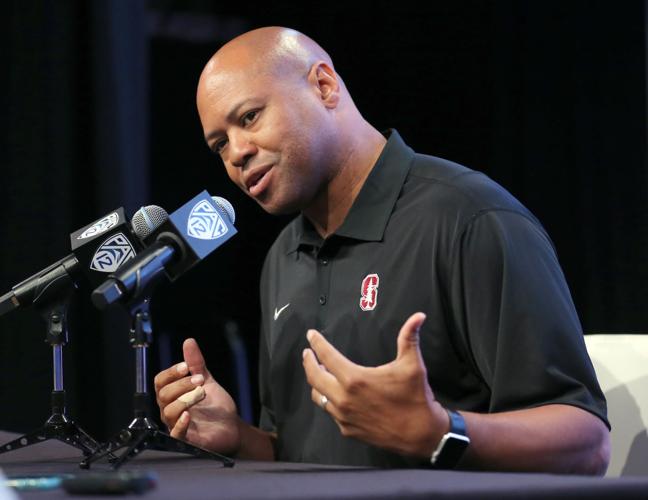
“The platform is powerful, more powerful than they even understand, truly,” Stanford coach David Shaw said on Friday during the second day of a two-day media circus. “I tell them to use social media cautiously, to truly believe what you say before you say it, not to be reactive. If you have something to say, I’m not going to stand in the way of it. Make sure you’re right. Make sure you’re justified. Make sure you can defend what you say. Make sure it’s honest.
People are also reading…
“But for kids who are 18 to 22 years old, they have more eyes on them they should.”
Sometimes voicing an opinion can have a lasting impact, especially when college athletes wade into the muddled waters of social justice and politics.
Some, such as USC’s Zach Banner and Washington’s Kevin King, choose to enter the fray, understanding the risk they face, from caustic fans telling them to “stick to football” to potential employers, who have historically knocked outspoken players down in the draft ratings.
Others are wary of putting themselves out there.
“I represent more than just myself at this point, so right now I would say no, but in the future, I know professional athletes who’ve taken a stand,” Arizona wide receiver Nate Phillips said. “So many young kids look up to us and follow what we say, I think we should monitor what we say a little bit. If you do choose to speak on it, it’s good because we reach out to people and they listen.”
He simply urges caution.
“If you have to think about the tweet, ‘should I post it?’ Don’t post it,” Phillips said. “We know how we should act, and coaches say they trust us with it. They put the faith in us that we’ll handle it appropriately. But as soon as you tweet something out, thousands of people have just seen it. As an athlete, you reach people who you aren’t even talking to, the world, simply because people admire you for your athletic abilities.”
This is not an easy decision for a young man to make.
And it’s not exactly a new problem .
Perpetual Problems
This story is a year in the making.
At last year’s Pac-12 Media Days at Warner Brothers Studios in Los Angeles, I sat down with several players and coaches to discuss the crossroads of sports, politics and race. This was only 11 days after the shooting death of Samuel DuBose, an unarmed black man killed in a traffic stop by University of Cincinnati police Officer Ray Kensing, and with Sandra Bland’s death by suicide under suspicious circumstances while in police custody in Texas still in the news from just 17 days earlier.
Washington linebacker Travis Feeney, a 2016 NFL Draft pick by the Pittsburgh Steelers, described his interactions with police in painful detail.
“Don’t be challenging, just do what you’re told and follow it,” Feeney said at the time. “Bite your lips on some things. It’s not worth it. At the end of the day, you just want to go back home. You don’t want to go home in a body bag.”
I’d never been told that by an athlete before.
Feeney was seething at the time, frustrated by not feeling free to speak on the issues without fear of blowback. He’d taken the step in July 2015 of deleting his Twitter account entirely, though he has since returned to the platform.
“It sucks we don’t really have a voice anymore,” he said then. “You don’t really have what you would call freedom of speech. That speech is going to make you look either positive or negative. You have to watch what you say, what you Tweet.”
What struck most, though, was a conversation with UCLA linebacker Deon Hollins, who represented the team last season as a junior and returns this season expected to play a major role on defense.
Not only an adept edge rusher, Hollins is one of the most thoughtful players in college football.
“It actually saddens me that more athletes don’t speak up,” Hollins said last year. “You look at the trouble athletes get in, and it hurts my heart. We’re kind of the representatives for the black community for a lot of people, and if we’re some of the richest guys and we’re doing bad things, that’s what society is going to think. It’s unfair to hold that individual to that standard, but that’s the way it works.”
Like Banner, King and countless other Pac-12 players, Hollins shared a story of his brushes with danger.
He spoke of being pulled over on the UCLA campus, along with former Bruins star linebacker Myles Jack and defensive back Priest Willis, while heading to a workout. A campus officer did not believe they were UCLA students.
“‘You guys sure you go here?’ and we pull out our Bruin cards, and he takes them, looks at them, takes them back to his car, comes back and says, ‘Are these fake? Did you steal these?’” Hollins said last year. “I guess he was trying to catch us in a lie?”
Hollins spoke of the feeling of not belonging in Westwood, needing to give extra just to be welcomed.
“I do have to be 150 percent,” he said then. “I have to be 150 percent in the classroom, on the football field, in the public spotlight. It’s so hard to identify in an environment like that. Some people don’t understand it, walking around somewhere where every single person feels you’re dirt or trash. The psychological impact of that just puts you on edge.”
Over the years, that stress turns to resolve, Shaw said.
“I was raised to never live in fear; I was raised to live in confidence and belief and I still believe in the goodness of people, I still believe that if you live in such a way, your outcome will ultimately be a positive,” Shaw said at the time.
“But once again, negative situations sometimes find you. For me, it’s how you handle them when they arise.”
The Coach’s Perspective
Less than a year later — Pac-12 Media Days were two weeks earlier this year — Shaw’s stance on athletes and activism hasn’t changed much.
“I was brought up to handle everything head-on, be honest, be open and communicate,” Shaw said on Friday. “We can resolve issues very directly. Say what you did and what you didn’t do. The thing about college is, these are not adults yet — they look like adults, talk like adults and sometimes they act like adults, but they’re not.
“They’re on their way to adulthood, and it’s our job to shepherd them to adulthood.”
That includes preparing them for the ramifications of being vocal.
On Friday, Colorado head coach Mike MacIntyre said that he has his Buffaloes undergo extensive media training, not actively dissuading his players from speaking out on social matters, but stressing the importance of the thought process. He believes that players can be vocal, but should collect the facts of a situation first, in order to prevent distractions.
And there have been distractions.
“I’ve had to suspend guys from games for Twitter. It’s a reality on our team and they understand that. It’s embarrassing you might get disciplined because of a tweet. That kind of stuff can affect them right now, but it can also affect their families and their job opportunities — it’s that big a deal. I just say, ‘Think before you push send.’”
And while a lot of Pac-12 players are indeed measuring their words, some don’t have any to share.
“I just stay out of it and let it play itself out,” Utah defensive back Justin Thomas said. “It’s not my place.”