

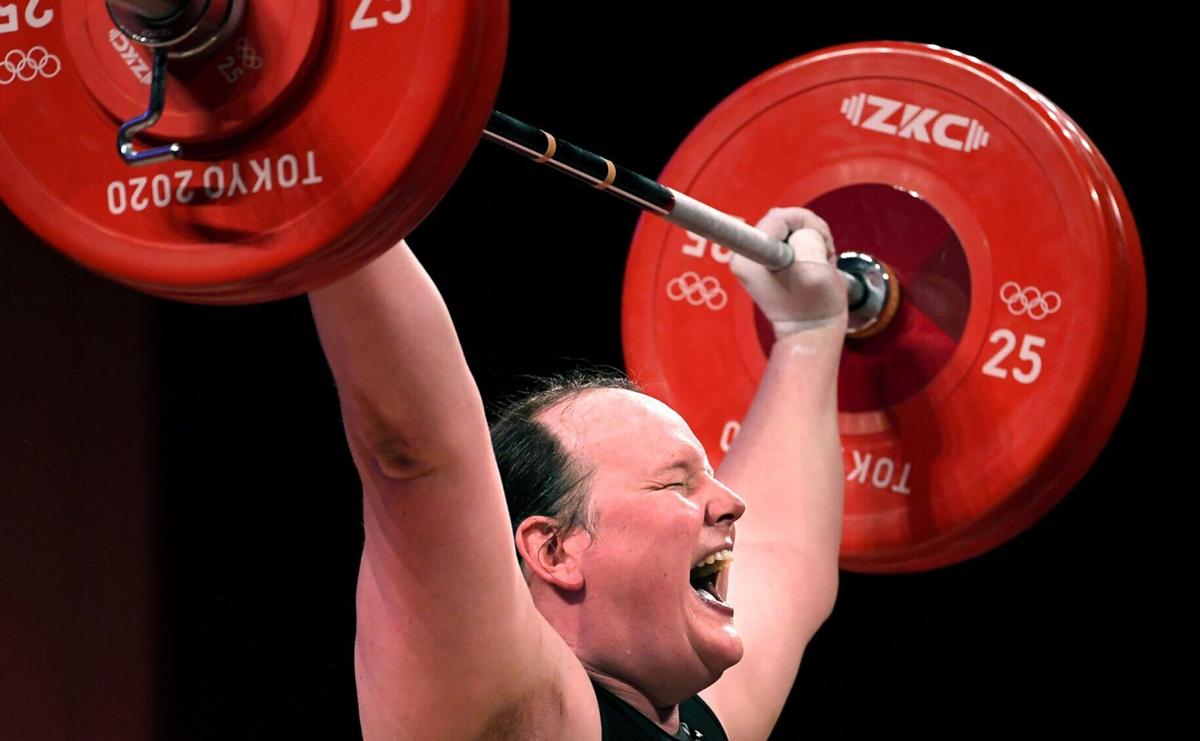
Transgender women athletes shouldn’t be seen as having an unfair advantage, according to new guidelines released this week by the International Olympic Committee.
The new guidance, entitled “IOC Framework on Fairness, Inclusion and Non-Discrimination on the Basis of Gender Identity and Sex Variations,” updates the IOC’s 2015 guidelines, which used testosterone levels to determine who was eligible to compete in women’s sports.
According to the organization’s previous recommendations, transgender female athletes were allowed to compete only if they kept their testosterone levels at 10 nanomoles per liter for at least 12 months before their first competition.
The eagerly-awaited announcement comes after a two-year consultation process with more than 250 athletes and concerned stakeholders, including international federations and sports organizations, as well as human rights, legal and medical experts.
People are also reading…
IOC officials say that the framework seeks to “promote a safe and welcoming environment for everyone,” and it recognizes the need “to ensure that everyone, irrespective of their gender identity or sex variations, can practice sport in a safe, harassment-free environment,” while respecting and recognizing the needs and identities of athletes participating in competitions where no one has an unfair disadvantage over the rest.
According to the new framework, athletes “should not be deemed to have an unfair or disproportionate competitive advantage due to their sex variations, physical appearance and/or transgender status.”
The framework also applies to athletes with differences of sex development, such as the two-time Olympic champion Caster Semenya of South Africa.
However, the IOC said that each sport and its governing body should be able to determine “how an athlete may be at a disproportionate advantage compared with their peers, taking into consideration the nature of each sport.”
“The framework is not legally binding,” IOC director of the athletes’ department Kaveh Mehrabi, said in a statement. “What we are offering to all the international federations is our expertise and a dialogue, rather than jumping to a conclusion. This is a process that we have to go through with each federation on a case-by-case basis and see what is required.”
The announcement comes just months after the conclusion of the 2020 Tokyo Olympics, which featured the first-ever openly trans Olympians: New Zealand weightlifter Laurel Hubbard and Canadian soccer player Quinn, who became the world’s first openly transgender Olympic gold medalist.
“Far too often, sport policy does not reflect the lived experience of marginalized athletes, and that’s especially true when it comes to transgender athletes and athletes with sex variations,” Quinn said in a statement following the IOC announcement.
“This new IOC framework is groundbreaking in the way that it reflects what we know to be true — that athletes like me and my peers participate in sports without any inherent advantage, and that our humanity deserves to be respected,” the Canadian midfielder added.
Here's a look at every Olympic gold medal design since 2000
Sydney 2000

American athlete Marion Jones holds up her 5 Olympic medals for track and field events in central Sydney, Australia, in this Oct. 1, 2000 photo. The IOC formally stripped Marion Jones of her five Olympic medals Wednesday Dec. 12, 2007, wiping her name from the record books following her admission that she was a drug cheat. (AP Photo/Adam Butler)
Salt Lake City 2002

Sarah Hughes of the United States displays her women's figure skating gold medal, during a press conference at the 2002 Winter Olympic Games in Salt Lake City, Friday Feb. 22, 2002.(AP Photo/Darron Cummings)
Athens 2004

Silver medalist Andreas Dittmer of Germany, gold medalist David Cal of Spain and bronze medalist Attila Vajda of Hungary (left to right) display their medals on the podium after in the Men's C1 1000 meter final, during the canoe flatwater event at the 2004 Olympic Games in Schinias near Athens, Greece, Friday, Aug. 27, 2004. (AP Photo/Mark J. Terrill)
Turin 2006

From left, the bronze, gold and silver medals of the Turin 2006 Winter Olympic games are seen in Turin, Italy, Tuesday, Jan. 10, 2006. The design of the medals is inspired by the shapes of historical Italian coins and rings, and the hole at the center of the medals represents the open space of a piazza, an Italian square. (AP Photo/Alberto Ramella)
Beijing 2008

Official medals of Beijing 2008 Olympic and Paralympic Games display during a delivery ceremony of the medals to Executive Vice President of BOCOG Jiang Xiaoyu in Beijing Thursday, July 3, 2008. (AP Photo/Oded Balilty)
Vancouver 2010

USA's gold medalist Shaun White reacts during the men's halfpipe medal ceremony at the Vancouver 2010 Olympics in Vancouver, British Columbia, Thursday, Feb. 18, 2010. (AP Photo/Jae C. Hong)
London 2012

The Olympic medals are seen on the hands of Chairman of London 2012 Olympic Games, Sebastian Coe, right, and Olympic gold medalist Kelly Holmes as the medals are unveiled during the London 2012 Olympic one year to go ceremony at Trafalgar Square in London, Wednesday, July 27, 2011. (AP Photo/Sang Tan)
Sochi 2014

Gold, left, silver, center, and bronze medals are displayed for journalists during a presentation of Sochi 2014 Olympic medals at the SportAccord International Convention in St. Petersburg, Russia, Thursday, May 30, 2013. (AP Photo/Dmitry Lovetsky)
Rio 2016

FILE - In this Aug. 12, 2016, file photo, five-time Olympic champion Katie Ledecky shows off her gold medal from the women's 800-meter freestyle swimming competition at the 2016 Summer Olympics in Rio de Janeiro, Brazil. (AP Photo/Michael Sohn, File)
Pyeongchang 2018

FILE - In this Sep.21, 2017 photo, South Korean athletes pose with the silver, gold and bronze medals, from left, for the Pyeongchang 2018 Winter Olympics during an unveiling ceremony in Seoul, South Korea. (AP Photo/Lee Jin-man)
Tokyo 2020 (now 2021)

The medals feature an unusual design quirk. They will be made using old cell phones and other electronics.


