CORTINA D'AMPEZZO, Italy — It takes an immense amount of energy to power venues and make snow for the Winter Olympics, and, for the 2026 Milan Cortina Games, organizers pledged that virtually all of the electricity would be clean.
The organizing committee said that energy use is where they can make the most meaningful impact, since it has been one of the main drivers of planet-warming emissions at major events.
And Italy's largest electricity company, Enel, guaranteed the supply of entirely certified renewable electricity for event venues.

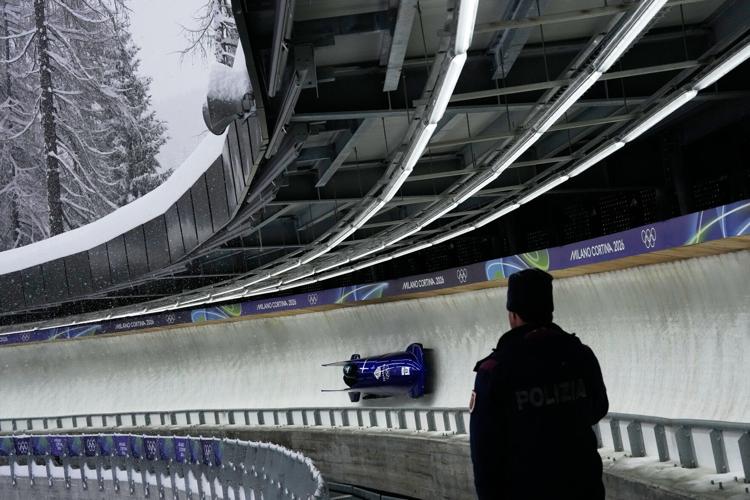
Great Britain's Adele Nicoll, right, slides down the track during a two-woman bobsled training session at the 2026 Winter Olympics in Cortina d'Ampezzo, Italy, Feb. 19.
Here's a look at what that means:
To guarantee 100% renewable energy, Enel bought certificates
The organizing committee said in its September sustainability report that its Games-time electrical energy would be 100% green, fed by certified renewable sources. In rare cases where temporary power generation is required, hydrotreated vegetable oil would be substituted for traditional diesel fuels, it said.
People are also reading…
"This is also an opportunity to contribute to a broader shift — showing athletes, spectators and future host cities that cleaner energy solutions are increasingly viable for events of this scale," the committee said Friday in a statement to The Associated Press. "We hope the steps taken for these Games can support ongoing progress across major events."
Enel said it is supplying 85 gigawatt-hours of power for the Olympic and Paralympic Winter Games. It bought "guarantee of origin" (GO) certificates on the market from renewable energy plants to cover the entire Games' energy demand.
GO certificates are a European mechanism created in 2001. Each certificate corresponds to 1 megawatt-hour of electricity produced using a certified renewable source.
Certificates are a way to prove your energy is green
These certificates are traded on the power market, in negotiations between companies or through brokers.
Once used, they are canceled to prevent the same megawatt hour from being claimed twice. This system is meant to support the development of renewable sources by helping companies meet their green energy targets.
Enel told the AP in a statement that its commitment to cleanly powering the events "translates the values of sustainability and inclusion inherent in the Games into concrete terms, combining technological innovation and environmental protection."
While many say GOs are vital to promote Earth's decarbonization, the system has its detractors. Matteo Villa, who leads the data lab at the Italian Institute for International Political Studies, said it is a "great way to promote your event," but it's not making Italy cleaner or more renewable.
The Games can only be as clean, or as sustainable, as the whole of Italy, Villa added.

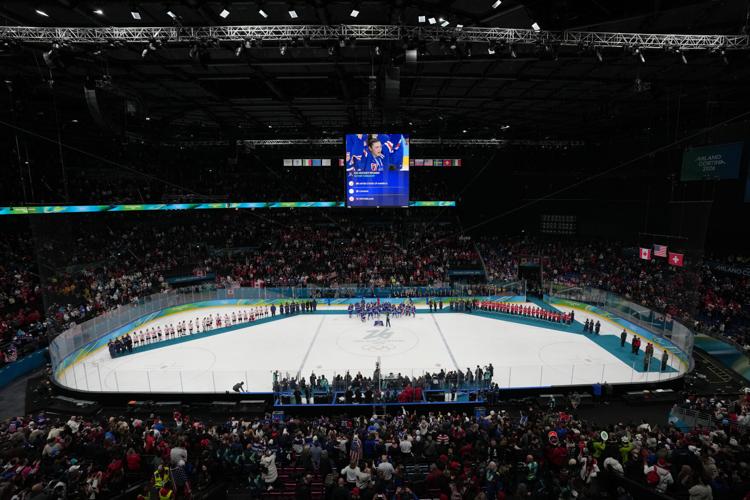
Teams from the United States, Canada and Switzerland receive their medals following the women's ice hockey gold medal game at the 2026 Winter Olympics in Milan, Italy, Feb. 19.
Enel says it's producing a lot of clean electricity in Italy
Nearly three-quarters of the electricity Enel produced in Italy in 2025 was carbon-free, according to its preliminary full-year operational data. About 50% came from hydropower, followed by 17% from geothermal and less than 10% from wind, solar and other renewables. The remainder was mostly from gas-fired power plants.
Many power plants that use water to produce electricity are in northern Italy, where mountains and rivers make for highly productive facilities. But Italy's national grid is still largely reliant on fossil fuels, according to country-specific data from the International Energy Agency.
Enel built new primary substations in Livigno and Arabba to distribute electricity throughout the territory. It also built and upgraded distribution infrastructure in the Livigno, Bormio and Cortina areas, which will benefit residents after the Games end.
Enel has a spot in the fan village in Cortina, where events are livestreamed.
Another challenge: emissions from spectators and athletes traveling
Sustainability has been a major focus for the Games, as both the organizers and the International Olympic Committee seek to model how to cut carbon pollution while running a major event. Researchers say the list of locales that could reliably host a Winter Games will shrink substantially in the coming years.
"Every Games we strive to push innovation in sustainability, reduce the overall impact and the carbon footprint," Julie Duffus, the IOC's head of sustainability, told the AP Friday. She highlighted the use of clean power, upgrades to the energy system and the way these Games were designed so that most venues would be existing or temporary.
Matteo Di Castelnuovo, a professor of energy economics at the SDA Bocconi School of Management in Milan, said he expects the Olympics will stay committed to clean energy, and that "the challenge lies somewhere else to make them greener." The thornier issue for Olympic organizers, and for any business, is figuring out how to reduce the emissions they do not have direct control over, notably those stemming from transportation, he added.
The amount of greenhouse gases estimated to be released into the atmosphere as a result of the Games is similar to the emissions of 4 million average-sized, gasoline-fueled cars driving from Paris to Rome, the organizing committee said in its greenhouse gas management strategy. The largest share of the carbon footprint are activities indirectly related to the Games, such as accommodations and spectator travel. Air travel is a significant contributor because burning jet fuel releases carbon dioxide.
Karl Stoss, who chairs the Games' Future Host Commission, has said they may eventually need to reduce the number of sports, athletes and spectators.
Many skiers, including Team USA members Lindsey Vonn and Mikaela Shiffrin, expressed concern during the Games about climate change accelerating the melt of the world's glaciers.

AP photographers use robotic and remote cameras for striking Olympic photos

Italy's goalkeeper Damian Clara fails to make a save during a preliminary round game of men's ice hockey between Finland and Italy at the 2026 Winter Olympics, in Milan, Italy, Saturday, Feb. 14, 2026. (AP Photo/Petr David Josek)

Sarah Warren of the United States takes the start of the speed skating women's 500m at the 2026 Winter Olympics, in Milan, Italy, Sunday, Feb. 15, 2026. (AP Photo/Christophe Ena)

Team Netherlands leads the men's 5000m relay short track speed skating followed by South Korea, Japan and Belgium at the 2026 Winter Olympics, in Milan, Italy, Monday, Feb. 16, 2026. (AP Photo/Bernat Armangue)

Xandra Velzeboer of the Netherlands celebrates the gold after the women's 1,000 meters short track speed skating at the 2026 Winter Olympics, in Milan, Italy, Monday, Feb. 16, 2026. (AP Photo/Bernat Armangue)

Ellie Kam and Danny O'Shea of the United States compete during the pairs figure skating long program at the 2026 Winter Olympics, in Milan, Italy, Monday, Feb. 16, 2026. (AP Photo/Bernat Armangue)

United States' Luc Violette and Aidan Oldenburg sweep ahead of a stone during a men's curling round robin match against China at the 2026 Winter Olympics, in Cortina d'Ampezzo, Italy, Tuesday, Feb. 17, 2026. (AP Photo/David J. Phillip)

United States's Casey Dawson, right, Emery Lehman, center, and Ethan Cepuran compete during the speed skating men's team pursuit final at the 2026 Winter Olympics, in Milan, Italy, Tuesday, Feb. 17, 2026. (AP Photo/Christophe Ena)

Italy's Amos Mosaner delivers a stone against the United States during a curling mixed doubles round robin session at the 2026 Winter Olympics, in Cortina d'Ampezzo, Italy, Friday, Feb. 6, 2026. (AP Photo/David J. Phillip)

Italy's goalkeeper Gabriella Durante fails to save the puck as Japan's Akane Shiga scores her side's second goal during a preliminary round match of women's ice hockey between Japan and Italy at the 2026 Winter Olympics, in Milan, Italy, Monday, Feb. 9, 2026. (AP Photo/Hassan Ammar)

Kazakhstan's Elizaveta Golubeva warms up before the women's speedskating 1,000-meters final at the 2026 Winter Olympics, in Milan, Italy, Monday, Feb. 9, 2026. (AP Photo/David J. Phillip)

Switzerland's Alina Muller scores her side's opening goal during a preliminary round match of women's ice hockey between Finland and Switzerland at the 2026 Winter Olympics, in Milan, Italy, Tuesday, Feb. 10, 2026. (AP Photo/Darko Bandic, Pool)

Laurence Fournier Beaudry and Guillaume Cizeron of France compete during the ice dancing free skate in figure skating at the 2026 Winter Olympics, in Milan, Italy, Wednesday, Feb. 11, 2026. (AP Photo/Bernat Armangue)

Mikhail Shaidorov of Kazakhstan reacts as he competes during the men's free skate program in figure skating at the 2026 Winter Olympics, in Milan, Italy, Friday, Feb. 13, 2026. (AP Photo/Christophe Ena)

Italy players before during a preliminary round match of women's ice hockey between Italy and France at the 2026 Winter Olympics, in Milan, Italy, Thursday, Feb. 5, 2026. (AP Photo/Carolyn Kaster)

Ilia Malinin of the United States competes during the figure skating men's team event at the 2026 Winter Olympics, in Milan, Italy, Saturday, Feb. 7, 2026. (AP Photo/Bernat Armangue)

Kaori Sakamoto of Japan competes during the figure skating women's team event at the 2026 Winter Olympics, in Milan, Italy, Sunday, Feb. 8, 2026. (AP Photo/Bernat Armangue)
Associated Press writer Colleen Barry and video journalist Brittany Peterson in Milan contributed to this report.
The Associated Press' climate and environmental coverage receives financial support from multiple private foundations. AP is solely responsible for all content. Find AP's standards for working with philanthropies, a list of supporters and funded coverage areas at AP.org.