

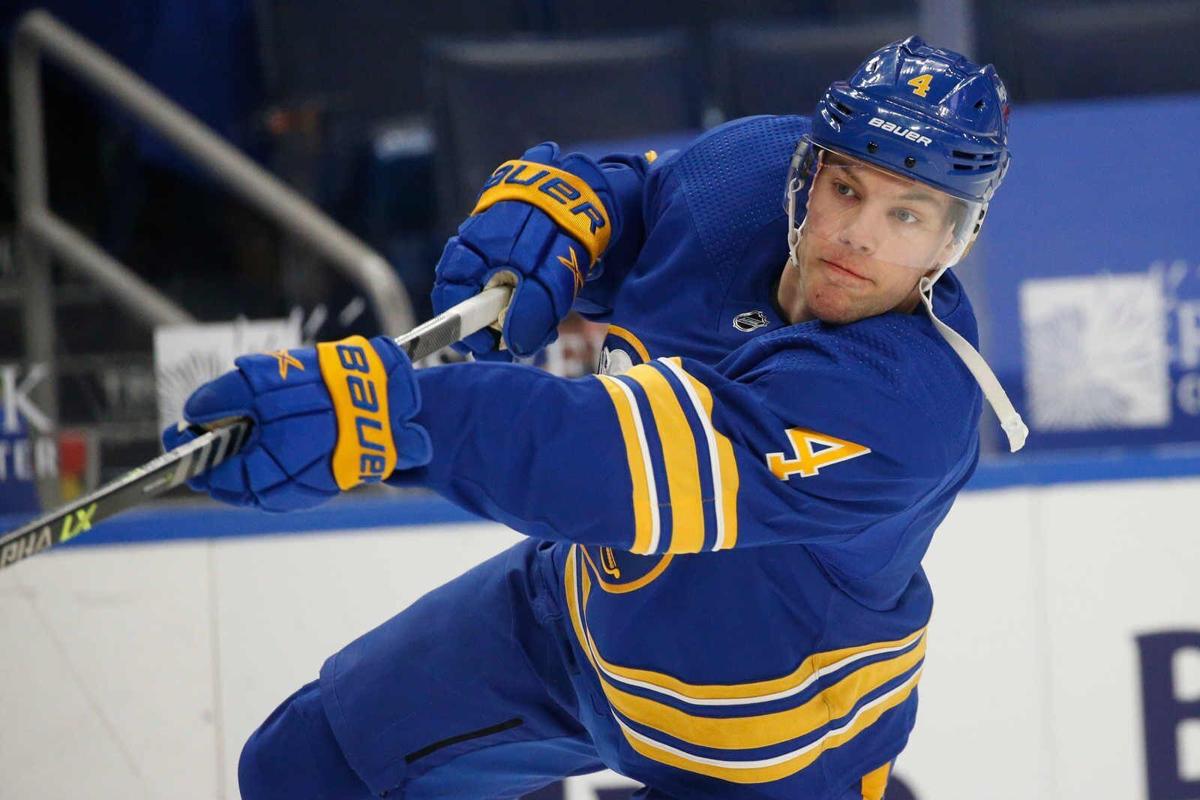
On the opening day of free agency in October, Buffalo Sabres owner Terry Pegula and General Manager Kevyn Adams huddled inside a KeyBank Center office to strategize how to land the top player on the market: former Hart Trophy winner Taylor Hall.
“If we sign this guy, we’re not only trying to make the playoffs, we’re trying to win the Cup,” Pegula told Adams, as captured by the Sabres in a behind-the-scenes video series.
After only two goals in 34 games, Hall was traded along with center Curtis Lazar to the Boston Bruins late Sunday night in exchange for winger Anders Bjork and a 2021 second-round pick. The Sabres announced the trade Monday morning.
In Bjork, the Sabres are getting a 24-year-old former fifth-round pick who has played 138 regular-season games over four years in the NHL. He has totaled two goals with three assists and a minus-8 rating while averaging 12:18 of ice time in 30 games for the Bruins this season. Bjork, who has been a healthy scratch in the Bruins' past five games, was at the USA Hockey National Team Development program at the same time as Sabres interim coach Don Granato, though Granato did not coach Bjork.
People are also reading…
"We really like Anders Bjork as a player," Adams said following the deadline Monday. "I think he's going to help our team. I think he's got speed, he's got compete. We see an offensive upside chance with a role that could expand in our team. So, he's a guy that we identified and liked what he brought. For us, that was something that was important."
With the Sabres sitting at the bottom of the National Hockey League, and Hall a pending unrestricted free agent, Adams managed to stockpile more assets in his quest to return Buffalo to prominence. He's added five draft picks by trading Hall, Eric Staal, Brandon Montour and Jonas Johansson.
Buffalo, which currently has the best odds to land the No. 1 pick, has 10 selections over seven rounds in this draft, including two apiece in the second, third and sixth rounds. The Sabres also retained half of Hall's $8 million salary in the trade.
Hall's time in Buffalo might be remembered as one of the most significant what-ifs in franchise history. The 29-year-old was haunted by an inability to finish, never benefitted from consistently skating alongside Jack Eichel, played out of position on the power play and his talents were suppressed by former coach Ralph Krueger’s system.
Hall, who was drafted first overall in 2010, might have an opportunity to skate in the playoffs for only the third time in 11 seasons.
His arrival represented a coup for the Sabres, a superstar talent who chose Buffalo over offers from several Stanley Cup contenders. He put pen to paper on a one-year contract and was willing stay long-term if his reunion with Krueger went well.
No one expected a marquee free agent to want anything to do with Buffalo. Hall, though, was coming off a season in which he totaled just 16 goals among 52 points in 65 games between New Jersey and Arizona.
With NHL teams facing a flat salary cap and significant revenue shortfalls caused by the Covid-19 pandemic, Hall chose to gamble on himself by picking the Sabres, specifically Krueger.
The two worked together in Edmonton from 2010-13, first when Krueger was an assistant coach and capped by his one lockout-shortened season as the Oilers' head coach. Hall had what he considers one of his best seasons in the NHL, finishing ninth in the league in points at only 21 years old in 2012-13.
During a conference call with Sabres management, including ownership, Hall heard a passionate sales pitch from Krueger, who boasted about the potential pairing with Eichel, a superstar center coming off a season in which he scored a career-high 36 goals.
“The team, in general, is much, much closer and better positioned to be successful than it might look like from the outside,” Krueger said then. “They’re missing the tipping point. And the big one. The big one would be you.”
Then came a season marred by calamity and chaos, beginning with the NHL’s decision to switch to play an intradivisional schedule that placed the Sabres in the East with perennial Cup contenders Boston, Washington and Pittsburgh.
Despite the daunting task of finishing in the top four during a truncated, 56-game schedule, the Sabres showed marked signs of improvement in the season’s opening weeks, beginning with the first game, when Hall scored on a deflection in front of the net on the power play.
Hall proceeded to endure a 19-game goal drought and he was one of nine players placed on the NHL’s Covid-19 protocol list in February, resulting in a two-week pause that derailed the Sabres’ season. The team fell apart as Krueger stubbornly stuck with a 5-on-5 system that failed to allow his players’ talents to create offense in transition. Eichel also played through injury during his 21 games with Hall on the roster and hasn’t been in the lineup since he suffered an upper-body injury on March 7.
Finally, amid a franchise-record losing streak that eventually reached 18 games, Krueger was fired. Hall insisted he remained open to returning to the Sabres next season, but a trade appeared inevitable as Buffalo fell further out of the race and Adams sought to make changes to the roster.
"With Buffalo, I think everyone came into this season with expectations that we would do a lot better than we did," Hall told reporters on Monday. "I don't think anyone expected us to win the Stanley Cup, but I thought that we would be maybe flirting with a playoff spot, probably ultimately end up on the outside looking in, but I thought we could really build something maybe for the upcoming years and then around trade deadline, like I am right now, I'd have to make a decision on if I wanted to stay or go or whatever it may be. Ultimately, things didn't go as well as I would have liked and obviously our team was in the situation that it's in."
Hall’s final stat line with the Sabres: two goals with 17 assists and a minus-21 rating while averaging 18:41 of ice time per game, his lightest workload since 2011-12. He did not score a goal in his final 16 games in Buffalo.
Hall's primary issue was an inability to finish. He had a career-low 2.3% shooting percentage compared to his previous career average of 10.4% and his mark of 14% during the Hart Trophy season with the New Jersey Devils in 2017-18.
According to MoneyPuck.com, Hall ranks second-to-last in the NHL in goals above expected, which measures a player's ability to finish scoring chances.
Lazar, 26, became expendable with the emergence of Casey Mittelstadt as a possible long-term option at center. Lazar totaled five goals with four assists and a minus-4 rating while averaging 13:36 of ice time in 33 games this season. The former first-round draft pick is under contract through next season with an average annual value of $800,000, but he's missed the past six games with a lower-body injury.
Bjork, who is listed at 6 feet and 197 pounds, will receive a bigger role in Buffalo. He's contributed on the penalty kill for the Bruins and hasn't produced much offensively since turning pro, scoring only 16 goals in the NHL. He'll now join a team that's gone 4-2-2 in its last eight games, a run of success ignited by promising performances by young players such as Mittelstadt, Tage Thompson, Henri Jokiharju, Rasmus Dahlin and Dylan Cozens, among others.
Adding another draft pick, and a young player with upside, will help Adams build this team in his vision.
"We said over the past few weeks, it’s just not acceptable where we’re at," Adams said. "Nobody’s going to feel sorry for us, nobody’s going to just flick the switch and it just happens; we’re going to have to earn our way to where we need to be, and that’s going to be through building the team the right way."


