

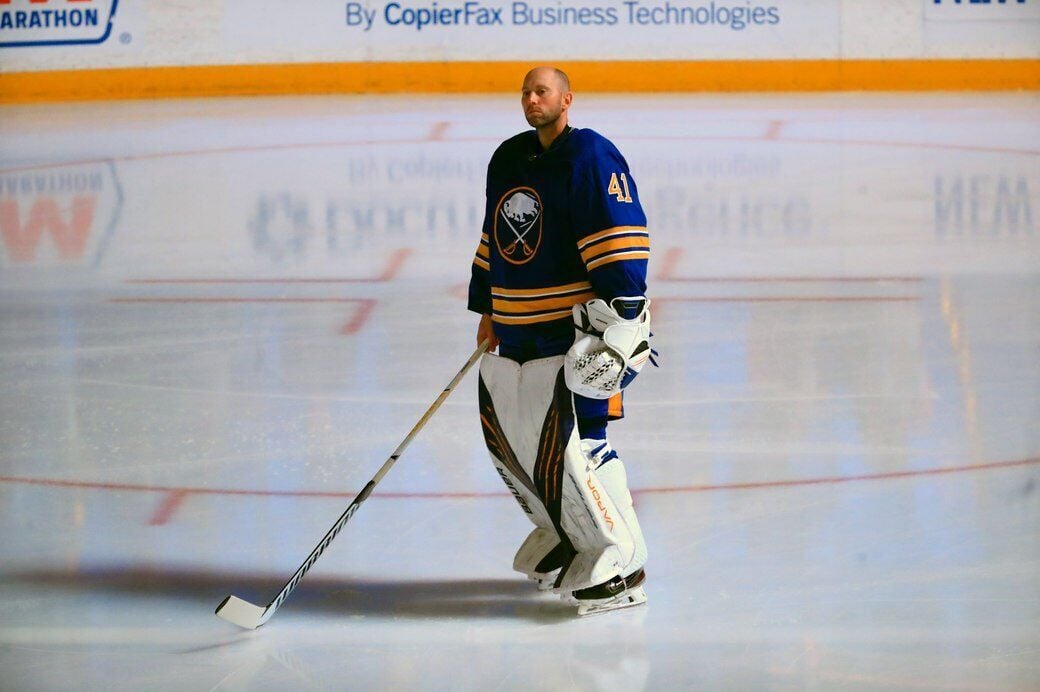
As Craig Anderson reflected on 19 years as an NHL goaltender following the Buffalo Sabres’ practice Saturday in LECOM Harborcenter, he didn’t need to be reminded how many losses he endured before his first of 299 wins in the crease.
“0-11-4 is what I remember,” said Anderson, 40, referring to his record at the beginning of his remarkable career. “Tough start.”
Nineteen years since he first appeared in an NHL game with the Chicago Blackhawks, Anderson is on the cusp of becoming the sixth U.S.-born goalie to reach 300 wins. He trails only Ryan Miller, John Vanbiesbrouck, Tom Barrasso, Jonathan Quick and Mike Richter.
Anderson’s historic production is remarkable, considering how it all began. He was winless in 15 straight games for the rebuilding Blackhawks, found himself claimed on waivers three times during the 2005-06 season and didn’t receive a starting opportunity until the age of 28, when he appeared in 71 of 82 games for the Colorado Avalanche.
People are also reading…
It wasn’t until Anderson arrived in Ottawa that he established himself as a top goaltender in the league, recording 202 victories, Vezina Trophy votes and a .914 save percentage from 2011-20. He was only 20 wins away from the milestone when, in March 2020, the season was suspended because of the Covid-19 pandemic.
A career that’s included countless encounters with adversity – none bigger than Nicholle, his wife, battling a rare form of throat cancer in 2017 – could have ended that spring. Anderson was determined to press on, earning another starting job in Buffalo this season after spending most of 2020-21 on Washington’s taxi squad.
“I think it’s just one of those nice even numbers,” Anderson said of 300. “In March of 2020, when everything kind of shut down, I felt kind of cheated a little bit that way. Just felt like I had more to give, and that was kind of a personal goal to set because if you don’t have goals, you have nothing to achieve or nothing to strive for, you can lose some motivation. I think finding ways to stay motivated, and that’s an easy one, to come into the rink and drive and keep trying to improve and compete. That’s an easy one to kind of feed off of.”
Anderson doesn’t remember much about his first career win, a 7-0 victory over Columbus on Jan. 22, 2004, other than the opposing goalie – Fred Braithwaite, now an assistant coach in the American Hockey League – and that he still has his stick from the game somewhere.
A native of Park Ridge, Ill., Anderson encountered his childhood hockey heroes in the NHL, facing Patrick Roy as a 21-year-old rookie in 2002 and meeting Grant Fuhr in training camp with the Calgary Flames. The game has rapidly evolved since Anderson first arrived in Chicago, and the changes phased out goalies who were unable to adapt.
Anderson never committed to playing one style and constantly evaluated what he needed to change to excel in a league that altered the rules to showcase speed and skill. Four of Anderson’s current Sabres teammates were born after he was selected by Calgary in the third round of the 1999 draft: Peyton Krebs, Mattias Samuelsson, Dylan Cozens and Rasmus Dahlin.
“I think the biggest thing for him is he's probably one of the best readers of the games, as far as a goaltender,” Pierre Groulx, who was Anderson’s goalie coach in Florida and Ottawa, told The Buffalo News in August. “He can read plays that develop quickly, and he reads the player's hands very well, where they're going to shoot. So, to me, that's what has allowed him to play as long as he has. … His ability to read the game is second to none. And that's what basically allowed him to play that long.”
A rocky start to the 2010-11 season led to Anderson's trade from Colorado to Ottawa, where he led the Senators to Game 7 of the Eastern Conference Finals in 2017. His final years as a Senator were spent playing behind a rebuilding team beset by the exits of franchise cornerstones, including Mark Stone and Erik Karlsson.
When the 2020 offseason arrived, rumors circulated that Anderson might retire, but he joined the Capitals on a professional tryout that December. He wasn’t claimed on waivers following training camp and spent much of the season on the taxi squad, serving as an extra practice goalie and a mentor to the club’s young netminders.
Anderson wanted more, though, and he proved he’s still capable of playing at a high level, stopping 21 of 22 shots in a Capitals opening-round playoff victory over Boston in May.
“I have a lot of respect for him as a person,” said Sabres coach Don Granato, who described Anderson’s career as “remarkable.”
“But when you think about the grind that he’s gone through, that respect rises even more, and I told even our team a few games ago that as a coach, I’ll be very proud to be a part of his 300 wins. I mean, it’s pretty special that he’s got a chance to do that and we have a chance to be a part of it.”
Anderson wasn’t the Sabres' first choice when free agency began in July. But when Linus Ullmark opted to sign with Boston and the goalie market was picked over, Anderson joined Buffalo on a one-year, $750,000 contract.
Right when Anderson was back into form, he was sidelined in November with a neck injury that kept him out of the Sabres' crease for almost three months. The agonizing physical rehabilitation was arduous, as Anderson couldn’t string together days when he felt good on the ice. He began to question why he was still putting himself through the physical challenges of a demanding position.
“It makes you wonder when you have a disk issue,” Anderson said. “It makes you start second-guessing, 'What am I doing here? You’re 40 years old.' But things started to turn and get better, and I was like, ‘Alright, well, let’s try to get through this.’ ”
Anderson returned in late January, stabilizing the crease for a franchise that needed a reliable goaltender until one of its three prospects at the position – Ukko-Pekka Luukkonen, Devon Levi and Erik Portillo – are ready for the pressure-packed job. The job for Anderson includes much more than performing on the ice. He’s also a calming voice in chaotic times.
During television timeouts, Anderson skates over to the bench to grab a quick drink of water and provide wisdom to teammates. Goalies don’t typically take on that role. His wry sense of humor and unflappable nature fit well, though. He even joked that he’ll occasionally tell guys to stop passing to the other team or to leave officials alone.
While it’s possible, if not likely, Anderson will be elsewhere after the March 21 trade deadline, his short- and long-term impact can’t be measured by wins or save percentage.
“My goal is to share my knowledge with the younger guys, so they don’t follow in my footsteps and fall back a few steps,” Anderson said. “The goal is to always climb the mountain. If I can help them not fall down the mountain at all, that’s kind of my goal as far as helping the young guys.”


