

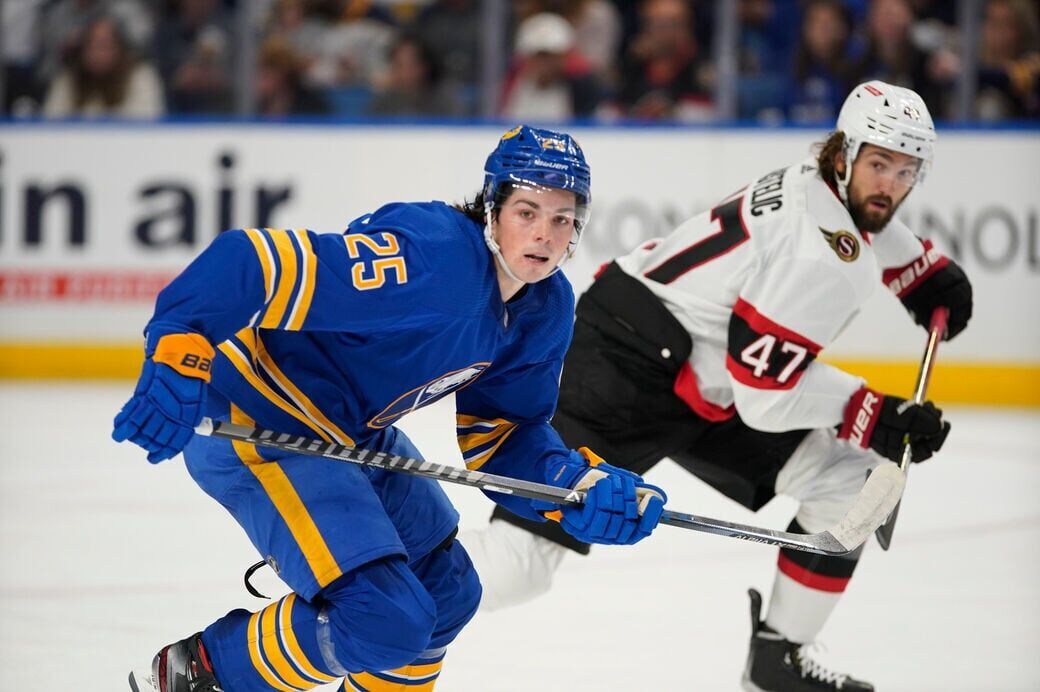
SEATTLE – Ilya Lyubushkin cracked a smile at his dressing-room stall in Climate Pledge Arena, motioned toward teammates who just stepped off the ice from practice and began to detail what he’s learned about the Buffalo Sabres through five games.
“We are so young, so fast and so skilled,” the 28-year-old defenseman began. “That Rasmus Dahlin, he’s unbelievable. It’s crazy, that guy.”
Lyubushkin’s expression of admiration occurred a few hours after Dahlin was named the NHL’s first star of the week for his league-record five-game goal streak to start the season. And with the Sabres losing a defenseman to injury in three consecutive games, Lyubushkin found himself skating alongside Dahlin at practice as they prepared for the road-trip finale Tuesday night against the Kraken. Puck drop is 10 p.m., Eastern.
Defensemen Henri Jokiharju and Mattias Samuelsson were placed on injured reserve, forcing Dahlin and Owen Power to adjust to new defense partners. Jokiharju returned to Buffalo to recover and be evaluated by team doctors, while the Sabres won’t have a clearer timeline on Samuelsson’s injury until the team is home, said coach Don Granato.
People are also reading…
Samuelsson avoided a long-term injury, but a league source told The Buffalo News that Samuelsson will be out “at least a few weeks." His absence will thrust Lyubushkin, Jacob Bryson and Casey Fitzgerald into larger roles while the Sabres work to build on their 4-1 start. Either Lawrence Pilut or Kale Clague, both of whom joined the team on the road after starting the season in Rochester, will draw into the lineup in Seattle.
General Manager Kevyn Adams strengthened the Sabres’ blue-line depth this summer by signing Pilut, Clague, Chase Priskie and Jeremy Davies, providing Granato with defensemen who have NHL experience and fit well within his system. There’s no replacing all that was lost when Jokiharju was struck in the face by the puck in Calgary and Samuelsson clutched his knee after falling to the ice Saturday night in Vancouver, but Buffalo’s other defensemen banded together to help the club win after losing one of their own to injury in three consecutive games.
“Thrown into the fire,” Granato said of his young defensemen. “The heat’s on and sometimes it’s even better for these guys, competitive guys to not have time to even think about what’s happening. Only as you step away from the game, after the game do you realize I played 18, 20 minutes, whatever it may be. And I think that’s a good thing. These guys are well-prepared, and they compete really hard, if we’re talking about Fitzgerald, Bryson having to play a bigger role. … They’re in there and they’re engaged.
"I know we, as coaches, have a lot of confidence in them to the extent that even when they make errors, they correct really quick. It doesn’t get the best of them.”
The Sabres benefit greatly from having Dahlin at his best and knowing Power’s “high, high-end talent,” as Granato put it, will help him adjust quickly to a different defense partner or workload.
Entering play Monday, Dahlin ranked first among all NHL defensemen in goals (5), points (8) and plus-minus (plus-8) while averaging 24:26 of ice time across five games. An alternate captain amid his fifth NHL season, the 2018 first overall pick defends well against top lines and frustrates opponents with his physicality, in addition to his remarkable skill offensively.
Power, at only 19 years old, leads all NHL rookies with 22:14 of ice time per game. He skated a team-high 25:27 against the Canucks, finishing with a plus-2 rating despite most of his 5-on-5 ice time coming against Vancouver’s top line of J.T. Miller, Conor Garland and Ilya Mikheyev.
Bryson, a left-shot defenseman, skated on Power’s right side at practice Tuesday and earned that assignment with an impressive start to the season. His 5-on-5 shot-attempt differential, which ranks first among Sabres defensemen to appear in at least three games, illustrates that Buffalo’s had the better of play when he’s on the ice. Bryson skated 22:15 in Vancouver, ranking third on the team behind Power and Dahlin.
“It’s always tough as a first overall pick,” Bryson said, referring to Power. “You have so much pressure on your back, but I think he’s handled it unbelievably well. He has so much poise with the puck. Every time he gets it, his eyes are up and he makes a smart play. The game looks easy for him, and I can see that in Dahls’ game, too. I think he’s learning a lot from Dahls, who’s been unbelievable this year.”
When the Sabres lost a defenseman mid-game in Edmonton, Calgary and Vancouver – a treacherous stretch that began with Lyubushkin going down against the Oilers after blocking a shot – defense pairs were no more. Each time, the group’s focus was to keep it simple. Quick shifts, stick to one’s own responsibilities and communicate.
The Sabres’ defensemen are always looking to jump into the play offensively, but they had to be careful when down to five in those three games. Overextending can lead to mistakes and there’s not as much comfort or chemistry when forced to play with someone different each time they touched the ice.
“It’s tough,” Bryson added. “You’re out there a lot more. You’re playing with somebody different every shift.”
Finally, though, the Sabres have the depth and talent to handle such adversity. Fitzgerald started the season as the club’s seventh defenseman, but he showed his value in Vancouver when given more ice time and responsibility. He skated 18:45, including more time on the penalty kill with Samuelsson out, and earned opportunities with the puck, including three shots on eight attempts. Based on line rushes during practice Monday, Fitzgerald will be with Pilut or Clague against the Kraken (2-3-2), who rank 21st in the NHL in goals per game.
Even with the injuries, and a difficult road trip early in the season, the Sabres’ plus-11 goal differential ranked third in the NHL entering play Monday. Their defensemen, not only Dahlin, have played a significant role in that fast start.
“You have to roll with the punches and go with what you get,” said Fitzgerald. “I think we’ve done a great job as the game went on, realizing that we’re down to five D and we’ve got to manage the game. … Each one of us can play with another one and jump in no problem and try to fill that void. It was good to see everyone managing the game. I think that’s the biggest step I’ve noticed just from last year. I know it’s only five games now, but it’s a big step in terms of maturity.”


