Like so many others, Adia Barnes was stunned when she heard the news of the attack on Israel by the terrorist group Hamas on the morning of Oct. 7.
That moment — it's been reported more Jews died on Oct. 7 than any day since the Holocaust — hit home to Barnes.
Now entering her eighth season at the helm of the Arizona women's basketball program, Barnes previously lived and played professional basketball in Tel Aviv for two seasons. It was home for a young woman settling into her new career and finding her way in the world. She learned about a different culture and built strong friendships that have endured.
It was also a time in her life that helped shaped her own global perspective.
People are also reading…
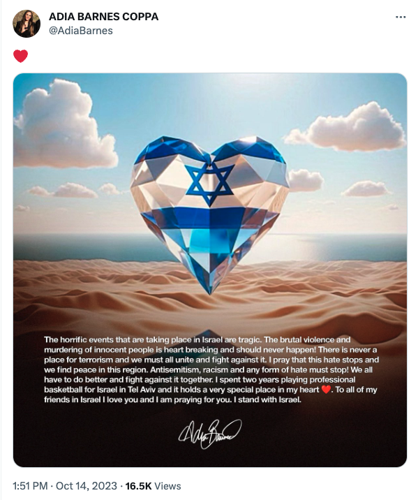
A few days ago, Barnes posted a statement online, saying “The brutal violence and murdering of innocent people is heart breaking and should never happen.

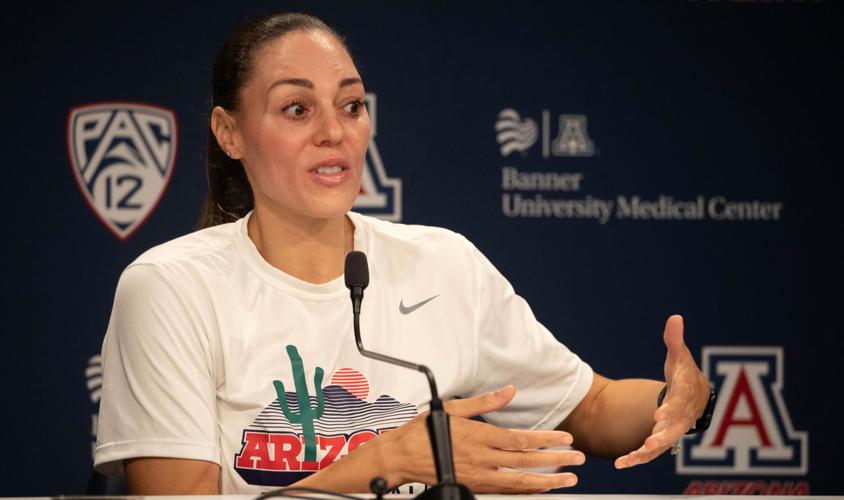
Adia Barnes, head coach of the UA women’s basketball team, holds a preseason press conference to kick off the 2023-24 season on Oct. 2 at McKale Center.
"Antisemitism, racism and any form of hate must stop! We all have to do better and fight against it together," added Barnes, whose name "Adia" means "gift from god" in Hebrew.
Her statement finished with the words, "I stand with Israel."
Knowing she might get some backlash, Barnes told the Star she hasn't spent any energy worrying about that, adding "I have to know what I stand for."
She added: “I don’t believe in terrorism and Hamas is a terrorist organization.
“My heart is broken and it’s very sad," she said. "I also don't believe in innocent Palestinian kids being killed. This whole situation is not their fault. It’s all just wrong. And it’s very sad.”
With the war raging between Israel and Hamas, the 10-team women’s professional basketball league that is based in Tel Aviv has suspended operations. Many in the WNBA are trying to decide what’s next as it's becoming more likely the season won't be getting underway soon. This includes Las Vegas Aces small forward Alysha Clark who has been playing in the WNBA Finals this week against the New York Liberty. Clark plays for Elitzur Ramla and has dual citizenship in America and Israel.

Adia Barnes posted the following on X (Twitter) on Oct. 14 regarding the war in Israel: "The horrific events that are taking place in Israel are tragic. The brutal violence and murdering of innocent people is heart breaking and should never happen! There is never a place for terrorism and we must all unite and fight against it. I pray that this hate stops and we find peace in this region. Antisemitism, racism and any form of hate must stop! We all have to do better and fight against it together. I spent two years playing professional basketball for Israel in Tel Aviv and it holds a very special place in my heart. To all of my friends in Israel I love you and I am praying for you. I stand with Israel.
Israel was good basketball for Barnes.
In her first season in 2001 with Bnei Yehuda, she averaged 21.5 points, 7 rebounds in 36.2 minutes per game. In 2002, she was with Maccabi Tel Aviv, averaging 21.8 points, 7.1 rebounds in 34.3 minutes per game.
“Israel holds a special place in my heart,” Barnes said. “I had the opportunity to play for Bnei Yehuda, which is an historic club, first. They have super passionate fans."
She said former WNBA All-Star and longtime pro Sue Wicks served as a mentor to Barnes, who was with Bnei Yehuda in just the second year of her own professional career.
"I really loved it there. I loved the people. I love the culture. I love the food. There was just this connection to the people that I felt," she said. "The families are close-knit. Nearly every Friday I went to different houses for Shabbat dinner.
"I lived the culture and I loved that. I made some amazing friends that I am still friends with today and they're just really special people.”
Barnes said she would have continued to play in Israel, but plain and simple, the money was better elsewhere. After winning a WNBA title with the Seattle Storm, she played in numerous places overseas including Turkey and Russia.
Barnes also played in Ukraine — along with Israel, another war-ravaged country where WNBA players aren't able to play at the moment in alternate seasons.
Playing in Israel early in her career actually made the transition in other countries a little difficult for Barnes.
In Israel, everyone plays in one city — at most 10-15 minutes from each other. English is spoken and there are a significant number of American Jews who move back to their homeland in what is called Aliyah.
Also, Barnes, a San Diego native, lived right near the beach.
“The people are so into (basketball)," she said, adding that they are "passionate and I think what makes the country so special. And this is going to sound strange: everybody has lost someone or has been affected by some kind of bombing. This is crazy. But they've all been touched by some kind of conflict or war in some way.
"It’s a small country like the size of New Jersey and you understand that when you're there that everybody has been touched by that. I think that their friendships and their family are way more united because of this.”
Barnes was also there during another difficult time in Israel’s history — the second intifada, which lasted from 2000-05. It was an uprising after peace talks between the Israeli and Palestinian leadership failed. There were missiles shot into Israel and suicide bombers.
It was dangerous to go to certain sites like the Dead Sea, so Barnes and her teammates had to take a different route. She couldn’t cross into Jordan from Israel to see the famed Petra archeological site, and when she went to Jerusalem, she could only stay on the Jewish side of the city.
“Israel was intercepting bombs into Tel Aviv and Jerusalem,” Barnes said. “I knew we were in a war but I didn’t feel it. When I was living there, I just had awareness. I was terrified every time a city bus went by, because buses were blowing up.
"I was scared of that. But it wasn't really as much in Tel Aviv. It was in the outskirts (of town) and in Jerusalem. I didn't know a lot of it until I watched CNN. My parents begged me to come home. I was, like, ‘Really?’ because it seemed normal to me."
In addition to looking out for buses, Barnes said she was taught to not go to really busy cafes on Shabbat and to be careful at the outdoor market (the Shuk).
“I was taught those things because there were a lot of suicide bombers. What hit home and was scary was there was a cafe that I had taken my dad to the week before, got shot up by a terrorist with machine gun.”
VIDEO: Arizona coach Adia Barnes speaks at Pac-12 Women’s Basketball Media Day Tuesday, Oct. 10, on the heightened fan support for her Wildcats in recent years, coinciding with multiple NCAA tournament appearances and five consecutive 20-win seasons. (Video courtesy Pac-12 Networks)
VIDEO: Arizona coach Adia Barnes speaks at Pac-12 Women’s Basketball Media Day Tuesday, Oct. 10, answering a question from former ASU head coach Charli Turner-Thorne on “greatest challenges” the Wildcats face this year, such as a shorter bench (10 players). (Video courtesy Pac-12 Networks)
VIDEO: Arizona coach Adia Barnes speaks at Pac-12 Women’s Basketball Media Day Tuesday, Oct. 10, on why the word ‘gritty’ fits as a descriptor for the Wildcats in 2023-24, as well as how she evaluates talent and builds a roster. (Video courtesy Pac-12 Networks)


 Kansas City no longer a slam dunk for Big 12 basketball tournament | Greg Hansen