

PHOENIX - Just days after the famous shootout at the O.K. Corral, the Cochise County coroner convened an inquest to hear testimony from the witnesses and survivors.
On Wednesday, the yellowed and taped original handwritten minutes of that inquest made their way to the state Department of Library and Archives, where officials hope to properly preserve them so they're around for researchers for the next half-millennium.
The documents were stored away and forgotten for 50 years until Michelle Garcia and Bonnie Cook - two clerks assigned to clean out a closet holding exhibits of Cochise County Superior Court in Bisbee - stumbled across an old box marked "juvenile." Inside, Denise Lundin, the chief court clerk, said her staff found a manila envelope marked with the words "keep" and "1881," and containing official notes of the inquest.
The Oct. 26, 1881, incident has become internationally known. Lawman Wyatt Earp, along with Doc Holliday and Virgil and Morgan Earp, confronted Ike and Billy Clanton, and Frank and Tom McLaury. The McLaurys wound up dead, as did Billy Clanton.
People are also reading…
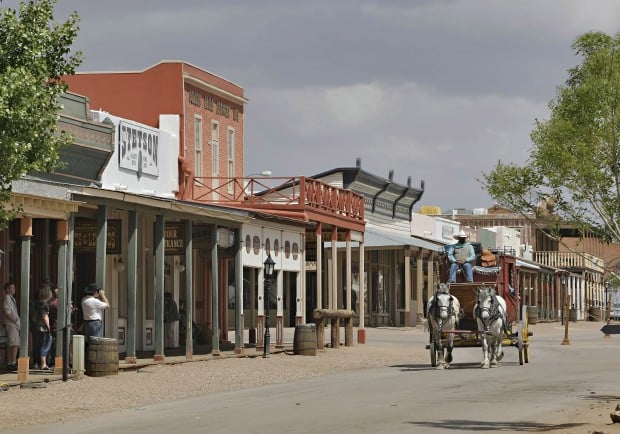
That shootout has since been chronicled in books and movies, and it became part of the lore and legend of Tombstone, with the fight re-enacted regularly.
Lundin said she knew the documents written by the court's inquest recorder were around somewhere because her office had a Thermofax, made in the first days of that photocopy technology. But that, she said, dated to around 1960. And no one had seen the originals since.
It was the fact that those poor-quality copies were still around, she said, that enabled her staffers to recognize what they had found. When the staff reviewed the actual documents, state librarian GladysAnn Wells said, there were a few surprises.
"Doc Holliday was carrying his weapon under his coat," she said.
Wells said she always had thought that in Holliday's era, people had with guns strapped to their hips. And she found the disclosure interesting, considering that the governor had just signed a measure to let virtually all adults carry concealed guns without getting state permits.
Lundin said the notes appeared to have been taken very quickly, without attention to penmanship, as the clerk was trying to keep pace with what the witnesses were saying.
She described the documents as "just beautiful."
"This is an old way of doing business," she said, with scribes taking copious notes, as opposed to today's digital records, created on a computer, sent electronically to the courts and never actually appearing as ink on paper.
"So to have things on paper, to have things in handwriting, is really a lost art," Lundin said.
Wells said the documents will now be digitized and posted on the Arizona Memory Project website her agency, available for viewing any time, while the yellowed and crackling originals are preserved in an archive.