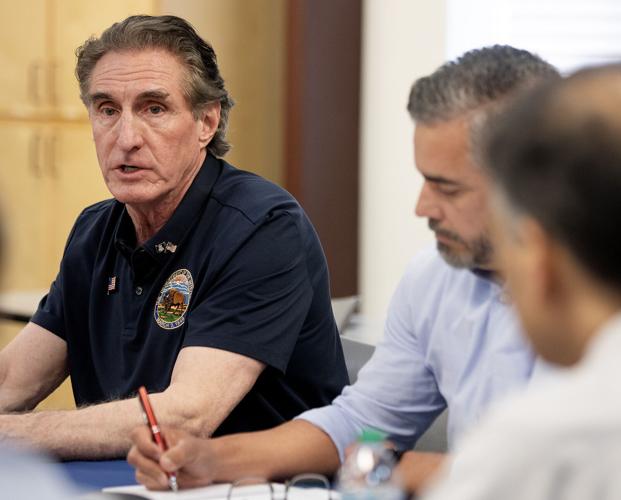
U.S. Interior Secretary Doug Burgum, pressed Monday to spell out how he’ll handle the Colorado River's water crisis, wouldn't get specific but said repeatedly that “nobody will be happy” with how his department will split a rapidly dwindling supply of river water among the seven states, including Arizona, that want a piece of it.
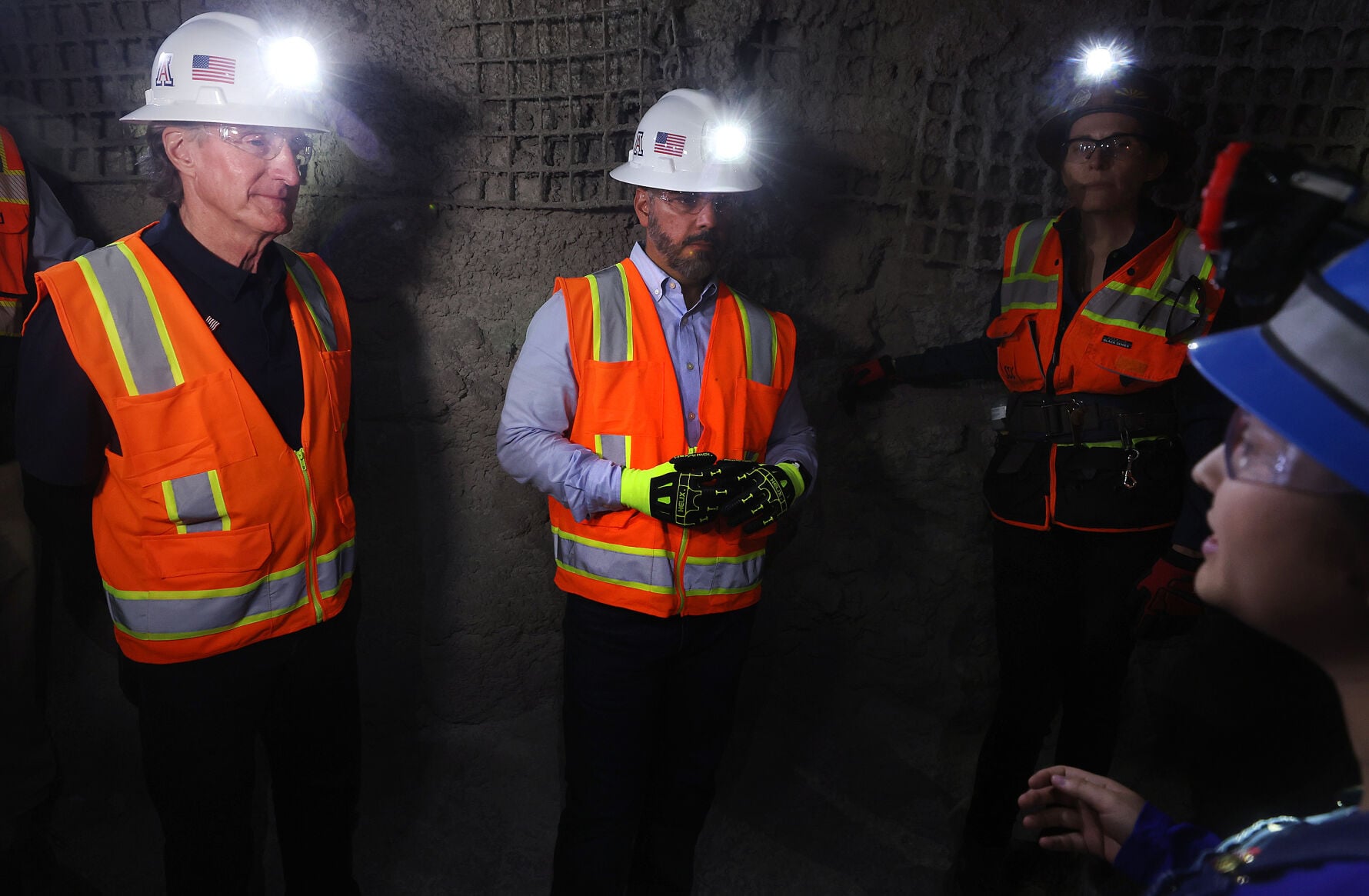
U.S. Secretary of the Interior Doug Burgum, left, and Rep. Juan Ciscomani, middle, listen to Kaitlyn Sutow, far right, a mining engineering student at the University of Arizona, during a tour of the mine at the San Xavier Underground Mining Lab in Sahuarita on Monday.
Speaking at a roundtable in the Tucson area populated by a host of public lands industry leaders and University of Arizona President Suresh Garimella, Burgum pledged to hand down a decision this month on the first of two crucial, divisive issues his office is confronting regarding the river.
That decision will be how much water the Interior Department's Bureau of Reclamation will release from its upstream reservoirs in the four Upper Colorado River Basin states to head off a potential calamity in which Glen Canyon Dam, forming the boundary between the Upper and Lower Basins, would no longer receive enough water to continue generating electricity that serves customers in seven Western states.
People are also reading…
Burgum will have to decide soon on an even bigger and more divisive issue: how to allocate river water supplies among users over the next 20 years, to replace an existing agreement among them on how the water is divvied up.
“We and the Bureau of Reclamation have to announce this month operating plans for next year. We can’t have all these reservoirs and no operating plan. We have to tell them to do something that no one will like," Burgum said.
"There wasn’t enough water to start with and there’s still less water” now, he said. “We’re in a super severe situation. For us to have a functioning, operating plan for 2026, decisions are going to have to be made this month. Under the current course we’re heading on, it’s unlikely there will be an agreement with the seven basin states, and the bureau is just going to have to make a decision — the best judgment it can make.”
“We’re positive about one thing — no one will be satisfied," he said. "We’ll be balancing water rights, power generation and water supply.”
Burgum’s comments on the Colorado, including an exchange he had with Central Arizona Project General Manager Brenda Burman, who attended Monday’s session, were the only unsettling or even mildly discordant moments at what was billed as a roundtable to discuss and emphasize the benefits of mining and other private business activities on federally owned lands.
The roundtable, drawing several dozen participants, was held at the University of Arizona's remote San Xavier Underground Mining Lab south of Tucson in the Sahuarita area. It was hosted by U.S. Rep Juan Ciscomani, a Republican whose district encompasses much of Southern Arizona.
Most of the speakers praised the work of mining companies, ranchers and other private interests, and Burgum and some private industry leaders blasted environmentalists for what the speakers said was unduly delaying federal approvals of their activities. They also spoke of the desirability and benefits of collaboration between the mining industry, the UA and the federal government.
Burgum’s comments on the river, including his exchange with CAP's Burman, almost sounded like they belonged at a different meeting. While the secretary and other speakers spoke of what they said are plentiful supplies of critical minerals and the need to extract them as quickly as possible, and of the need to lift what they said were unfair restrictions on cattle grazing under previous Democratic presidential administrations, the river discussions focused on scarcity.
As Burgum and Burman noted, the snowpack in Upper River Basin states such as Utah and Colorado is at record low levels. Last week, the federal Colorado Basin River Forecast Center lowered its forecast for April to July flows of Colorado River water into Lake Powell for the fourth straight month. This time, the center is predicting 22% of normal runoff from the mountain snows into the river and its tributaries, one of the lowest totals since Lake Powell was formed by Glen Canyon Dam's construction in the 1960s, and down from a 36%-of-normal runoff forecast a month ago. The lake lies at the Utah-Arizona border and stores river water for future release to the Lower Basin states of Arizona, Nevada and California.

U.S. Interior Secretary Doug Burgum, far left, speaks during a roundtable discussion about mining as Rep. Juan Juan Ciscomani is next to him at the UA's San Xavier Underground Mining Lab in Sahuarita on Monday.
After the roundtable ended, Burman told the Star she believes the runoff could ultimately prove to be "the lowest in my lifetime."
“We talk about copper and critical minerals and so many things the president (Donald Trump) supports happen right here in Arizona. Ultimately, our territory served by CAP has 6 million people, 80% of Arizona,” Burman said, referring to the population served by the Colorado River water that the CAP brings via canal to cities and farms. "We are delivering to all of those resources, including 11 of 22 tribes.”
But under three of five proposals that Interior and Reclamation are now considering for the river, CAP would lose 80% to 98% of its total water supply, which serves Tucson and Phoenix with drinking water.
“I do not envy you, because the Colorado River is at a true crisis point. We knew that was coming 20 years ago; then Mother Nature has thrown in what is most likely the driest year in our lifetimes,” Burman told Burgum. “We’re looking at, how do we prevent crisis in the short term? How do we create in the long term” a system that works, she asked.
“We’re intimately involved with the Department of the Interior, with Hoover Dam, the Salt River Project, the Flaming Gorge reservoir (at the Utah-Wyoming border) and the Glen Canyon Dam,” Burman said. “These bureau (of Reclamation) resources were built for the West to thrive.”
But she warned that federal decisions this year that could sharply limit water releases from Lake Powell to Lake Mead in the Lower Basin at the Arizona-Nevada border would likely cut off 80% of the electric power generated by Hoover Dam.
“It is absolutely unfathomable that that is what our future looks like,” Burman said. “There are many laws that were put in place 100 years ago, 70 years ago, 40 years ago, and they were designed so the basins could share water. We are concerned some of those promises will be broken.”
But when asked by the Star at the end of the roundtable if he would rule out some of the steepest CAP cuts now under consideration, Burgum said he can’t make any of what he called “pre-decisional” comments like that.
He said Interior Department officials are in touch with representatives of the seven river basin states regularly, running ideas through them to get their reactions. He said it’s important for the states to get past their beliefs that “if we don’t get what we want, we will sue you.”
He recalled that even when six of the seven basin state governors met in February in his Washington, D.C office, “we still couldn’t get across the finish line.”
“We have to balance out everybody’s needs. Everyone can come to talk about their needs, but it’s a systemwide approach we have to take — how to keep the system alive and functioning. It’s an extreme year. We need everyone to keep coming up with the best ideas, for new sources of supply, conservation, and seriously pray for more rain."
Contact Tony Davis at 520-349-0350 or tdavis@tucson.com. Follow Davis on Twitter@tonydavis987.

Tony Davis
Reporter