

BATUMI, Georgia - Georgia's Black Sea resort of Batumi was once a bleak site: Roads were dotted with potholes, the city was pitch dark at night, running water was scarce and the city's best hotel was infested with rats.
Today Batumi glitters with neon lights, and luxury high-rise hotels dot its skyline; soon the city will even boast a fountain flowing with Georgian grape vodka.
The transformation of the ancient city of 180,000 near the border with Turkey is a vivid example of Georgia's drive to capitalize on its tourism potential, boosting the economy of an ex-Soviet nation where 1 person in 5 lives in poverty. The government has attracted top foreign investors, such as U.S. real estate magnate Donald Trump, to build hotels and develop and renovate tourist sites. And it has aggressively marketed Georgia as a tourism hot spot.
The project capitalizes not only on Georgia's geographical riches - the Black Sea, the soaring Caucasus mountains and its ancient cities - but also on the very essence of the Georgian culture: hospitality itself. Here, refusing to come into one's home and sitting down at a food-laden table can result in deep personal insult, while declining to toast with traditional Georgian wine can prompt reprimands like, "Don't you respect me?"
People are also reading…
"Unfortunately, Georgia is not a country that has a lot of natural resources, there is no oil, no gas, and so what helps the country grow economically is intellect and tourism," Batumi Mayor Robert Chkhaidze told said. "For us, a guest is something precious. For a Georgian, each guest is like God."
Since coming to power in the peaceful 2003 Rose Revolution, the pro-Western President Mikhail Saakashvili has turned the tourism industry into a key sector of the Georgian economy, now making up 7.1 percent of the Georgian GDP, compared with 3.4 percent in 2004.
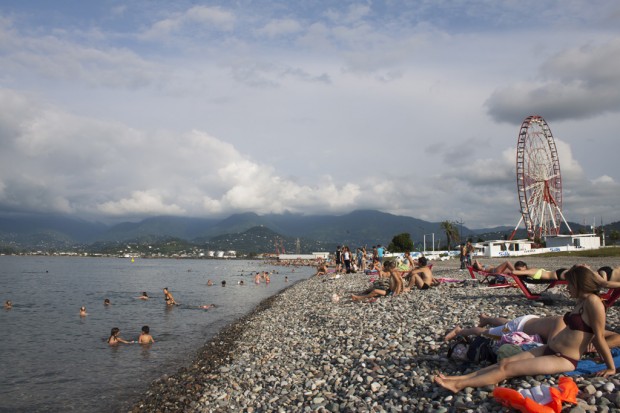
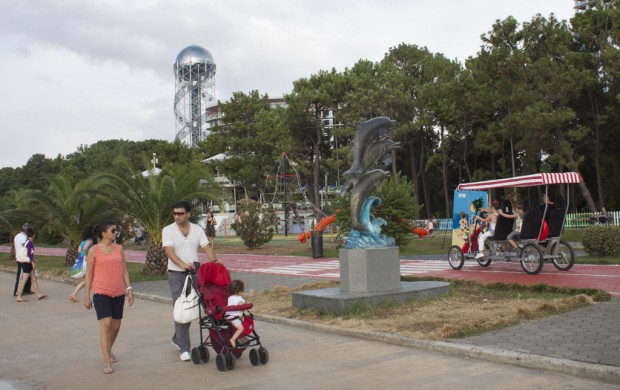
Today, the center of Batumi could easily be mistaken for a Western European seaside town with neat cobblestone streets, bustling cafes and noisy fountains. The city skyline is dotted by internationally renowned hotels like the Sheraton and the Hilton; scores of others including a 47-story Trump Tower are being built. At night Batumi is bright with lights, and even the pineapple-shaped palm trees, which line the embankment, are illuminated.
Batumi now boasts its own piazza dominated by a soaring clock tower, which is modeled after central-city squares in Italian cities. Work is also under way to erect a fountain flowing with Georgian grape vodka, available for free, though in small amounts. There are scores of fashion boutiques and even a plastic-surgery clinic.
The new hotels have created several thousand jobs for the graduates of a recently opened tourism college, a heartening change in a country with high unemployment. Restaurants and cafes have sprung up like mushrooms, offering the traditional Georgian dish called khachapuri, crusty, boat-shaped bread in which an egg yolk floats in melted cheese and butter.
And while some skeptics say that the official tourism figures may be inflated, there is no doubt that tourism is booming, with beaches and restaurants busy with visitors. Most tourists come from other ex-Soviet nations like Russia, Ukraine, Belarus, Armenia and Azerbaijan. But English, French and other languages are also heard on the streets.
Oksana Dovrenova, 40, came to Batumi with her daughter, Damira Rakhmanova, 15, from the Central Asian nation of Kazakhstan. It was their first time at the sea, and they were pleasantly surprised to discover that seawater is indeed salty.
"The people are very friendly, very welcoming, they are always happy to see you. Good job," Dovrenova said.
Shi Tang, 29, from China, who works as a sales manager at a radio station in Turkey, said he will return to Batumi, which he called a "European city," with his friends.
Locals call Batumi "the city of love" and authorities have erected numerous monuments to make the point - like the figure of a man kneeling down before a woman, offering her a red heart. They've even opened a round-the-clock marriage registry, where anyone can tie the knot day and night.
"A lot of families have been created after the tourist season in Batumi," Chkhaidze, the mayor, said with a smile.
But a lot remains to be done. Step a few blocks away from the city center and you may see crumbling buildings and underwear flapping in the wind on balconies. Locals complain that water shortages still persist in residential areas and the average monthly salary in the city is just $300.
Associated Press Writer Misha Dzhindzhikhashvili contributed to this report from Tbilisi.


