

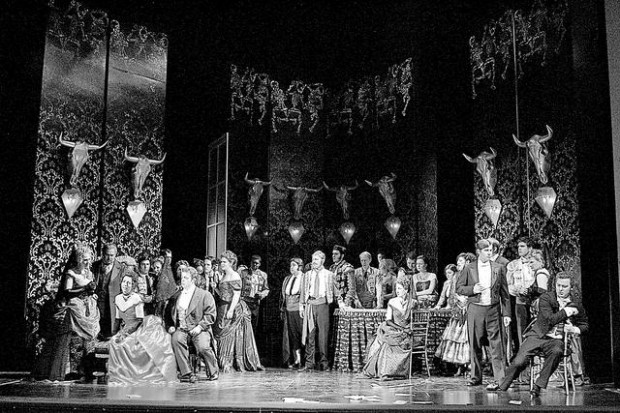
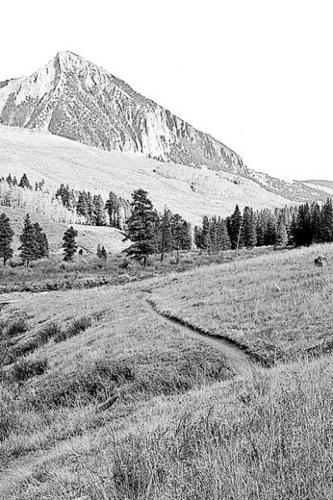
CENTRAL CITY, Colo. — At almost 8,500 feet in the Rockies, it can take a few breaths to walk up Central City's steep granite hills lined with Victorian homes, souvenir shops — and an opera house that has served 19th-century gold miners as well as modern-day visitors.
For almost a century and a half, Central City and other Colorado mountain towns have been alive with the sounds of opera. Partly because of its opera house, Central City, up Clear Creek Canyon some 40 miles west of Denver, is a national historic district and such a marvel of local history one can almost hear the Cornish miners singing.
But Central City Opera is not just a relic of the past. It is a vibrant, popular arts venue, with nearly 24,000 tickets sold in 2007 and a record $1.25 million in sales. The opera hopes to bring in as much or more business this summer, with performances of Benjamin Britten's "The Rape of Lucretia," a new production of Leonard Bernstein's "West Side Story," and American composer Carlisle Floyd's "Susannah," the story of a woman accused of immorality and shunned by a rural Tennessee community.
People are also reading…
Still, the opera has its roots in the rough and tumble mining days of the 19th century. European immigrants to towns like Central City brought their musical traditions with them. A town's mark of civilization included having a sheriff, a courthouse and an opera house. Theaters wouldn't do because they often also housed brothels or put on "leg shows."
"They hankered for some kind of civilized lifestyle that would ameliorate their loneliness and the drudgery of the work they were doing," said Charles Ralph, a Colorado opera historian. "Having entertainment, especially coupled with attractive people, mainly female, was exactly what they wanted."
In Central City, opera supporters in the town of 3,000 raised $12,000 in 1878 to hire a Denver architect to design the building and $23,000 to build it over Eureka Creek. The interior's trompe l'oeil murals were created by John C. Massman of San Francisco. Fortunately, several months before it opened, natural gas became available, so it did not have to rely on hundreds of kerosene lamps.
In all, about 150 opera houses were built in Colorado between 1860 and 1920. Thirteen are still operating, including several in once-struggling mountain mining towns such as Aspen and Crested Butte.
In Denver, the Tabor Grand Opera House opened in 1881. A gilded curtain painted by artist Robert Hopkins depicted a "moody neoclassical city in ruins" across the 72-foot-wide stage, flanked by balconies trimmed in carved cherry wood, according to Colorado historian Tom Noel.
The building, used for the 1908 Democratic National Convention, was renovated in 2005 and became the Ellie Caukins Opera House, boasting state-of-the-art sound and lyrics on seatbacks. The theater is now home to Opera Colorado, which stages four operas a year. Performances of its summer opera, "Nixon in China," were scheduled to run through today, and "Madama Butterfly" will be presented in November.
Central City's musical traditions predate its opera house. During the Civil War, troupes held shows on makeshift stages for the gold-seekers who swarmed what was billed as "the richest square mile on Earth" and "The Little Kingdom of Gilpin County."
It wasn't always genteel. In 1861, a theater manager shot and killed the leader of a minstrel group from a balcony. It was ruled to be justified, though the details remain vague.
If You Go
• Central City Opera: 124 Eureka St., Central City, Colo., www.central cityopera.org or 1-303-292-6700. Tickets $45-$93, depending on seats and performance date. About 40 miles from Denver.
• Opera Colorado: 695 S. Colorado Blvd., Denver; www.opera colorado.org. Tickets $28-$157.
Other Colorado operas
• Aspen Music Festival: www.aspenmusicfestival.com or 1-970-925-9042.
• Crested Butte Music Festival: www.crestedbuttemusicfestival.com or 1-970-349-0619.
• Opera Fort Collins: www.operafortcollins.org or 1-970-482-0220.


