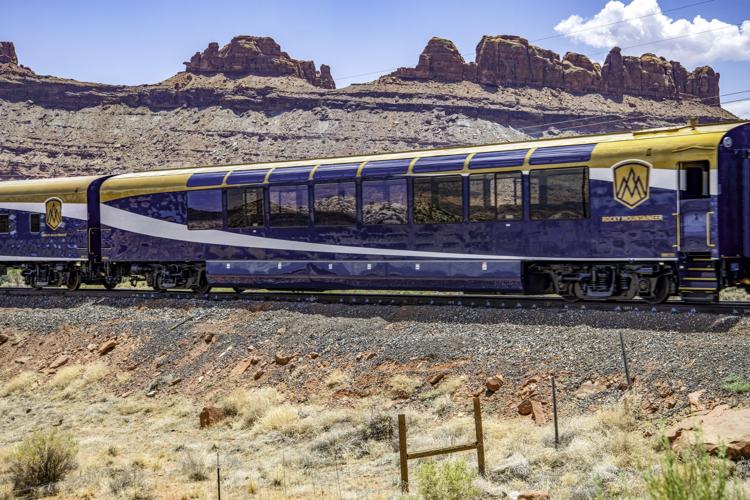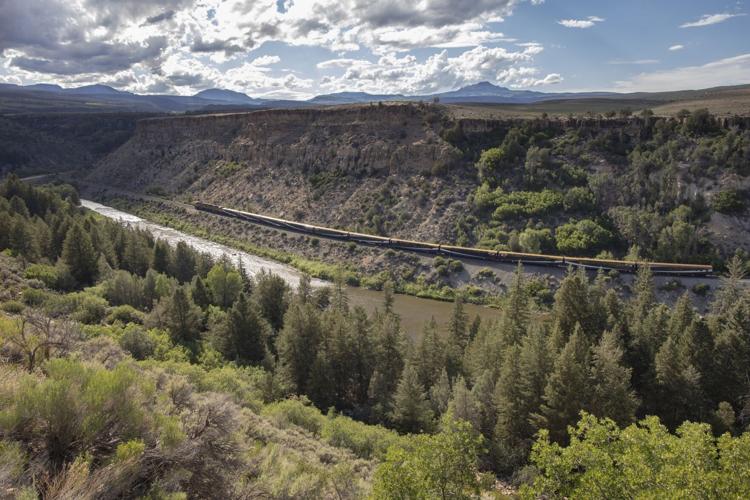

The train passes close to attractions such as Arches National Park in Utah. The rail line offers add-on tours to the park and other spots on either end of the journey.
The United States' railroad system is getting a boost from its northern neighbor.
One of Western Canada's most-decorated luxury scenic train lines, the Rocky Mountaineer, launched its first U.S. route on Aug. 15 through its namesake mountain range, running two-day, one-night trips back and forth between Denver, Colorado, and Moab, Utah.
The new route, known as Rockies to the Red Rocks, joins the line's three rail offerings in Western Canada (Vancouver to Banff, Lake Louise and Jasper) and takes passengers through several distinct regions of Colorado before cruising into the heart of canyon country in Southern Utah.
The U.S., while not known for its train travel, does already have a handful of dedicated scenic trains in the West. The Durango & Silverton Narrow Gauge Rail, for example, or Amtrak's Coast Starlight between Washington and California.
People are also reading…
None, however, quite fit the same bill as the Rocky Mountaineer, whose unique operations, food and beverage program and luxury-focused service have made it a model for the industry.
Since its exception in 1990, it has been honored by the World Travel Awards as the "World's Leading Travel Experience by Train" eight times, and in 2020, it won a Globe Travel Award for "Best Rail Company."
U.S. President Joe Biden's new infrastructure bill calls for an investment of $66 billion into Amtrak and America's railways. But before any of that can come to fruition, Rocky Mountaineer is off and running. So what can we expect from its debut in America? Come along as we explore the new route.

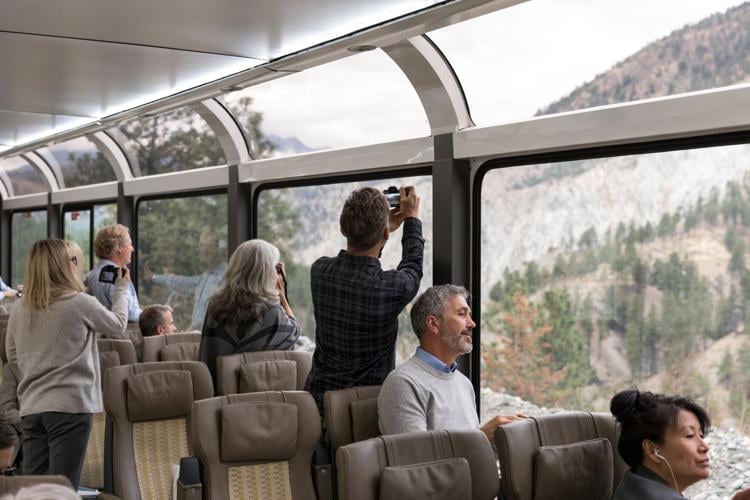
The train features expansive windows and only travels during the day to maximize the scenery.
An overnight train without sleeper cars
Depending on your perspective, the most differentiating thing about the Rocky Mountaineer's operations is either its best competitive advantage or its worst Achilles' heel: Although it's a multi-day trip, you don't actually sleep on the train.
In fact, there are no sleeper cars at all on any of the Rocky Mountaineer's routes. Instead, guests disembark the train each evening and spend the night in a local hotel.
The purpose of this setup is two-fold: To allow guests to get a better night's sleep (no rocking and rolling), and to ensure darkness does not cloak the scenery.
"Our routes showcase some of the most spectacular scenery North America has to offer," said Nicole Ford, communications director at Rocky Mountaineer. "Our trains only travel during the day and feature oversized windows so guests do not miss a moment of the ever-changing landscapes."

The train features expansive windows and only travels during the day to maximize the scenery.
Another differentiating factor for this Rocky Mountaineer route is its food and beverage program, which forgoes a classic dining car for an eat-at-your-seat approach with individual tray tables. Each row is treated as a table at a restaurant, with personalized service, scheduled meals and drinks on demand.
The menu features local ingredients, many from areas the train passes through, such as short ribs braised with beer from Epic Brewing, charcuterie boards made with Colorado bison, elk and venison, seasonal vegetables from Colorado growers and desserts from Aspen Baking Company.
The drink menu for the launch doesn't showcase any regional wine (it's from California and Oregon instead), but it does offer Colorado beers (Denver Beer Company). Rocky Mountaineer said the beverage selection could continue to change throughout the inaugural season as it looks to establish more local partnerships.
There are two classes of service on the Rockies to the Red Rocks itinerary: SilverLeaf ($1,250 per person) and SilverLeaf Plus ($1,645). Both include all meals and drinks — both alcoholic and non-alcoholic — seats adjacent to oversized glass-dome windows and an overnight hotel stay in Glenwood Springs at either the Glenwood Hotel Colorado, the Hotel Denver or the Glenwood Hot Springs Resort.

Passengers on the two-day, one-night journey stay overnight in a choice of hotels. The overnight stay is included in the fare.
The SilverLeaf Plus adds an additional course during meals and exclusive access to a separate lounge that features a mixologist who makes craft cocktails with premium spirits.
Though meals are enjoyed at your seat, there is reason to get up and walk around — each car, regardless of class, has a small outdoor viewing platform where you can get a blast of fresh mountain air.
The journey — mountains, hot springs and canyons
The Rocky Mountaineer can be ridden in either direction, but here, we focus on the east-to-west route.
The journey begins in Denver, where passengers board the Rocky Mountaineer at the Union Pacific Railyard at 9 a.m. From there, the train sets off for an eight-hour, 175-mile ride to Glenwood Springs.

The train passes through Eagle County, Colorado.
As you slowly roll out of downtown Denver (5,280 feet above sea level), wave goodbye to the skyscrapers and bustling city life. You won't encounter either of them again.
The train breaks free of the metropolitan area and begins climbing into the Front Range of the Rocky Mountains via the "Big 10 Curve." It was built in the early 1900s as a switchback to help trains climb the steep terrain. At about the middle of the curve, two dozen rail cars filled with cement are permanently parked alongside the track as a wind block. If you visit one of the outdoor viewing platforms at this time, you may experience for yourself the region's notorious winds.
After the climb into the Rockies, you'll come to the Moffatt Tunnel. It's been open for nearly a hundred years (since 1928), and it cuts through the Continental Divide at 9,239 feet above sea level to the base of Winter Park Ski Area.
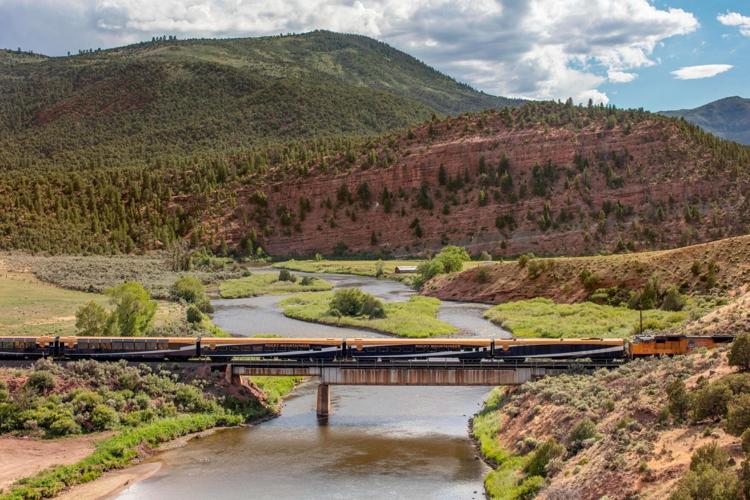
Just down the tracks from there, in Granby, you'll pick up the mighty Colorado River and follow it, more or less, for the remainder of your journey to Moab. Watch as the green and yellow ranch lands and expansive valleys give way to a series of canyons, the first day culminating with a ride through Glenwood Canyon.

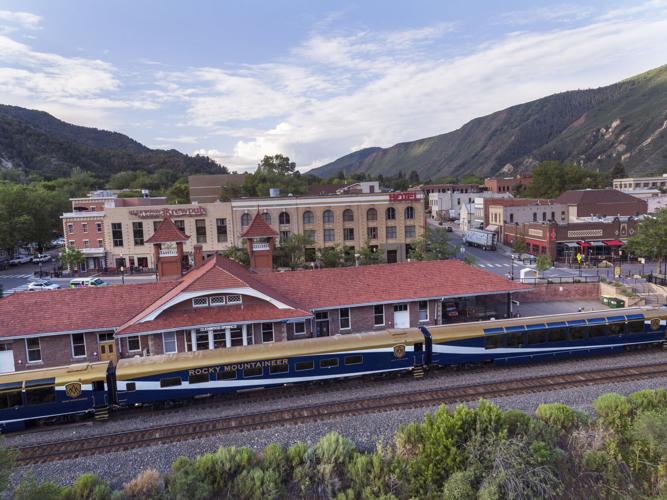
Passengers spend the night in their choice of three hotels in Glenwood Springs, Colorado.
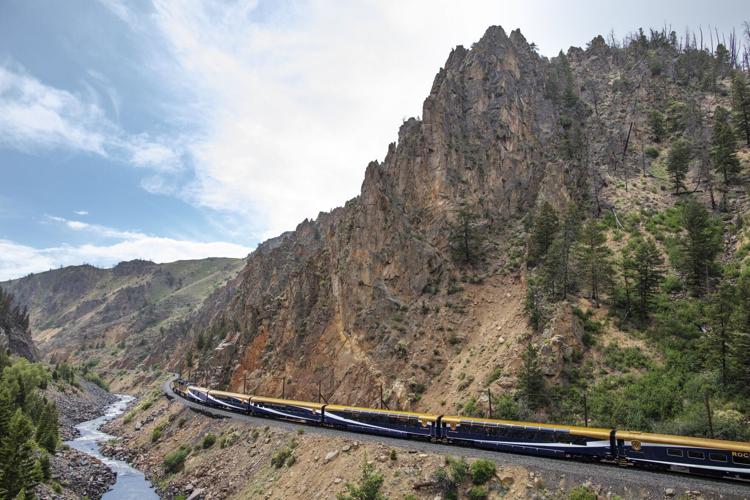
Sixteen miles in length, it is one of the most scenic stretches of road and track in the entire state of Colorado, with jagged walls that rise to more than 1,300 feet tall. It serves as the gateway to Glenwood Springs, where you'll disembark for the night with a chance to explore its downtown area and soak in a hot spring.
The next day's route between Glenwood Springs and Moab is 194 miles, longer than the previous day. But, because this ride follows a decline in elevation, the trip takes only five hours.
Yesterday, you got to see the how the city of Denver and the Front Range transition into the high elevation of the Rocky Mountains. Now, you'll discover how Colorado's Western Slope transitions from high alpine forests to red rock cliffs and canyons.
The convergence takes place west of Glenwood in the Grand Valley, where the 11,000-foot Grand Mesa and its thick, green forests are juxtaposed with the beige, sandstone cliffs of the Book Cliffs Mountain Range.
As you enter the Grand Valley, you'll pass through the small town of Palisade, home to the Palisade Fruit & Wine Byway, with more than 30 wineries and about two dozen peach orchards butted up against the Book Cliffs.
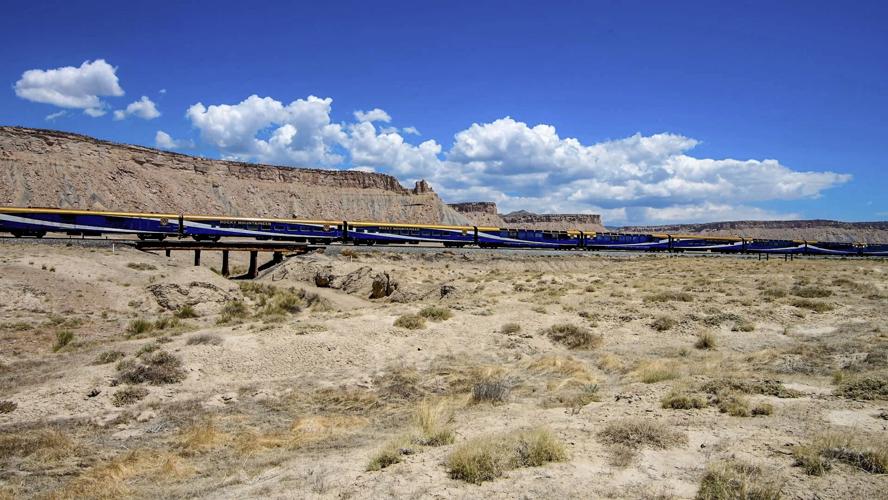
From there, it's 25 miles through Ruby Canyon and its red sandstone cliffs, an area only accessible by train, foot or raft. The train then crosses into Utah, and the Rocky Mountains give way to the expansive desert that leads into Moab.

Rocky Moutaineer's Rockies to the Red Rocks route stretches between Denver, Colorado, and Moab, Utah.
Using the train as a launching point
Traditional train travel wisdom says it's the journey and not the destination that matters. Luckily, Rocky Mountaineer's approach is a little more modern and a little more inclusive.
Obviously, the two-day experience on the train is the main dish, but Rocky Mountaineer encourages its guests to spend more time in its destinations with pre- and post-trip planning services.
When booking, it will help guests make a bigger trip of it by arranging extended stays at the origin and destination. It also partners with tour companies to facilitate adventures in the surrounding areas.
There are package options for add-on tours, activities and hotel stays in Denver and Moab, including Arches and Canyonlands National Parks, as well as within-reach destinations such as Bryce Canyon, Lake Powell, Salt Lake City and Las Vegas.
The inaugural season for Rockies to the Red Rocks will run now though Nov. 19. The 2022 season will be extended to seven months and begin next spring.
___
A ride on the wild side: Your guide to a picture-perfect safari
Where to start looking

Since most safari lodges now have websites, comparing them is easy. Treat yourself to a leisurely tour through Uyaphi.com and Go2Africa.com, travel and touring companies that book family, individual, group and customized safaris. The websites are a treasure trove of photographs. Descriptions include locations, indoor and outdoor areas, gardens, views and extras, from mokoro (canoe) rides to spas and swimming pools. Prices per-person per-night vary widely because they include not just full-service game lodges but area hotel rooms. When you find something you like, search the site for an email contact. The person who gets back to you can answer questions, create a plan and make reservations.
A 'game drive' timeline

5:45 a.m. – You've slept your first night at your African game lodge, which serves as your home base, when a staffer knocks with a wake-up cup of tea and toast. Dressing in your khaki-colored shorts, shirt and hat (laundry is done every other day, no charge, so two changes are enough), you rush over to the main lodge. Your guide and tracker – and fellow guests – are waiting at the car, an open-top Land Rover, ready for the morning’s four-hour drive in search of lions, elephants, giraffes and antelope. A half-way stop includes a delicious breakfast treat.
10:30 a.m. – As the sun rises in the sky and the animals seek shade, the group returns to the lodge. This is your free time to join a guided walk, enjoy lunch, write in your diary, visit the gift shop or crash for a nap.
4:30 p.m. – Changing into long pants and a light jacket, and adding a coating of mosquito repellent, you join the afternoon drive. As the sun begins to sink, male lions awake and stretch, leopards come down out of the trees and antelope move closer together. At 6 p.m. the guides park for a “sundowner” stop, toasting with wine, gin-and-tonics, crackers and cheese. A male lion roars and you shiver down to your toes. A second lion answers. Down at the waterhole a thousand frogs sing at top volume, an unearthly chorus. If a leopard appears, you’ll follow it.
8 p.m. – Back at the lodge, with shirt changed and hair combed, you gather for a four-course dinner with wine, a feast usually served at long tables. The guests, numbering from eight to 24, tell and retell of their adventures and each new sighting.
10:30 p.m. – Bedtime, but because it’s dark out, an armed guide escorts you back to your cabin. He will remind you now and every night, NEVER, EVER walk alone in the dark without an escort. Once in your cabin, stay inside until morning. If you hear huffing or rustling it’s animals prowling through the camp, curious and probably hungry. Guests have been killed walking alone.
My favorite lodges

My Botswana favorites, all in the Okavango Delta, are traditional lodges with eight to 10 spacious tent cabins bolted onto wood decks, per conservation regulations. Shinde is close to water and open plains; Kanana, near water, adds mokoro (canoe rides) to birding islands. Chiefs’ Camp and Stanley’s Camp explore a mix of wooded islands and surrounding lagoons.
In Kruger National Park, my favorite is Londolozi (www.londolozi.com), highly rated and a sentimental destination. Now enlarged and divided into four different lodges, it remains true to its origins as the country’s first leopard conservation project.
In the Sabi Sands Preserve, also in Kruger National Park, Bush Camp (www.sabisabi.com) is a big, lively lodge that would fit best in the resort category. It has 25 luxury suites and is an ideal place to meet other travelers and their children. Activities include daily game drives, cultural community visits, swimming pools, a spa, an exercise gym, a child-care play center, a gift shop, and a waterhole near the dining room, where guests sip tea as the elephants come to drink.
In Zambia, the Bushcamp Company Group, in South Luangwa River National Park, is unique (www.BushcampCompany.com). The main lodge, with an open-air lounge, casual restaurant and 12 adjacent cabins, is a 30-minute drive from Mfuwe town, thus a handy getaway for passing travelers and area residents who come to watch the elephants that walk through the lobby. More importantly, this is headquarters for eight distant lodges, intimate, isolated and rustic hideaways sleeping no more than eight. At cozy Bilimungwe, you’ll meet the elephant family. At Chamilandu you can spend a morning up in the “Hide,” as it’s called, waiting for the parade of animals that comes daily to drink.
Why choose southern Africa?

Not only do these countries have many animals, but they use 4x4 vehicles with open tops and bench seats for game drives. Open-air seats allow unimpeded views and better photography while sitting. In East Africa (Tanzania, Uganda and Kenya) most parks permit only minivans or enclosed cars with open tops, limiting viewing.
Reasons to book through a tour company

It’s possible to book your own plane flights, game lodge reservations and ground connections. But many North American travelers would rather spend more for a trip they can plan on the phone with an experienced representative from a full-service tour company. It’s a relief when a local employee meets you upon arrival, helps with luggage, drives to your hotel or lodge, drives you to the next day’s lodge or flight, and helps with visas, customs and local money.
A partial list of top-rated companies includes Sanctuary Retreats (www.Sanctuaryretreats.com); Ker & Downey (www.Ker-downeyafrica.com); Wilderness Safaris (www.Wilderness-Safaris.com); Bushcamp Company in Zambia (www.BushcampCompany.com); Abercrombie & Kent (www.Abercrombie&Kent.com); and SabiSabi Company (www.Sabisabi.com).
Tips for health and safety

If you are flight-hopping between game lodges, remember that light high-wing planes enforce space and weight restrictions. Pack light, no more than you can fit into a 36-inch by 18-inch duffel, plus a carry-on for your camera, money, passport, medications and toiletries.
Mosquitoes carry malaria but are rarely a threat during Southern Africa’s dry months, from July to mid-October. Prevent bites with light-colored or khaki long-sleeve shirts and long pants and insect repellent. Or use a prophylactic drug from your doctor. We recommend travel and medical insurance, including emergency evacuation back to South Africa.
When to go

June through August (winter) are dry months, with chilly nights and mild, sunny days. September and October are warmer and dry with less foliage on the trees, but they offer better game viewing because of it.
More images:
Giraffe

Our guide says this giraffe is about to give birth. (Steve Haggerty/TNS)
Elephants family

Elephants families seek shade in the heat of mid-day. (Steve Haggerty/TNS)
Mokoro tours

Mokoro (canoe) tours are popular with guests at Kanana Camp. (Steve Haggerty/TNS)
Lions

Lions pay scant attention to nearby Bushcamp Company Lions ignore game-drive vehicles, as long as passengers sit still. Near the Luangwa River, South Luangwa National Park, Zambia. (Steve Haggerty/ColorWorld/TNS)
Kanana Camp

Front steps of Kanana Camp in the Okavango Delta. (Steve Haggerty/ColorWorld/TNS)
A single elephant

Male elephants spend most of their time alone. (Steve Haggerty/ColorWorld/TNS)
Will McGough is a travel writer, author and tour guide.