

ZION NATIONAL PARK, Utah — Late each winter, when the snow gets sloppy and the streams get muddy, the same thought creeps into my mind: I need green. I need warmth. I need spring.
That feeling often demands beaches. But when it hit last winter, a different vision commanded — desert, slick-rock cliffs and sheer monoliths. That meant southern Utah. And in southern Utah, there is no place better than Zion National Park for a spring getaway.
Zion is in Utah's southwest corner, the part of the state that Utahans call Dixie, where the early leaders of the Mormon church kept their winter homes. It is here that spring arrives first.
The grass was still brown when we left our home in Montana in early April, headed south on Interstate 15. But as we descended the last stretch toward Zion, dropping from mountains into valleys, canyon walls soaring beside us until we reached the Virgin River, we could feel spring engulfing us.
People are also reading…
Wildflowers were in riotous bloom under the warm desert sun. Kids on spring break splashed in the still-frigid river. Desert this may be, but after a long winter it was a welcoming oasis.
The park is part of the Grand Staircase, a huge geological formation on the Colorado Plateau. Layers of sedimentary rock have been lifted, tilted and eroded. Its colorful cliffs stretch from Bryce Canyon to the Grand Canyon.
The scale of the staircase is enormous: The sedimentary rock layers were 10,000 feet thick before erosion began carving.
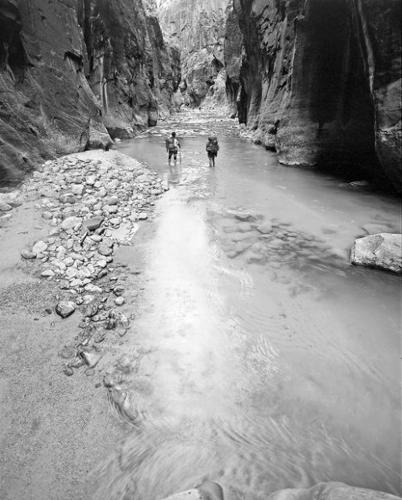
As the thousands of feet of sedimentary rock were lifted over the millennia, swift streams cut downward, forming the region's famous canyons. The main canyon in Zion, center of park activity and the focus of our visit, was cut by the North Fork of the Virgin River.
It is narrow, less than a quarter-mile wide. But it is deep, flanked by towering sandstone palisades 2,000 to 3,000 feet high that draw rock climbers who savor big walls. Climbers can often be spotted camped in mid-ascent, their sleeping platforms suspended from pitons.
The six-mile canyon drive ends at a formation known as Temple of Sinawava, where the canyon begins narrowing to a slot only 30 to 40 feet wide.
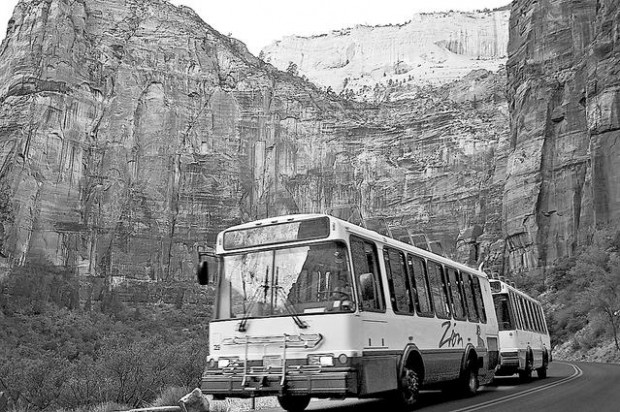
The canyon used to be overwhelmed by traffic during the spring and summer, bringing noise, pollution and endless frustration for visitors who could find nowhere to park. The National Park Service responded by beginning a mandatory shuttle bus system in the year 2000.
During the summer months — April through October — the heart of the Zion Canyon is closed to private vehicles. Visitors ride free propane-powered shuttle buses near the entrance station to complete their journey into the park.
While shuttle buses may rankle some who like the freedom of coming and going at will, the buses also restored quiet to the inner canyon.
A separate shuttle bus route runs through the town of Springdale, at the park's main gate. Visitors dropped at the entrance by a city shuttle need only cross a foot bridge over the Virgin River into the park, show or buy their park pass, then re-board a park shuttle at the adjacent visitor center.
Two campgrounds are located just inside the park entrance, and a grocery store is located on the city side of the foot bridge. That means it's possible to spend a week or more at Zion —hiking all the major trails inside the park and using all the amenities in town — and never have to move your car from your campsite or motel.
One trail we could not resist was one of its classics — Angels Landing.
Angels Landing is only a five-mile hike, but guides recommend allowing at least five hours because of the terrain the trail covers — a 1,500-foot climb through a slot canyon and out to a 5,785-foot peak perched at the end of a narrow rock fin. The name came from an early Zion explorer who looked up at the precipice from the canyon floor and declared "only an angel could land on it!"
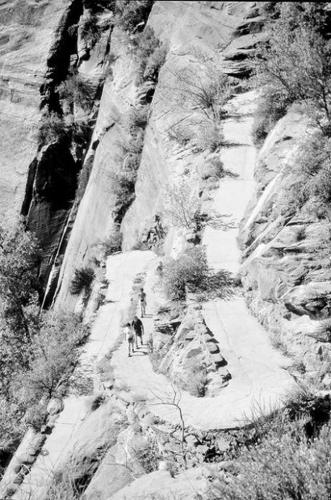
This is not a hike for those afraid of heights. After a two-mile gradual approach, then climbing through a cool side canyon, the trail ascends Walter's Wiggles, a series of 21 switchbacks that steeply ascend a cliff wall, topping out at a broad sandy area known as Scout Lookout.
From there, hikers work their way across a rocky ridge that steadily narrows. It finally becomes a rock fin only a few feet wide, with 1,000-foot drops on each side. Fixed chains attached to the rock allow a safety grip on exposed sites for those traversing the edge of the fin, but it can be terrifying for those who fear heights. It also is a hike not recommended for young children.
Despite that, it is a crowded trail, with frequent waits at narrow spots for hikers coming the opposite direction. The reward for those who travel the entire rock fin is an unequaled view of the Zion Canyon 1,500 feet below.
If You Go
Zion National Park is located in the southwest corner of Utah, about 8 hours by car from Tucson. The entrance fee is $25 per vehicle for seven days.
The Zion Lodge, midway in Zion Canyon, is the only hotel in the park and offers cabins, motel rooms and suites beginning at about $150 per night; reservations at www.zionlodge.com or 1-888-297-2757.
The Watchman and South campgrounds are just inside the park entrance. Watchman campsites can be reserved on the Web at www.recreation.gov; South campsites are first-come, first-served. Motel and bed and breakfast accommodations, as well as full-hookup campsites for RVs, are available in Springdale and other nearby towns.
For more information go to www.nps.gov/zion or 1-435-772-3256 or www.zionpark.com.


