

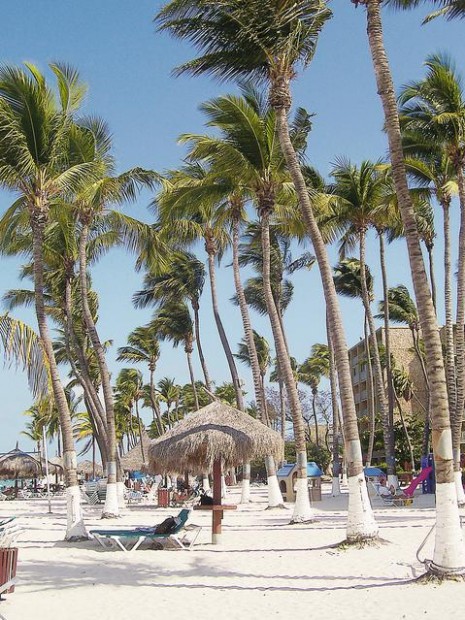
ORANJESTAD, Aruba, Netherlands Antilles — Aruba has a lot going for it as the tourist mecca of the southern Caribbean.
That includes some of the best beaches in the Caribbean, its aquamarine waters, first-class hotels and restaurants, duty-free shopping, casinos, night life and water sports, especially windsurfing.
Lovers of sun and surf are attracted by Aruba's powdery white beaches, especially Palm and Eagle beaches, and its azure waters, with visibility of up to 100 feet.
The beaches are the biggest draw to Aruba, which proudly calls itself "One Happy Island."
Aruba's average temperature is 82 degrees. The breezy island — 19 miles long and six miles wide — sits 18 miles off the coast of Venezuela. Its sister islands are Bonaire and Curaçao.
Aruba has made a big push to become a tourist hot spot, and its efforts are paying off with 2 million international visitors a year from North and South America and Europe. It can be a pricey island, depending on what you book at its 30 major resorts and hotels.
People are also reading…
Palm Beach, on the western or leeward shore, is known for its sugary sand. The beach is lined by palm trees and the island's large, high-rise resorts.
You can enjoy beach volleyball, banana-boat rides, scuba diving and parasailing, along with swimming and sunning.
To the south is Eagle Beach. It is wide and talcum-soft and has been voted one of the top 10 beaches in the world by Travel & Leisure magazine.
Water sports are abundant, and the island's low-rise resorts line Eagle Beach. It is great for beachcombing at dawn and dusk.
Both beaches (together, they are seven miles long) are popular and can get crowded, especially narrow Palm Beach.
Malmok Beach, near the California Lighthouse on the northwest coast, and Arashi Beach, at the island's northwest tip, offer the best snorkeling.
Hadicurari Beach, on the northwest coast, is the top spot for windsurfing. The island's breezes are 11 to 23 mph in winter and 17 to 28 mph in summer.
Baby Beach, with its man-made breakwater, is a favorite for families with children and for snorkeling.
Reefs offshore and several wrecks accessible by boat offer the best scuba diving.
The once-Dutch island, though, feels as if it should be sitting outside Phoenix. That's because of the rocky, scrubby outback and the chain restaurants you find in the United States. You may even encounter traffic jams and parking headaches in Oranjestad, the capital. Aruba just doesn't feel very foreign or very exotic.
The island's most distinctive natural landmark, the Natural Bridge, is gone. The 100-foot-long and 23-foot-high arch of sea-carved coral — the most famed and most photographed spot on Aruba — collapsed in 2005.
But tourists still are dragged there, sadly, to see the rocky rubble by the seaside. A smaller natural bridge still stands. There are several other arches on the island.
For me, the most interesting part of Aruba's interior was dry, rocky and rugged Arikok National Park, which covers about 20 percent of the island and the eastern coast.
The island's "cunuco," or countryside, is a rocky land of red dirt, giant candlestick cacti, wind-blown divi-divi trees, aloe plants, caves, dry stream beds and sand dunes. There are wild goats along with stray dogs, iguanas and rattlesnakes.
Dirt roads wind through the 8,000-acre park and along the northern and eastern coasts. Land is arid, desolate and rocky. The island gets only 17 inches of rain a year.
Hiking trails stretch through the unshaded, parched and hardscrabble countryside, but travel by jeep, ATV, motorcycles and horses is more common in the park, which was established in 2000.
There are ruins of gold mines at Balashi and Bushiribana and ancient petroglyphs at Ayo Rock.
You can climb through the ruins of a gold smelter at Bushiribana at the edge of the rugged eastern coast. It produced more than 1,500 tons of gold starting in 1824. The mining ended in 1924.
Waves crash against the limestone eastern coast and send geysers of spray skyward. It looks like California's Big Sur.
Several spots along the coast are marked by good-luck cairns of stacked rocks left by onlookers.
When cruise ships dock (and that's often), the passengers head for guided jeep and ATV trips through the national park. You can rent your own jeep and wander the dusty interior roads.
It's hard to get lost because the wind-blown divi-divi trees all point to the southwest, the prime tourist area.
The beauty of Aruba's outback is subtle. It won't knock your socks off, but it is the best natural feature of an island that overall is flat, dusty and otherwise very developed.
The island's other attractions fall into the quirky category: Hooiberg, a haystack-shaped mountain 541 feet tall that offers an up-high look at the island, and Casa Bari and Ayo, where the rock piles look like King Kong. Other island attractions include a butterfly farm, a donkey sanctuary, an ostrich farm and a bird preserve.
Dutch and Papiamento remain the official languages of Aruba, although English and Spanish are also commonly spoken by the island's 100,000 residents.
Aruba, like Bonaire and Curaçao, was first occupied by Arawak Indians. It was discovered by the Spanish in 1499, but they were not interested in the desertlike isle. The Arawaks were supplanted by the Spanish, English and Dutch. The Dutch took over Aruba in 1636.
Aruba became self-governing in 1986, although it remains in the Dutch realm.
The island formerly was used for ranching and horse breeding. Aloe vera plantations sprang up in the early 1900s. Oil refineries came to Aruba in the mid-1920s. The last closed in 1985 (it later reopened). But that's when Aruba made its push for increased tourism.
The oldest building on the island is Fort Zoutman, built on the Oranjestad waterfront in 1796. The main shopping street is the overdone Caya G.F. Betico Croes, with boutiques, restaurants and shopping malls.
Aruba visitors typically will pay high-season rates from mid-December through mid-April.
For tourist information, contact the Aruba Tourism Authority at www.aruba.com.


