

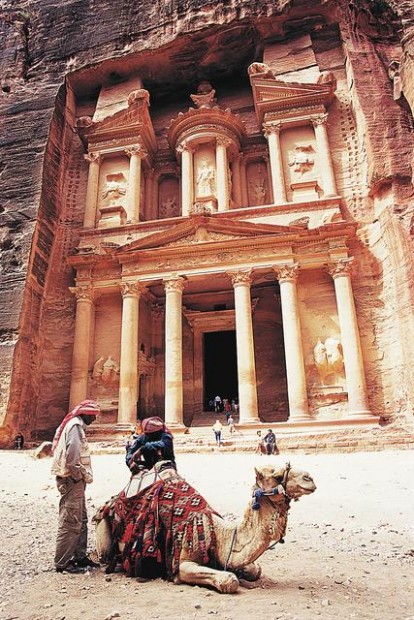
On July 7, Petra was declared one of the New Seven Wonders of the World. Hewn from towering rock walls of multicolored sandstone, the fabled ancient city is an enduring testament to the vision of the desert tribes that sculpted it. The imposing facades of its great temples and tombs wow first-time and repeat visitors.
Indeed, just ask the famous archaeologist Indiana Jones, who deduced that the city was the final resting place for the Holy Grail. The last shot of "Indiana Jones and the Last Crusade" may be Petra's iconic Al-Khazneh, or the Treasury, but just to set the record straight, the city lies in southern Jordan, not the kingdom of Iskandria.
Hollywood aside, the "Rose-red city half as old as time" was built by the Nabataeans, Arabs who dominated the region in pre-Roman times. They chose Petra as their capital, concealed it from the outside world and fashioned it into one of the Middle East's most remarkable cities. The ancient city is approached via the Siq, a canyonike passage that is actually a single block that has been rent apart by tectonic forces.
People are also reading…
The Siq can seem to continue forever, and the sense of anticipation builds as you look around each corner for your first glimpse of the Treasury. Tucked away in such a confined space, the Treasury is where most visitors fall in love with Petra. The Hellenistic exterior is an astonishing piece of craftsmanship, with the sophistication, scale and grandeur that helped make Petra a UNESCO World Heritage Site in 1985.
Heading toward the ancient city center are more than 40 tombs and houses built by the Nabataeans and colloquially known as the Street of Facades. Continuing along, you'll reach a Roman-style theater, which was built more than 2,000 years ago and had a capacity of about 3,000 in 45 rows of seats.
The Wadi Musa riverbed widens out after the theater. To the right (or north), carved into the cliff face, are the impressive burial places known collectively as the "Royal Tombs." There are more tombs dotted around Petra than any other type of structure, and for years archaeologists assumed that the city was just one vast necropolis. The simple reason so few dwellings have been discovered is that the Nabataeans lived in tents, much like some Bedouin do today.
One of Petra's most magnificent sights is Al Deir, or the Monastery, reachable via a one-hour slog uphill from the Colonnaded Street (Cardo Maximus). Similar in design to the Treasury, the imposing Monastery — approximately 164 feet wide and 147 feet high — is just as impressive. Built in the third century B.C. as a Nabataean tomb, the Monastery gets its name from the crosses carved on its inside walls, suggesting that the building was used as a church in Byzantine times.
For an especially magical way to see the old city, Petra by Night (a two-hour tour on Mondays and Thursdays) takes you in silence along the Siq, lined with hundreds of candles, to the Treasury, where traditional Bedouin music is played and mint tea is served.
Getting there: Royal Jordanian Airlines (www.rja.com.jo) has daily flights connecting several North American cities to Amman, Jordan's capital. From Amman, minibuses and private taxis travel daily along the Desert Highway between Wahdat station and Petra's base town, Wadi Musa (Valley of Moses).
Where to stay: In Wadi Musa, the Cleopetra Hotel is a popular backpacker spot offering inexpensive, no-nonsense private rooms and the obligatory nightly screening of "Indiana Jones and the Last Crusade." The Amra Palace Hotel (www.amrapalace.com) is a bright, modern, midrange hotel complete with an outdoor pool, summer terrace, Jacuzzi and Turkish bath. Located 100 yards from the entrance to Petra, the luxurious Moevenpick Resort Petra (www.moevenpick-petra. com) is heavy on the Mediterranean stylings, with a beautiful swimming pool, rooftop gardens, a Middle Eastern library and a whole slew of on-site bars and restaurants.
Where to eat and drink: Dine on hummus, falafel and shawarma with the locals at Al-Adandi Quick Restaurant in Wadi Musa, which has Jordanian staples at rock-bottom prices. To quaff a cocktail in a 2,000-year-old Nabataean rock tomb, look no farther than the Cave Bar, located behind Petra's visitor center.


