

VANCOUVER, British Columbia — Three young ladies in minimal dresses with maximum cleavage were not happy with their back corner table in the Elixir bistro in Vancouver's fashionable Yaletown area.
"They wanted to sit at the same table Pamela Anderson sat at," said maitre d' Mikel Kanter, who complied with their wishes and led the entourage to the center table. "Looked like Yaletown-a-go-go," he said a bit later.
Over cocktails and an appetizer of french-fried olives stuffed with anchovies, Pamela Groberman, who represents the sleek restaurant on the ground floor of the equally chic Opus Hotel, confirmed that the other Pam did, indeed, visit the restaurant during her frequent trips back to her hometown.
Outside the restaurant's windows, the streets of Yaletown, a former warehouse district, were coming to life as the young and restless prowled the several blocks of bars, cafes, restaurants and coffee shops on every corner.
People are also reading…
This town is cranked on coffee.
The Province, a local newspaper, had a column of "You know you're from Vancouver when . . ." quips. No. 1 on the list was: "You know more than 10 ways to order coffee."
Perched near the Pacific on the southwest corner of Canada, Vancouver brings to mind the San Francisco of 30 or so years ago with a young, cosmopolitan population and renovated neighborhoods such as Yaletown springing up throughout the city. There's Gastown, Coal Harbour, West End, South Granville, False Creek, South Main, Kitsilano and more. One guide to the city described the former hippie enclave of Kitsilano as "a comfortable, liberal paradise of well-heeled vegetarians."
Vancouver is cool, and not just because it claims the best weather in Canada.
The city is named for a British sea captain, George Vancouver, who spent one day here in 1792. The Hudson Bay Co. set up the first permanent non-native settlement in 1827 and is still busy trading from a location in the downtown core. In another bit of local lore, the Gastown area of cobblestone streets and a famous hissing steam clock is named for a talkative fellow nicknamed "Gassy Jack," who opened a saloon for forestry workers in 1867.
Despite its scenic setting on the Coast Mountain range, on the doorstep to adventure in the wilds of Alaska and British Columbia, Vancouver wasn't really discovered by the rest of the planet until Expo '86, the last world's fair in North America. Twenty-two million people attended during its six-month run, including Prince Charles, Princess Diana, Bob Hope, Bill Cosby, Mikhail Baryshnikov and Jacques Cousteau.
This area of British Columbia's West Coast is known as Lotusland, both for its temperate climate and Asian connections, which began with an influx of people from South China more than a century ago and now includes every Asian nationality. Asian restaurants almost outnumber the Starbucks outlets. You can walk the streets and find Vietnamese pho, Northern Chinese dim sum, Japanese yakitori and Singaporean curries. Oh yeah, endless sushi, too.
Vancouver now is the most expensive city to live in throughout Canada, with the average sale price of a home at $520,686, up 18.3 percent from a year ago.
And it may be getting more expensive. In 2010, Vancouver and the neighboring ski community of Whistler will host the Winter Olympics.
Venues are under construction throughout the city. Outside my room at the Opus Hotel, crews were working on an underground rapid transit train that will link the downtown to the airport on the outskirts. Vancouver is polishing things up for another round of world publicity.
Besides its unending scenery, world viewers will find a tolerant town that knows how to play. On my stay there, the newspaper reported on the trial of a woman charged with openly selling more than coffee at her Vancouver cafe. Her attorney was quoted as telling the judge: The belief that marijuana consumption is OK in Vancouver is "as plain as the proposition that the Earth is round."
As the newspaper quips said: "You know you're in Vancouver when . . . You can't remember: Is pot still illegal?"
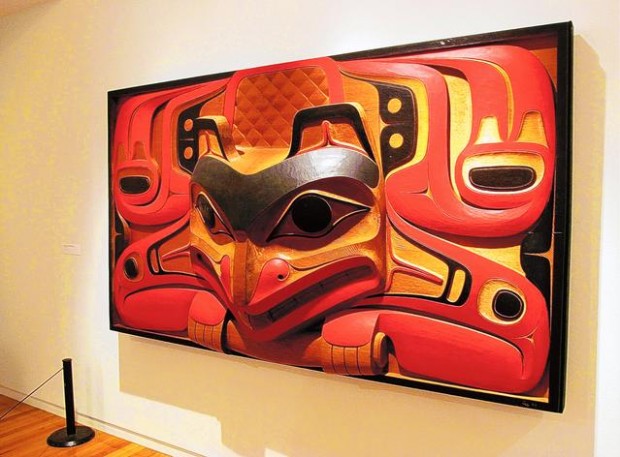
From the time they arrive at the Vancouver International Airport, visitors are immersed in First Nations art. "The Jade Canoe," Haida Indian artist Bill Reid's monumental sculpture of mythical figures in an emerald green canoe, decorates the airport terminal.
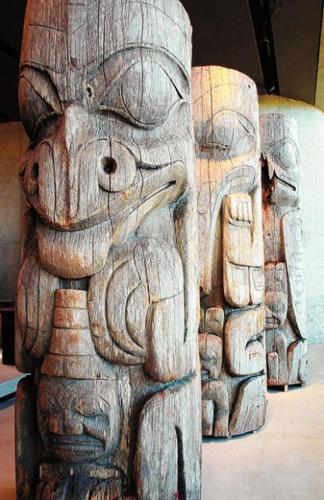
Equally impressive sculptures are found in the Great Hall of the concrete-and-glass Museum of Anthropology on the campus of the University of British Columbia. The museum has one of the world's finest collections of Northwest Coast Indian art and displays huge totem poles in the Great Hall.
With the city surrounded by sea and mountains, there are plenty of outdoor playgrounds. You can sea-kayak, scuba-dive, windsurf, fish, sail, ski or mountain-bike — many on the same day.
One of the more popular tourist attractions is the Capilano Suspension Bridge in North Vancouver. Some 800,000 visitors a year walk the bridge, which hangs 230 feet above the Capilano River and is said to be strong enough to support a loaded 747.
Another top tourist attraction, literally, is the mile-long ride on North America's largest aerial tramway system to the top of Grouse Mountain, 3,700 feet above the sea.
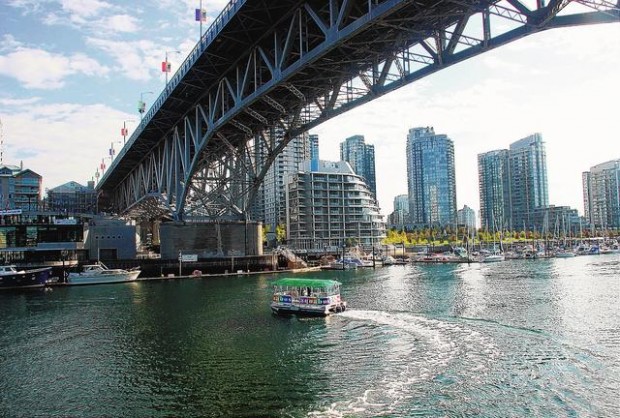
I chose a more leisurely pursuit on my first day and headed off on foot on the Seawall Promenade, a walkway that follows the water around much of the downtown, including Stanley Park, where evergreen forests and open green spaces fill the tip of the peninsula that holds the city. The park is home to the Vancouver Aquarium.
The nearly nine miles of walkway around the park is a favorite with joggers, dog walkers and in-line skaters, and offers the occasional sculpture, totem pole, flock of seabirds and view of the 70-year-old Lions Gate Bridge. The arcing bridge was built by the Guinness Brewing Co. and is billed as the most beautiful in Canada.
The Greater Vancouver Convention and Visitors Bureau is at www.tourism vancouver.com.


