

Q: What is the weather like on Inauguration Day?
A: Despite the fact that the presidential inauguration has moved from March 4 to Jan. 20 in the course of our history, on a number of occasions it has been strongly influenced by the weather.
Though many blamed the weather for sparking the fever that led to President William Henry Harrison’s death just 31 days into his term, this was almost certainly not the case. In fact, the noontime temperature on March 4, 1841, was 48 degrees with overcast skies and a stiff wind from the northwest.
President Abraham Lincoln’s second inaugural was sparsely attended — though his assassin, John Wilkes Booth, was there — because the day was rainy and cold with a temperature in the high 30s. President William Howard Taft was inaugurated in a blinding snowstorm on March 4, 1909 — a storm that Weather Bureau forecasters had, just a day before, dismissed as a minimal threat.
People are also reading…
Since the date was moved in 1937, the average temperature on Inauguration Day has been lower, not surprisingly, as late January is the coldest time of the year.
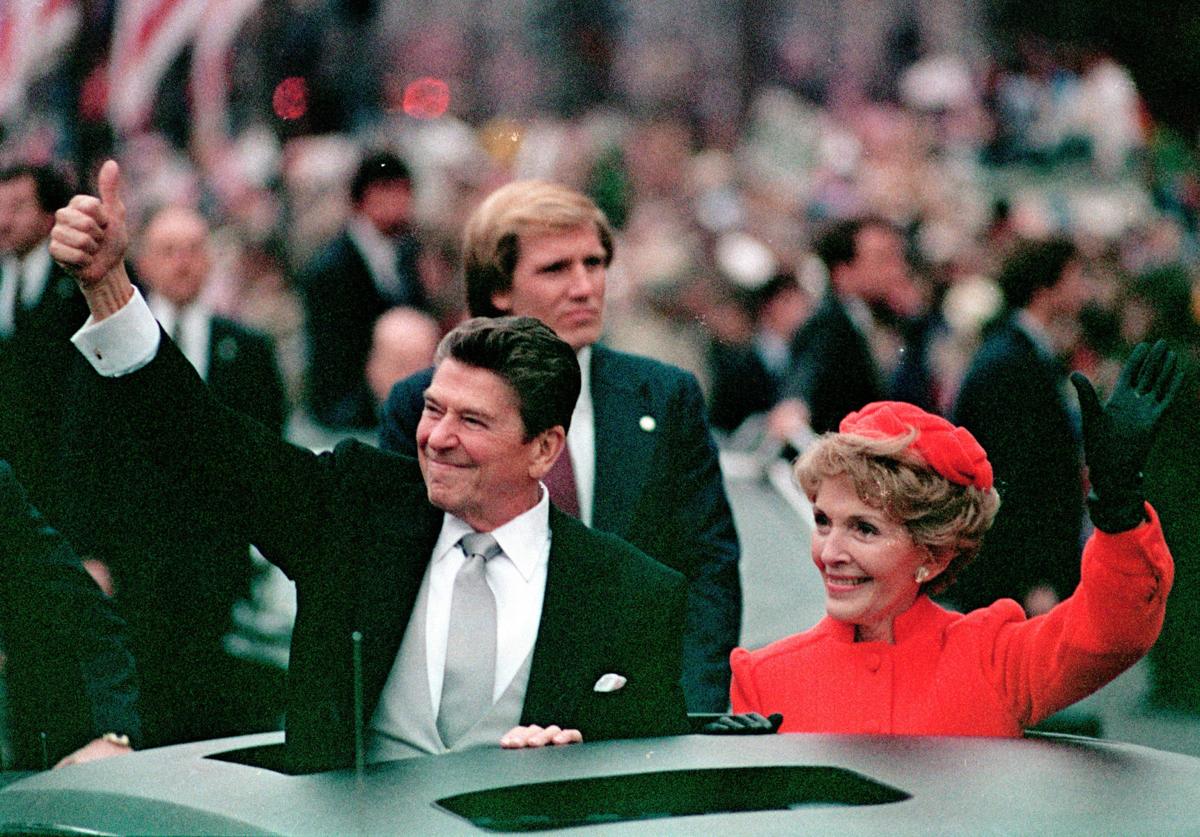
A couple of the Jan. 20 inaugurations have been characterized by notable weather. In 1961, President John F. Kennedy was inaugurated the day after a powerful snowstorm covered Washington, D.C., with 8 inches of fresh snow on a sunny day when the temperature barely reached 20 degrees. In fact, his was the second-coldest Inauguration Day in history, topped only by President Ronald Reagan’s second inauguration on Jan. 20, 1985, when the noontime temperature was 6 degrees after a record-setting morning low of minus 2. As a result of the bitter cold, the inauguration took place in the Capitol Rotunda, and the parade was canceled. In contrast, Reagan’s first inaugural was the warmest of all the January inaugurals, enjoying a high of 55 degrees.
Inaugurations
William Howard Taft inauguration

William Howard Taft, center, wore a big fur-lined overcoat when he reviewed the parade after his inauguration as president, on March 4, 1909, in Washington. At right is James S. Sherman, vice president of the United States, and at left is Edward Hallwagon, chief of the Inaugural Committee. A whirling blizzard, featured by flashes of lighting, as well as rain, snow and a cutting wind, made it one of the roughest of all inauguration days. (AP Photo)
Lincoln inaugural

In this file image, President Abraham Lincoln stands under cover at the center of the Capitol steps during his inauguration in Washington. The scaffolding at upper right was used in construction of the Capitol dome. Historians cite the first inaugural speeches of Thomas Jefferson and Abraham Lincoln as possible parallels for Joe Biden, who has said his goal is to “restore the soul” of the country. (AP Photo)
JFK inaugural

After taking the oath of office, President John F. Kennedy delivers his inaugural address at Capitol Hill in Washington, D.C., on Jan. 20, 1961. Kennedy said, "We shall pay any price, bear any burden, meet any hardship, support any friend, oppose any foe, to assure the survival and success of liberty." (AP Photo)
Barack Obama inauguration

In this Jan. 20, 2009, file photo, Barack Obama, left, takes the oath of office from Chief Justice John Roberts, not seen, as his wife Michelle holds the Lincoln Bible and daughters Sasha, right, and Malia watch at the U.S. Capitol in Washington. (AP Photo/Chuck Kennedy, Pool)
Ronald Reagan, 1985

In this Jan. 21, 1985, file photo, first lady Nancy Reagan watches as President Ronald Reagan is sworn in during ceremonies in the Rotunda beneath the Capitol Dome in Washington. Reagan, forced indoors by a record inaugural freeze, reenacted his oath taking and sounded a second term dedication to his conservative principles. (AP Photo/Ron Edmonds)
"Weather Guys" Steve Ackerman and Jonathan Martin are professors in the University of Wisconsin-Madison department of atmospheric and oceanic sciences.
