

Homegrown solar technology spun off from the University of Arizona's world-renowned astronomy program is finally finding its place in the sun.
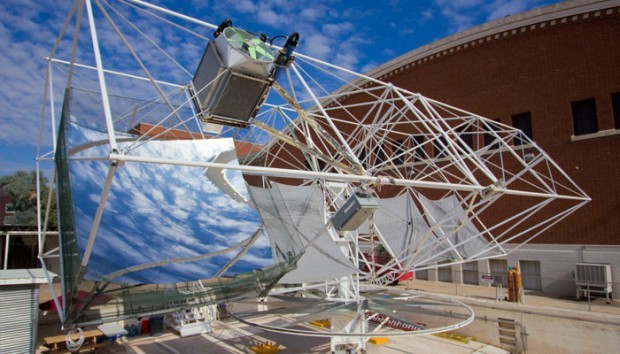
After years of development, a unique concentrating photovoltaic system developed by UA astronomy and optics professor Roger Angel is quietly going up at the UA Science and Technology Park.
And the company created to commercialize the system, REhnu, recently received $827,000 in investments to take its technology to the next level.
But first, the system must prove its worth at the UA Tech Park's Solar Zone technology demonstration park, where a single, 20-kilowatt REhnu solar system is now being installed.
Though there's been no formal announcement of the project, Angel said the installation should be up and running in the next few months.
People are also reading…
"We're in a transition, out of the lab and into the realm of the commercial market," Angel said recently at the site of his latest prototype, undergoing tweaking and testing on the UA campus.
Drawing heavily on the UA's optics and astronomy expertise, Angel's design uses mirrors to focus and concentrate sunlight up to 1,200 times on a spherical lens, which transmits it onto an array of ultra-high-efficiency photovoltaic cells.
The Solar Zone installation will start with one system of eight mirror arrays and collectors on a tracking mount. The 5-acre site has room for 42 individual systems, for a total output of 840 kilowatts.
Former UA President John P. Schaefer, who recently became CEO of REhnu, said the company plans to raise $1 million in investments this year and $25 million in coming years to build out the entire Solar Zone site and further develop the technology.
In the private company's recent investment, detailed in a Securities and Exchange Commission filing for REhnu Inc., 15 investors ponied up a total of $827,149 at the end of December in exchange for equity stakes in the company.
Raising the bigger, venture-capital money would seem no easy task, given the chill that recent events such as the bankruptcy of PV maker Solyndra has cast over new solar technologies.
But Angel and Schaefer think REhnu presents a compelling opportunity to investors, with a technology designed to be cost-competitive with fossil fuels in the not-too-distant future.
By 2020, REhnu is aiming for an installed cost of $1 per watt, at production volumes, and a levelized cost of energy production - including the capital and lifetime costs of an energy source - of 5 cents per kilowatt-hour, low enough for large-scale adoption without government subsidy.
With the advanced concentrator technology, Angel said, he is working on getting the PV cell cost down to around 15 cents per watt. Together with mirrors and other hardware designed for ease of manufacture, the company should be able to meet the $1-per-installed-watt goal and perhaps spur local manufacturing as well, he said.
"It's a different game, a different architecture, where you're drawing on a lots of established technologies," said Angel, founder and director of the UA's Steward Observatory Mirror Laboratory.
Borrowing from the sky-tracking mounts used for big telescopes, the REhnu system features a lightweight but rigid "spaceframe" built to withstand hurricane-force winds.
The finely balanced system quietly tracks the sun with a chain-driven, circular carriage powered by small electric motors. A relatively simple system of four water-cooled radiators arranged in a box keeps the receiving unit from overheating. The prototype is securely mounted in a 12-foot-deep hole filled with river rock, eliminating the cost of concrete.
"The idea is, the whole thing can be mass-produced at a factory, like you build a car," Angel said.
Contact Assistant Business Editor David Wichner at dwichner@azstarnet.com or 573-4181.
