
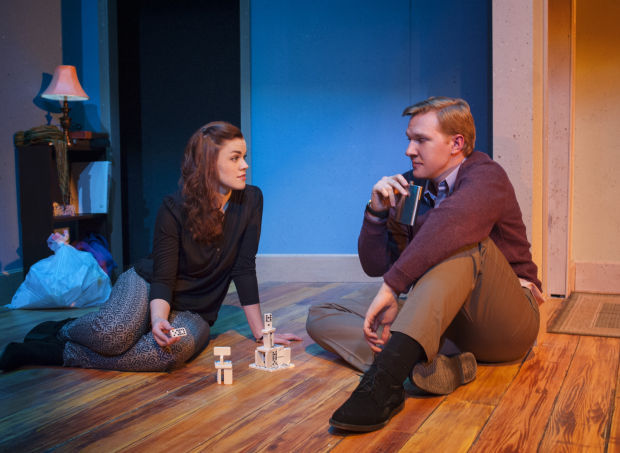
Slices of self-conscious, self-absorbed lives have taken over the University of Arizona Marroney Theatre stage.
“This” by Melissa James Gibson is about a group of friends, on the verge of middle age, facing questions about death, adultery, parenthood and even what they should do with their lives. Facing them; never exploring them.
Really, most of the characters are shockingly vacuous.
Arizona Repertory Theatre’s current production, “This” brings us to New York City. Jane’s (Heather Marie Cox) husband died a year before and she has been too distracted to grab hold of her life, clean her apartment, or pay much attention to her daughter.
Marrell (Rhetta Kampel) and Tom (Zackry Colson) are married, have an infant child, and rather than taking a good look at their problems, they squabble about the amount of water in the Brita bottle. Tom’s response to his unhappiness is to have a one-night fling with Jane, his wife’s best friend. Marrell can’t quite figure out what’s going on in her marriage, so she flirts, becomes obsessed with fixing Jane up, and quibbles with her husband about the most inconsequential things.
People are also reading…
Alan (Micah Bond) is gay, has total recall and hocks the skill on TV shows, and constantly wonders what he should do with his life.
The fifth person in this group is Jean Pierre (Aaron Arseneault), with Doctors Without Borders, working in Africa but in the states for a conference. He only knows Marrell, who decides he’s perfect for Jane. The play opens at the tailend of a dinner party she is holding in hopes the two will hit it off.
Gibson’s dialogue is in starts and stops and has a natural flow to it — one can feel voyeuristic watching the play. She has an impressive instinct for the rhythm of conversation.
And this production, directed by Hank Stratton, features some fine acting. It was easy to imagine these college students were barely on the bright side of 40, and of their connection to each other.
But, really, it’s hard to care about these characters. They so rarely get outside themselves — which is understandable, given their age and situations, but not particularly enjoyable to watch. And in the end, there’s no satisfaction, no illumination. Jane has a small epiphany late in the play, but it feels thrown in.
There is one scene when all five are together, and the four longtime friends are bickering. Marrell begs Jean Pierre to help her resolve a problem, insisting it’s important. No, he says, this is important, waving around a manila folder full of Doctors Without Borders information.
Of course, he’s right.
But perspective is something these old friends don’t seem to have much of.
Earlier in the play, Jean Pierre has a long phone call. He speaks angrily and long, in French. Clearly, the other four, who stop to listen, have no idea what transpired. (Arseneault received applause at the end of the call — and rightfully so, his anger, and his prolonged conversation in French, were impressive).
When he hung up, the only comment was “Maybe you should call them back.” Not, “is everything ok?” “Can we do anything?” “Are you alright?”
It’s especially disturbing if you know what Jean Pierre’s conversation was about: An ambulance was fired on in Africa, threatening his fellow humanitarian workers and their patients. If you don’t know French, you haven’t a clue what was said.
Perhaps putting that phone conversation in English might have too obviously underscored the triviality that defines the other characters’ lives. But delivered in French? It sort of makes you wonder why it’s even there, other than to show how nearly solipsistic the others are. And there are so many examples of that.
Yup, there are mixed feelings about this play. But not about this production. It has a solid cast, clean direction, and a great set (by Alyssa M. LeBlanc) that’s divided between two apartments, each with a distinct personality.