
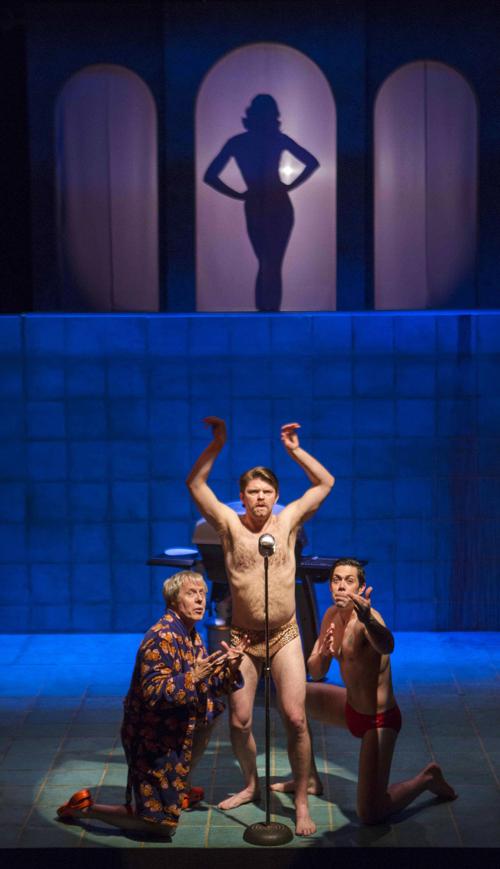
The testosterone is thick and hangs heavily over the stage in the Rogue Theatre’s powerful production of “Penelope.”
It is sweaty, desperate, hungry and gloriously intoxicated with words.
The Enda Walsh play is also slapstick, tragedy, ill-mannered, existential and heartbreakingly tender.
You may be lost at times, you may be prone to tears one moment and laughter the next, you may wonder what it all means. But what you are unlikely to do is leave the theater putting the experience of “Penelope” behind you. It follows you and sticks with you. It will not leave you alone.
Much of that, of course, is due to Walsh’s strange, poetic script about the last of the suitors vying for the affection and bed of Penelope. They’ve been there 20 years — ever since her husband, Odysseus, marched off to do impressive battle in the Trojan War.
People are also reading…
Once there were 100 men wooing Penelope from the bottom of an empty pool on her estate. Now, there are just four. And they’ve all had the same dream: Odysseus is on his way home and he will rip their spines out and roast them on the broken barbecue that mysteriously joined them at the pool bottom a few years back.
The only way to be saved: If one of them wins Penelope’s heart before he returns, Odysseus will have nothing left to fight for.
Christopher Johnson directed this piece so that the men’s machismo and vulnerability hold hands without ever feeling false. He shaped a play that moved with a rhythm and gave it space so that the words are as heavily in the air as the men’s lust for the beautiful Penelope.
All the men are decked out in skimpy Speedos. The swimsuits make them vulnerable, while their words and actions do everything possible to make them seem the mighty warriors that Penelope’s husband is.
The youngest of the suitors is Burns (Eric Du). He has been pushed around by the others and his poor, gentle soul just can’t take it anymore. He longs for connection but knows he’ll never find it amongst this band of not-very-merry men. Quinn (Matt Bowdren) is slick-haired, body-conscious and unbearably cruel. Dunne (Ryan Parker Knox) has a body that has begun to soften and slacken and while not as wide as Quinn’s, he, too has a cruel streak. The senior in the bunch is the book-loving Fitz (Joseph McGrath), who is rarely without his copy of Homer and whose mind is beginning to become as flabby as his body.
One by one, they serenade Penelope (Grace Kirkpatrick) with monologues, Occasionally, moved by the words, she’ll come out on the balcony above the pool, but most often she is seen behind a scrim, casting off a silhouette that looks like an unattainable ’40s pinup model.
Walsh’s writing certainly gave depth and nuance to the characters, but these actors made them breath with intense life.
Adding to that is the set, designed by McGrath. Blue pool tile — it looks real but scenic artist Amy Novelli actually painted it — is bloodstained. The bottom of the pool, where the men live, is chaotic. It has lawn chairs, a table heavy with alcohol, and an air that speaks loudly of desperation.
“Penelope” weaves together ancient mythology with modern man, and makes us ask questions about the truth in love if there is no love in the truth.
See it. See it twice, maybe three times to fully grasp its many layers. But you only need to see it once to recognize that the Rogue has made theatrical magic again.