

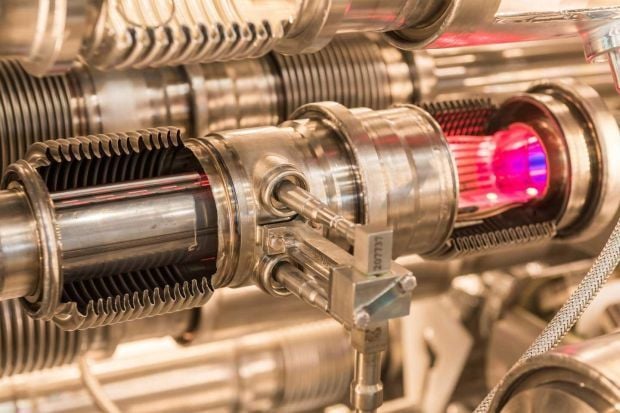
The Large Hadron Collider is about to restart and nearly double the energy of the experiment that produced evidence of the subatomic particle known as Higgs boson.
UA physics experimentalists who helped build the particle accelerator’s largest detector hope this time to find surprises. “It’s been quite a long time in our field since we’ve found something the theorists hadn’t expected,” said UA physicist Erich Varnes.
Physicist Elliott Cheu said surprises should be in store, now that the world’s largest and most powerful physics experiment is ready to run at full force.
The LHC is billed as “the largest machine in the world” by its creators at CERN, the European Organization for Nuclear Research.
Its circular particle accelerator, 27 kilometers (nearly 17 miles) in circumference, lies 100 meters (328 feet) below ground near Geneva on the border of Switzerland and France.
People are also reading…
Its series of super-cooled, giant electromagnets accelerate and steer a beam of particles into collisions at four detectors, including the ATLAS detector that the UA group helped build.
The collisions smash protons into their component parts and leave traces of those elementary particles on the detectors. In its first run, which ended two years ago, it reached speeds approaching the speed of light at energies of 8 trillion electron volts (TeV).
This time, its operators plan to operate first at 13 TeV and, if all goes well, ramp up to 14 TeV.
“The thing that is significantly different is that the LHC will finally be able to operate at its design energy,” said Cheu.
That will produce “particles with higher masses” than found in the first run, he said, providing the opportunity for discoveries of new phenomena.
“The Higgs (boson) was a great discovery, but in some sense we were discovering something many people expected would be there.”
Cheu expects the upcoming years will shed light on the “dark matter” that is theorized to make up most of the matter in the universe.
The LHC, in essence, can recreate conditions that existed shortly after the Big Bang, he said.
The higher energy of Run 2 will also aid the UA ATLAS group in its search for “vector-like quarks,” said Varnes.
This theorized new class of particles, if it exists, could be evident at the higher energy of the LHC’s second run, he said.
The UA Physics Department group, led by John Rutherfoord, includes faculty members Michael Shupe and Kenneth Johns, along with Varnes and Cheu and a cadre of staff scientists, undergraduates and graduate students.
Varnes said most of his work analyzing data from the collisions is done in Tucson. The analysis is divided among thousands of scientists worldwide. About 3,000 scientists are involved with the ATLAS experiment alone.


