


When she volunteered to work in Iraq with the military, defense staffer Emilye Rainwater confronted her mortality in much the same way soldiers do.
Picturing any number of perils, she packed her bags, said a prayer and headed overseas hoping for the best.
It never crossed her mind, she said, that the trip might leave her terminally ill.
Six months after returning to her Sahuarita home, the defense contracting officer now fights for life in a Tucson hospital, stricken with a virulent form of blood cancer.
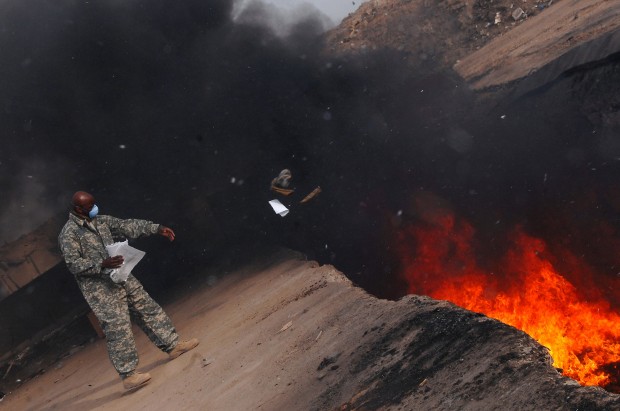
She and others suspect they were poisoned by toxins released when thousands of tons military trash was burned in massive open-air pits in Iraq and Afghanistan.
Rainwater is one of more than 300 troops, civilians and their survivors suing KBR Inc. and former parent firm Halliburton, claiming the Texas-based military contractors ran the burn pits without regard for the hazards they posed to human health.
People are also reading…
"You think, when you go over there, about all the things that could happen. But you never think of something like this," said Rainwater, 41, diagnosed a few months ago with acute myeloid leukemia, a disease that typically strikes men in their 60s. The risk for the illness is known to increase with exposure to toxic chemicals.
Rainwater spoke in a phone interview from Tucson Medical Center after a fourth round of chemotherapy to try to become well enough for a stem-cell transplant, her best chance for survival.
The class-action court case, representing plaintiffs from more than 30 states, contends that many items that could not be burned outdoors legally in the U.S. - including plastic water bottles, PVC pipes, lithium batteries, vehicle tires, styrofoam, paints and solvents, asbestos insulation, and medical waste - were routinely disposed of that way on military bases and outposts overseas.
Hundreds of Americans who went to war healthy and inhaled the burn pit smoke now have chronic problems including respiratory illness, nerve damage, heart problems, nosebleeds, severe migraines, lung cancer or the same form of leukemia as Rainwater, the lawsuit claims.
KBR Inc., in a statement on its Web site, disputes negligence.
The firm says it followed Army guidelines for the location and operation of the burn pits, and paid close attention to the list of items the Army banned from being burned.
Rainwater, one of eight Arizona plaintiffs in the case, served two six-month stints in Iraq as a staffer with Defense Contract Management Agency, overseeing suppliers who provide goods and services to the military.
While there, she lived at Joint Base Balad, Al Asad and Forward Operating Base Warhorse in Baqouba.
Rainwater said she never thought much at the time about the smoky haze that seemed constant in the air.
Her health seemed fine after her first trip in 2008, she said. It wasn't until her second tour a year later that she began to tire easily.
By the time she got home, she felt so exhausted that she went in for medical tests.
"The doctor came in and said 'We know what's wrong with you and it's not good. You have leukemia.' Then he gave me a hug and left," she said.
It was her twin sister, Mickey Rainwater, also of Sahuarita, who scoured the Internet and learned of others who had come home sick.
Congress acted last year to restrict the use of burn pits.
The Defense Department was told to come up with alternatives, and some burn pits have since closed and have been replaced by garbage incinerators.
The federal Institute of Medicine recently began a study, sponsored by the Department of Veterans Affairs, to look more closely at potential health impacts of burn-pit exposure.
Several lawsuit plaintiffs diagnosed with the same disease as Rainwater have already died. She knows she may not survive but is choosing to stay positive.
"I have a very strong Christian faith," she said. "So I believe that whether I live or die from this, God will use it for a positive benefit."
Contact reporter Carol Ann Alaimo at calaimo@azstarnet.com or at 573-4138.


