

PHOENIX — State lawmakers should stop fighting public schools in court and come up with the money the schools are due to compensate them for inflation, Gov. Jan Brewer said Wednesday.
Brewer said she supports efforts by the schools to reset state aid to where it would have been had the state properly funded a voter-mandated inflation formula. That figure, according to Maricopa County Superior Court Judge Katherine Cooper, would pump about $317 million immediately into public schools.
Brewer said there’s another reason lawmakers should end the legal battles: A settlement now avoids the possibility that a court could rule schools are owed a lot more, notably the $1.3 billion they say they have coming for the years lawmakers did not properly fund the inflation formula.
Brewer’s suggestion is likely to fall on deaf ears at the Legislature.
People are also reading…
Rep. David Gowan, R-Sierra Vista, likely in line to be the next speaker of the House, said he considers any move now to end the 4-year-old lawsuit to be premature.
He acknowledged the risk that a final court judgment could be much larger. But, Gowan said, “We’re letting the process play out.”
Senate President Andy Biggs, R-Gilbert, also objects to signing off on the $317 million owed to schools this year, with that higher base carrying forward from now on.
Biggs said he is open to a deal. But if there is one, he thinks it should be closer to $80 million.
A 2000 voter-approved measure boosted the state’s 5 percent sales tax by six-tenths of a cent through June 30, 2021. It also requires the Legislature to forever increase funding for schools by 2 percent or the change in the gross domestic price deflator, whichever is less.
Brewer acknowledged her own role in shorting the schools. Beginning in 2010 she signed a series of state budgets which were “balanced” by a decision not to fully fund the inflation formula.
“During difficult times we had to do some difficult choices,” she said.
“But the bottom line is, we need to fund our education system. And they need to figure out some way in order to do that.”
The “they” does not include her, as her term is up at the end of the year.
That puts the problem in the hands of either Democrat Fred DuVal or Republican Doug Ducey, competing to succeed her.
Both have said there’s enough in the state’s “rainy-day fund” to take care of the first year’s cost. But neither has outlined a specific program for the more than $320 million in unexpected expenses the year after that, and each year beyond.
“As governor and as lawmakers, that’s your responsibility to figure out how you’re going to do it,” Brewer said.
She offered no specific advice. But Brewer said in her own bid to keep education funding from being cut even further, she persuaded voters in 2010 to approve a temporary 1-cent hike in state sales taxes.
“I had to do some things that I thought maybe I couldn’t do,” she said. “But I realized it wasn’t about Jan Brewer,” she said, “It’s about our state. It’s about our education system.”
Biggs said voters did have a chance to make that 1-cent levy permanent two years ago, with a plan to divide up the money among K-12 education, community colleges, universities and road construction. But he pointed out that was soundly rejected, with even Brewer in opposition, and the levy expired last year.
“The economy is really slammed,” he said, explaining his opposition. “The economy hasn’t fully recovered.”
Cooper’s finding that the state owes schools an extra $317 million follows last year’s Arizona Supreme Court ruling that lawmakers illegally ignored the 2000 ballot measure. The state high court left it to Cooper to determine how much was owed.
Biggs figures it’s a lot less than $317 million, based on the fact the state boosted state aid more than was required some years. He contends lawmakers should get credit for that excess, which he estimates at about $240 million.
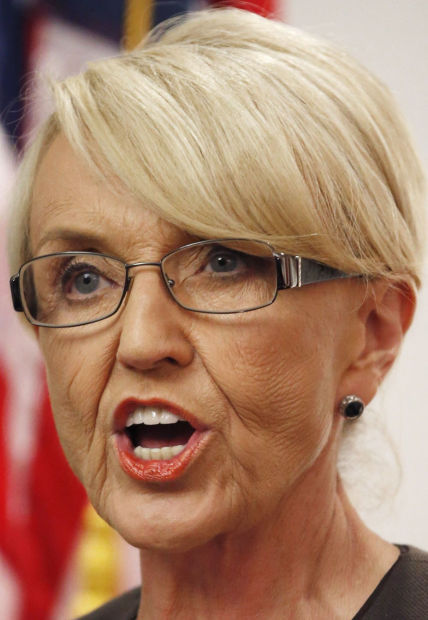
Outgoing Gov. Jan Brewer


