

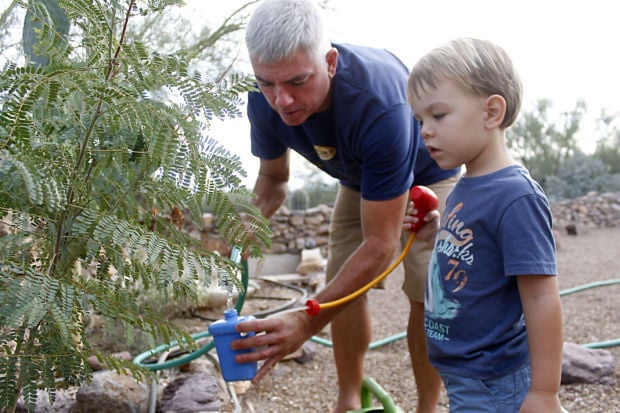
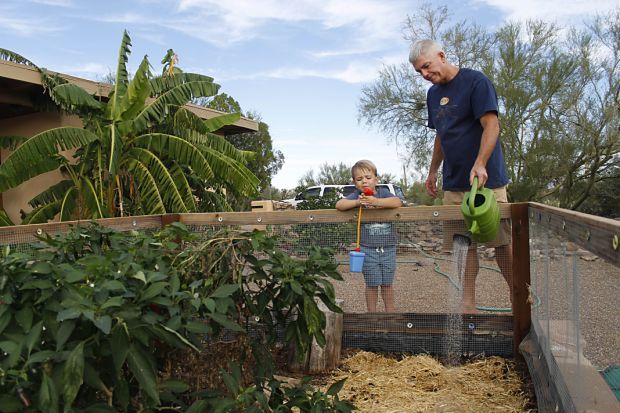
The chile peppers, lettuce and kale growing in a wire mesh pen in Scott Mencke’s backyard garden show rainwater harvesting at its best.
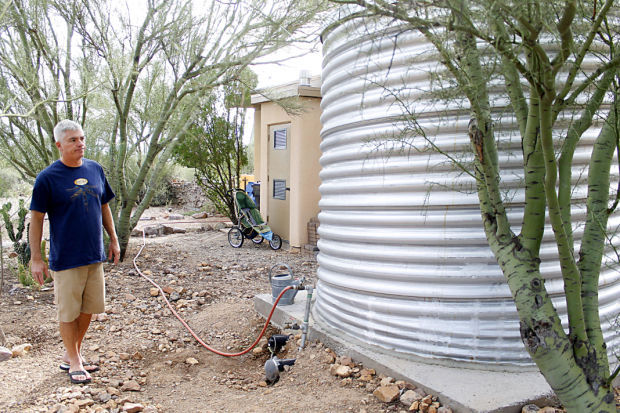
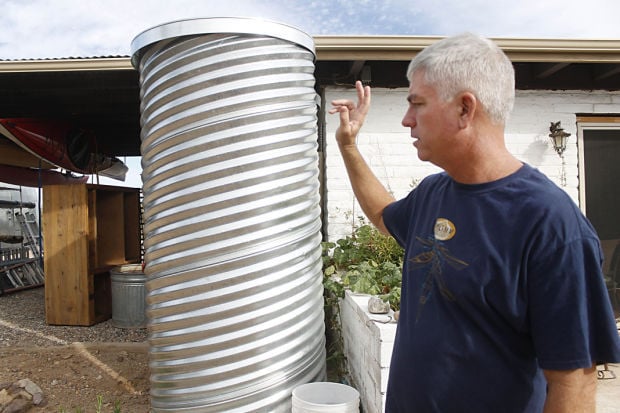
All were nourished with rainwater stored in a 3,000-gallon, 8-foot-tall, 8-foot diameter steel cistern that restaurateur Mencke bought partly with a $2,000 rebate from the city of Tucson.
About 600 homeowners in the past two years have received such rebates, which were approved to promote water conservation — and many more may get them if the Tucson City Council decides to expand the program at its Wednesday meeting.
But despite collecting rainwater to irrigate their yards, those in the rebate program haven’t reduced their use of city water, Tucson Water says.
For the moment, that paradox isn’t on the table at the City Council. On Wednesday, the council will discuss expanding the harvesting rebates from homeowners to small businesses and people who carve curb cuts in front of their homes to draw in storm runoff from the street.
People are also reading…
In a memo advocating the expansion, council members Paul Cunningham, Regina Romero and Karin Uhlich say Tucson is “ground zero for climate change.” As temperatures keep rising and the periods between big rainstorms keep increasing, expanded use of rainwater harvesting should be a top priority, they say.
Tucson Water, originally dubious about water harvesting, doesn’t oppose the expansion. But the utility says in a new draft water conservation report that it doesn’t consider the rebates a success. The harvesting rebate program is the least cost-effective of eight city water conservation rebate programs, the utility says.
The utility’s view frustrates supporters of the program, like Mencke, who say it needs more time and better public education to succeed.
“I think we should capture whatever water we can and conserve what we can within reason,” he says. He, like many people who harvest rainwater, say they landscape their yards and grow food for their families without using drinking water.
Cunningham says Tucson Water’s methodology needs revising.
“Rainwater does not flow through a meter, so the water savings can’t be measured the same way as a low-flow toilet,” he says. “We have a 10,000-gallon tank at the Ward 2 (council) office. When it is full, we use it on our landscape. That’s 10,000 gallons of water not running into the street and 10,000 gallons of water we don’t have to use from the tap.”
Backers say the utility’s focus on water conservation ignores rainwater’s many other benefits, not least that it’s free and unlike city water, requires no energy to pump it from the ground or uphill from the Colorado River.
This debate could continue at least until next June, when Tucson Water makes recommendations as to whether the homeowner rebates should continue.
Mindful of usage
Mencke’s attraction to water harvesting stems from his boyhood, growing up in the Avra Valley northwest of Tucson. As a young teen, he went with his stepfather on a weekly 1.5-mile drive from their house to a community well, where they filled 55-gallon drums with water and put them in a pickup.
“It was a pain to do it,” he said. “It made you pay attention to how much you use.”
Now 48 and part-owner of Fini’s Landing, a seafood restaurant and bar in the Catalina Foothills, he, his wife and son live on two acres. When they moved in, “our backyard was bare. We were surrounded by all this beautiful landscape, but it was just empty. It wasn’t a nice place to hang out.”
He wanted a garden because “I like to grow my own food as much as possible,” he says. Even without cisterns, he would have planted things anyway, he said.
Harvesting rainwater is “something that everyone in this town should do,” he says.
“Relatively low benefit”
Tucson Water officials point to its conservation program’s objectives to explain why they don’t see the harvesting rebates as a success. The objectives include strengthening the community’s water conservation ethic and insuring that adequate water supplies are available to meet customer demands and public health and safety needs.
To calculate effectiveness, the utility uses a cost-benefit analysis. Of the eight water conservation rebates, only those for high-efficiency, low-flow toilets pass that test, the utility’s conservation report says. The rainwater harvesting rebate, costing $702,000 over two years, is the second most expensive rebate program, the report shows.
“The water harvesting rebate program has a relatively low benefit to the utility and a very high benefit to the participant,” the report says.
The utility’s assumption that rebates encourage more plantings is backed up by a questionnaire this fall from Councilwoman Romero’s office. It got 300 emailed responses out of the 656 people surveyed. About 45 percent said they had added landscaping or fruit trees after getting rebates.
The utility has an ally in Val Little, director of the Water Conservation Alliance of Southern Arizona, which represents Pima County and several suburban water utilities.
“If the goal of Tucson’s rainwater harvesting program is customer outreach and education it is probably OK as such,” Little says. “If the goal is to reduce residential per capita water use, it is a dubious effort.”
Romero, however, says the harvesting program, by shading people’s yards, combats the urban heat island effect caused by pavement. It helps flood control, by keeping stormwater off the street, she says.
“Water harvesters are also ambassadors to friends and family about water conservation and smart use of our existing resources,” Romero says.
Sales pitch at classes
Supporters and detractors of water harvesting agree that data is needed to evaluate the program’s success.
“The better the data, the better we can design the system,” says Brad Lancaster, Tucson’s leading water harvesting advocate, and a strong supporter of the rebates.
He and the nonprofit Watershed Management Group, which installs harvesting systems, want to tailor the size of some rebates to the type of trees planted and the amount of shade they grow, he says.
“More money for water harvesting systems with lower water use and native shade trees” is his prescription.
He’d also like to give rebate recipients more incentive to conserve water. One way is for people to get half their rebate at the start, and the other half after proving they’ve saved water, he says.
Lancaster and others, including rebate recipient Ron Tolf, say the rebates need more time to work. Recipients must take a class on harvesting rainwater, but Lancaster and Romero say the classes should deliver a more consistent conservation message.
Some class lecturers run businesses that install harvesting systems, and “we got a number of responses from people saying they felt like their class was a sales pitch,” Romero says. “We also heard ... that some of the classes were really having people size their installations to the bare minimum (or) to maximize the rebate size, not water savings or water collection.”
Tolf installed two 1,100-gallon cisterns at his southwest-side house last year thanks to rebates. He saw no savings in his water bill through the first half of 2014 because he got little or no rain.
From July through October, however, monsoon rains cut his bill by a range of 10 to 66 percent monthly from a year earlier, even though one more person lives at the house now. The cisterns support mesquites and other landscaping on his one-acre lot.
“Is it what I wanted? No. I was expecting more,” he said. “But at the same time I haven’t had time to fine-tune my system.”
Contact reporter Tony Davis at tdavis@azstarnet.com or 806-7746. Follow Davis on Twitter@tonydavis987.

Tony Davis
Reporter


