

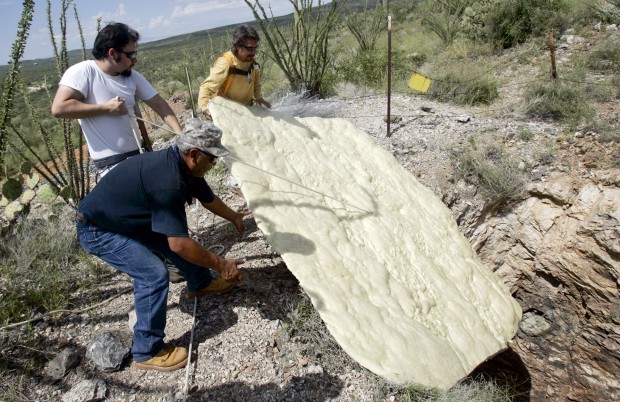
The huge blob of yellowish material looked like a surfboard, or maybe like a crudely shaped omelet.
Instead, it was a slab of polyurethane foam, lying next to a field of ocotillos and saguaros, ready to be lowered into a 50-foot-deep abandoned copper-mine shaft - the first step toward making the mine safe.
Workers on a federal contract spent Friday and Saturday at Saguaro National Park East pouring foam into what was part of the Mona Mine complex nearly a century ago. The mine area now sits inside the park.
The idea behind the work, said park official Meg Weesner, is, "You want to make a plug in the mine - it's like putting a cork in the top of the shaft."
The hope is that with the shaft filled, people won't fall in. On top, the shaft opening is about 80 square feet.
People are also reading…
This is one of nine old mine shafts and other mine openings in the national park that are being filled or given new barriers to keep people out.
Three are in Saguaro Park East in the Rincon Mountains. The rest are at Saguaro Park West in the Tucson Mountains. Most of the sites were mined for copper or at least explored for copper from the 1860s to the 1950s, park officials say.
By mid-October, the National Park Service will have spent about $350,000 on this work, having hired five contractors and subcontractors, including the Arizona Game and Fish Department and two Tucson companies, to handle various tasks.
Foam will be used at four sites. At others, crews will use shovels and picks to backfill old mines with material on site. In others, where bats are known to congregate, they'll build steel bat gates with openings large enough to accommodate bats while keeping people out.
The park service spent an additional $324,000 from January through April this year fencing off more than 100 mine sites in Saguaro park, most in the western district, to keep people out.
All the sites are being fenced, and the foam and other materials are designed to provide extra barriers.
Money for the projects came from the American Recovery and Reinvestment Act, better known as federal stimulus funds.
The law, passed in 2009, allocated another $418,000 for planning and sampling for hazardous materials for a possible future cleanup of arsenic and lead known to be contaminating the Old Yuma Mine in the Tucson Mountains in Saguaro park.
"The mines are a serious safety problem, and the park is really glad that this funding has allowed us to take care of a few real serious ones," said Weesner, Saguaro's science and resources management chief. "This is the first time we've had the money to do something like this."
The park service and the U.S. Bureau of Land Management were warned of safety problems with abandoned mines in a stinging July 2008 audit report from the Inspector General's Office of the U.S. Interior Department, the service's and bureau's parent agency. After visiting 45 areas - not Saguaro National Park - with abandoned mines auditors concluded that "BLM and NPS are putting the public's health and safety at risk by not addressing hazards posed by abandoned mines on their lands ... Mines located on lands primarily in the western states of California, Arizona and Nevada have dangerous physical safety and serious environmental hazards."
At least 12 people died in accidents at abandoned mines on all private and public lands in the western United States between 2004 and 2007, the report said.
Saguaro park authorities know of only one abandoned mine accident causing a serious injury, when a youth was rescued after falling 40 feet down a shaft in the Tucson Mountains in the early 1970s.
"We've been incredibly lucky" that no one has died at Saguaro National Park, Weesner said.
The 50-foot-deep shaft in Saguaro National Park-East is one of the deeper openings being filled.
On Friday, six workers from the various contracting and subcontracting firms were on hand to work with the foam.
First, they pulled plastic bags of foam-producing chemicals from boxes weighing nearly 75 pounds. Then, they pulled out dividers in the bags that separated the chemicals, allowing the foam to form.
Next, Tony Nava, a general manager for the national contracting firm NFI Inc., poured the foam material onto a plastic tarp, where it quickly hardened and expanded into a layer 3 or 4 inches thick.
Then, four workers lifted the slab into the air to harden it. Then, holding the foam slab up with ropes, the crew tried to gingerly lower it into the shaft. The first three tries, the foam was too wide, forcing the crew to slice off sections with a small knife.
Finally, they eased the foam in, but a space remained. The gap had to be filled with another piece of foam.
Before the threat of rain forced them to stop work, the workers had poured about about 3 feet of additional foam on top of the initial layer. Once the foam is in place, dirt is used to fill in the last several feet of the mine opening, which prevents someone from entering the shaft.
When the foam has hardened, "it will be strong enough to support an 18-wheeler truck," said Nava.
The plan is for workers to fill in all three of Saguaro East's mine shafts by the middle of the week.
At the same time in the Tucson Mountains, two mine openings are being filled now. The crews will soon depart for Coronado National Memorial south of Sierra Vista, where they'll spend a month tackling some of its 36 old mines.
They'll be back at Saguaro National Park in October, to fill in the last three mines in the Tucson Mountains. Then, some will go to Death Valley National Park in California to take on more abandoned mines.
Contact reporter Tony Davis at tdavis@azstarnet.com or 806-7746.


