

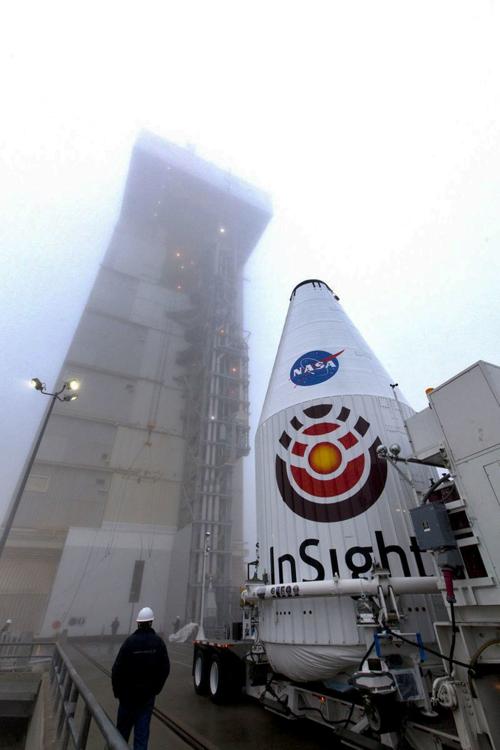
Mars rovers Opportunity and Curiosity may have some new company by the end of the year with the launch of InSight, NASA’s newest mission to Mars.
Originally set to launch in March 2016 but delayed because of failed attempts to repair a leak, the latest launch window for InSight (short for Interior Exploration using Seismic Investigations, Geodesy and Heat Transport) opens May 5 at 4:05 a.m.
Set to take off from Vandenberg Air Force Base near Lompoc, California, Saturday’s mission marks a historic first for the space agency: the first-ever interplanetary mission from the West Coast.
Focused on the geophysics of the red planet, InSight researchers hope to probe the depths of the Martian surface for a greater understanding of Mars’ planetary structure and how it and other rocky planets — especially Earth — were born.
People are also reading…
“The goal of InSight is nothing less than to better understand the birth of the Earth, the planet we live on,” said Bruce Banerdt, InSight principal investigator at NASA’s Jet Propulsion Laboratory (JPL) in Pasadena, during a March 29 news briefing. “We’re going to do that by going to Mars.”
Getting there
NASA officials identified Vandenberg as a launch site — most interplanetary missions launch from Kennedy Space Center in Cape Canaveral, Florida — due its less-congested launch schedule. While East Coast missions benefit from proximity to the target planet, the extra power of the Atlas V 401 rocket allows for a successful launch from either coast.
The early morning launch should be visible from most parts of Southern California, and possibly Mexico, for 90 minutes. InSight is expected to reach Mars by Nov. 26, when it will begin its entry, descent and landing phase.
The lander will enter Mars’ atmosphere at 12,000 mph before slowing to a speed of 5 mph at the end of the seven-minute entry period. InSight’s heat shield and parachute will help slow the craft, which will use radar to determine its speed and distance from the ground.
Once close enough to the Martian surface, the parachute will detach,and the lander will drop. The craft will utilize thrusters as it approaches the planet, slowing it down to a safe-enough speed before landing. The legs double as shock absorbers to mitigate any remaining energy.
“We’ve done a lot of testing and analysis to make sure we’ve done everything we possibly can to land safely,” said Tom Hoffman, InSight project manager, during JPL’s March 29 briefing. “I believe we’re going to do that.”
Once settled on the planet’s red dirt, the 3,200-cell solar array will unfold, powering the craft and its residual components. InSight will then begin what Hoffman refers to as its second entry, descent and landing phase — setting up its equipment and components.
Why Mars?
Mars is special.Roughly 33.9 million miles from us, Mars is smaller and less seismically active than Earth, where shifting tectonic plates and mantle convection have altered its original composition.
Now, scientists are turning to Mars to observe what they believe would be the early evolution of a planet.
Equating the scope of the mission to a doctor’s “checkup,” InSight will attempt to take the “vital signs” — seismology, heat flow and radio transmissivity — of the red planet.
“We’ve been studying Mars with orbiters, landers and rovers for years now, discovering and learning much with each mission,” said Thomas Zurbuchen, associate administrator for NASA’s Science Mission Directorate, in a prerecorded message at the March 29 news conference. “We haven’t landed on a planet since 2012, and now we’re ready to go back.”
Carrying two specially designed instruments — a highly sensitive seismometer to measure planetary vibrations and a burrowing heat probe to calculate the temperature of the planet’s core — and an array of antennae, InSight will be the first craft to land on the surface of another planet since Curiosity touched down.
Understanding the red planet’s interior could help scientists understand planetary evolution, how some planets — namely Earth — were formed and, most importantly, how they came to sustain life.
InSight will operate for 720 days before ending its primary mission in November 2020.


