

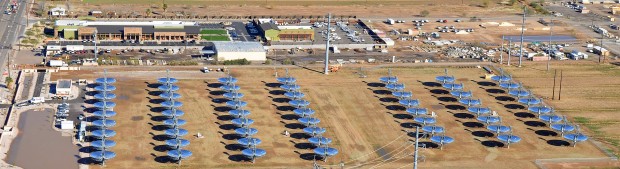
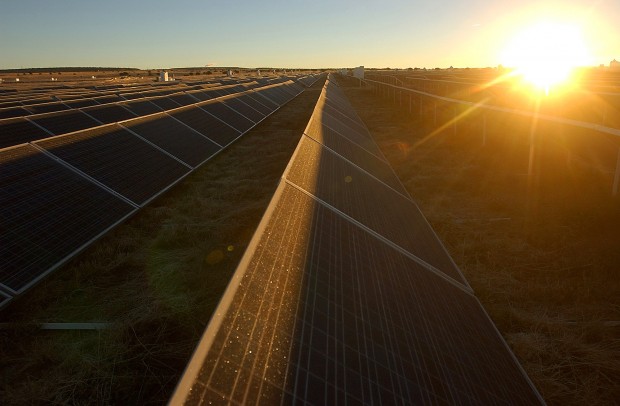
A federal proposal to set aside millions of acres of public lands in Arizona for solar energy pits one form of environmentalism against another.
The U.S. Bureau of Land Management, calling Arizona "the land of sunshine and opportunity," wants to make up to 4.48 million acres available for solar energy plants occupying 1,500 to 4,000 acres each. The land is mainly desert, mostly in western, southwestern and central Arizona.
The bureau is holding a public meeting tonight in Tucson on a draft environmental impact statement on impacts of solar on water supplies, wildlife and cultural resources.
This proposal has gained support from some solar advocates, who see solar as a fix for the country's dependence on fossil fuels.
"Polls have shown the public feels very, very strongly we should be using more solar," said Monique Hanis, a spokeswoman for the Solar Energy Industries Association, a national trade group. "We can do it on rooftops, but to really make an impact we need to begin replacing traditional fossil fuel plants with solar generating plants."
People are also reading…
But the BLM's proposal draws opposition from wilderness advocates in the Wilderness Society, the Arizona Wilderness Coalition and the Sierra Club, who say they're all for solar energy, but not at this scale.
They note that the BLM's reports show that about 22,000 acres will be needed in Arizona for solar over the next 20 years. They favor a scaled-back solar-energy zone plan of about 13,700 acres of public land, using private land to make up the difference.
They're particularly concerned about solar development of 500,000 acres that these groups consider worthy of being set aside as wilderness. They also are unhappy that the bureau has put 1,000 acres just outside Ironwood Forest National Monument northwest of Tucson in its solar development area.
"Four-point-five million acres is so big it defeats the purpose of providing guidance for where Arizona will develop solar and renewable energy," said Matt Skroch, director of the Arizona Wilderness Coalition. "Abandoned agricultural land, old mines, and other degraded BLM land provide better options for solar development."
Across the West, the BLM is considering classifying 22 million acres in six states as suitable for solar. In California, it's facing lawsuits against six large solar plants approved on public land. But the bureau is particularly enthusiastic about Arizona, calling it "the New Frontier" on a solar web page. It has received 32 applications from companies for solar projects on Arizona public land, although all but three are not likely to be built soon because of a lack of power line capacity to transmit the energy.
"The Arizona desert is prime territory for the use of sunlight to produce energy," the BLM said. "The state has an annual average of 325 sunny days, wide open spaces and an increasing need to locate and take advantage of 'green' energy opportunities."
Kieran Suckling, director of the Center for Biological Diversity, praised the BLM for agreeing to keep all critical habitat for endangered species out of the solar proposal, but added that species don't just need critical habitat to survive. He said the bureau should keep its solar facilities on degraded land close to roads rather than trying to move endangered plants away from the solar facilities.
But if only 13,000 acres are considered for solar, "The question in my mind is, why even go through with the exercise?" countered Martin Pasqualetti, a board member for the educational Arizona Solar Center and a professor at Arizona State University's school of geographical sciences and urban planning.


