

All around her hospital bed were nurses in masks, their hands protected by neon-yellow gloves and carefully holding small sacks of liquid.
For four hours, they injected that fluid into Carlee Hill's body - the same body carrying Carlee's unborn child.
The 23-year-old Tucson woman learned she was pregnant last September, and almost immediately discovered a lump in her neck.
Doctors confirmed the mass was cancer, but they couldn't be sure which type, a distinction pivotal to her survival. She needed surgery, but anesthesia to do a biopsy or remove the tumor during her first trimester could harm her baby.
Her pregnancy had been unexpected, and Carlee found herself facing the scary prospect of single-parenthood on a meager income.
But despite her fears, her decision was swift and final.
People are also reading…
The tumor would have to wait.
PREGNANCY
In early August, shortly after returning from a trip to Disneyland to celebrate her 23rd birthday, Carlee ducked into the restroom of a Walmart store and took a home pregnancy test.
On the white stick she saw a plus sign. Pregnant. She was scared, but optimistic.
This kid, she believed from the beginning, was destined to change her life for the better.
The baby's father, a good friend of Carlee's for several years, respected her decision to continue with the pregnancy, she said, but he was uncomfortable with the idea of being a father himself.
Undaunted, she dived into impending parenthood on her own.
"There are as many ways to be a person as there are people," she said. "Just because I'm not in a relationship or married doesn't mean the baby is going to lack any influence."
Her plan was this: Don't party, work two jobs, save money and build a nest.
To feather that nest, by day she shelved books at the main library in downtown Tucson. At night she worked as a waitress at Grill, a 24-hour downtown diner. Under a neon slogan, "Grill, open later than you think," she juggled orders from hungry drunks who came fresh from last call.
She was tired but pumped up with what she calls the "you-can-do-this, everything-is-going-to-be-great" hormones of early pregnancy.
But as she walked into her shift one night, she noticed something that would threaten to derail all her plans.
THE TUMOR
Mirrors line most of the walls in the old art-deco diner.
Carlee passed them as usual, glancing over to check herself, but slowed and then stopped when she saw it. Just above her left clavicle, a small, hard lump had formed on her neck. When she showed it to co-workers they agreed. It wasn't her imagination.
At an obstetrician appointment three days later, Carlee was sent to the emergency room.
There she had her first ultrasound - normally an exciting occasion for expectant moms. But this one wasn't to check up on her baby; it was to examine something disturbing taking place in her neck.
Doctors were concerned. Carlee asked them to call her mother.
It could be cancer.
As Carlee listened to the doctor, she wished her mom hadn't come.
How dare he? Carlee thought, stiffening her gaze toward the doctor.
"You can't say cancer to my mom," she said sternly. "She's been down that road before."
Six years ago Sharon Hill lost her first husband, Shane - Carlee's father - to cancer.
Carlee didn't want to put her mom on that road again. But she also knew that if it were cancer, her mom would be there for every treatment, just as she had been for Carlee's dad.
"The words 'You could have cancer' were devastating and seemed overly dramatic and unreal," Carlee said. She came up with a new plan: Wait until the baby is born, then have surgery to remove the lump.
SURGERY
But the lump kept growing.
Over the next couple of months, it got so large that Carlee had trouble eating. She had to turn her head sideways as she swallowed to make room in her throat for the food to slide down.
As it grew, Carlee tried to keep working, but her health was deteriorating. Her plan for supporting her baby was falling apart.
Day after day she was plagued with crippling back pain, constant fatigue and profound nausea.
Feeling defeated, she took sick leave from both jobs and moved in with her mother.
Not longer after, the cancer spread into her chest, packing itself against her lungs. Her breathing became laborious and her heartbeat accelerated dangerously to supplement the lack of oxygen. At that time, her mother said, her heartbeat was, "through the roof. … She was like a hummingbird."
For a time, the future grandson her daughter had dubbed Max became Sharon Hill's worst enemy.
"Her baby," she said later, "was screwing up my baby."
"I'm not a big feelings-repressor," she said. "But when I was having bad feelings about Max I was like, 'Push it down. Just push it down.' "
BEFORE SURGERY
The surgery couldn't wait for Max's birth.
In early December, Carlee's second trimester, surgeons at Northwest Medical Center operated to remove the tumor.
"I expected the surgery to be minor, and was confident," Carlee said. "I was too loopy and disconnected to be really worried while we waited to find out what kind of lymphoma the tumor was."
The operation was supposed to last two hours. But after four hours, Sharon Hill was still waiting for a doctor to come and tell her it was over.
At last, a sweaty surgeon emerged. The tumor is out, he said, but it was much deeper than expected. Removing it had damaged nerves in Carlee's neck and her left side now slumped, he told her mother. Also, Carlee couldn't speak louder than a whisper, and doctors said not to expect much improvement.
Her left side repaired itself in time, as expected, and her voice came back, which was not expected.
But other problems didn't correct themselves. One of her pupils retracted when a nerve was severed, leaving it permanently dilated.
Still, there was cause for optimism. The growth that had been pushing against Carlee's trachea was out. After recovery, she would eat and breathe comfortably again.
AFTER SURGERY
Three days after surgery - three days after the mass taken from her neck was sent to a specialist for analysis - an oncologist appeared at her hospital room.
His name was Dr. Donald Brooks, he told her, and he wanted to talk.
Carlee brushed him off.
"Man, you got bad timing. My mom just left," she told him.
"I can't remember anything doctors say to me," she said later. "I'm not paying attention unless it's funny and they are seldom that funny."
What he said was the opposite of funny, but it got her attention nonetheless.
Her cancer was one of several types, ranging from non-Hodgkin's lymphoma, which is fatal in some instances, to Hodgkin lymphoma, also known as Hodgkin's disease, which has a much better prognosis.
He wanted to start Carlee on a series of risky but necessary treatments. As soon as you're stabilized, he said, we want to start chemotherapy.
Chemo used to be considered too risky for pregnant patients like Carlee. But treatment to expectant mothers has more than doubled this decade because researchers have discovered that after the first trimester, chemo drugs can be administered safely, says the National Cancer Institute.
"I was really never scared for me," Carlee said. "My main concern was putting on weight, during extreme morning sickness and chemo-nausea and vomiting, to support Max. While those around me were deeply concerned, especially before the type of lymphoma had been determined, I was very confident.
"I was more worried during chemo."
CHEMO
Christmas was nearing, and Carlee was moved to the oncology ward, where she continued to get chemotherapy.
As people outside shopped and partied, she balanced the side effects of chemotherapy, a malfunctioning face and an uncertain pregnancy.
Despite her grown-up challenges, she felt like a kid.
Dr. Brooks "told me I probably won't be able to go home for Christmas while the 'Charlie Brown Christmas Special' was on," she said. "I just cried and cried at him, 'I don't want to stay at the hospital. … I don't know how I'm going to do this.'"
At her south-side home, Sharon hadn't put decorations on the tree. After visits to the hospital and worrying about her daughter and unborn grandson, she couldn't find it in her at the end of the day.
Knowing this broke Carlee's heart. She tried begging and bargaining, but her doctors wouldn't budge. Until Dec. 23.
"Dr. Brooks came in and he was smiling," Carlee said. "He was like 'Aren't you going to ask me when you get out of here?' "
She left the hospital that day.
Sharon decorated the tree. And she went from seeing Max as a burden to her daughter to seeing him as a miracle.
"The best blessing of Christmas, and the Christmas season," she said, "was finally being able to love Max."
TREATMENT
As the new year dawned, Carlee returned to Arizona Oncology several times a week for chemotherapy and various checkups on her pregnancy.
During each treatment, she was injected with cancer-fighting poisons and a small amount of steroids meant to counter the immediate and intense side effects of chemotherapy. Days later, though, the steroids would wear off and nausea, fatigue and overwhelming discomfort sometimes took over.
Despite assurances that her baby would be safe, Carlee worried about his development. Her fears were eased early in the new year when she went in for a second ultrasound - this time to capture sonograms of her baby, not her cancer.
On the screen she saw a tiny, healthy baby boy. She named him Max Thunder Hill. Her father, who died of prostate cancer, wrote poetry under the pen name 'Shane Thunder.'"
As her pregnancy progressed, and her chemotherapy continued, Carlee and her mom slapped every black-and-white sonogram on the fridge - including those of Max's feet.
One sonogram was labeled "five toes." At just over 6 pounds, Max was healthy and developing normally.
Soon after, there would be more joy.
GOOD NEWS
Tests showed that Carlee had one of the most treatable cancers: Hodgkin lymphoma.
She calls it "the Cadillac of cancers."
"We all did a happy dance when we found out," she said, chuckling.
Despite her good prognosis, Carlee had many complications from the cancer. She underwent a second surgery to treat a sudden staph infection and was hospitalized in February for intense nausea and vomiting.
In order to aggressively fight her cancer, and to address the other health problems she was battling, doctors wanted to induce Carlee as soon as they could, sometime after March.
The induction day would be her son's birthday. Carlee suggested April Fool's Day.
MOTHERHOOD
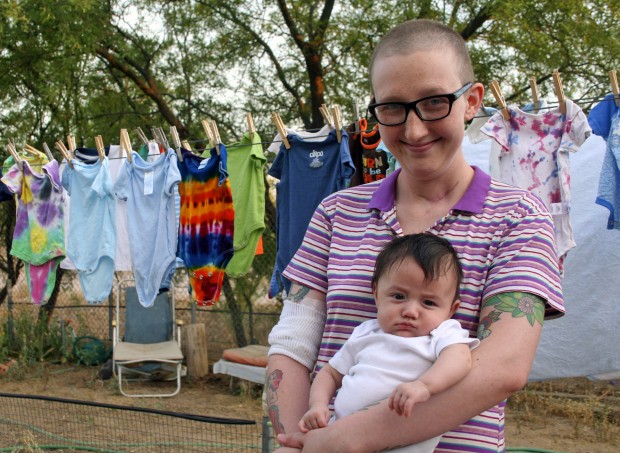
Carlee gave birth to a healthy boy, Max Thunder Hill, on April Fool's Day.
She returns for chemotherapy at Arizona Oncology every two weeks, a regimen she is to continue until September.
She and Max live with her mom, two brothers, sister and best friend. Because of her ongoing health issues, she hasn't yet returned to work and receives help from food stamps and her family. Her medical care is through the Arizona Health Care Cost Containment System, the state's indigent health-insurance program.
She hopes to go back to work, if she can get her doctors' blessing, after Thanksgiving.
In many ways, Carlee is a typical new mom, crazy about her son and loving the time spent with him.
"I'm in love," she said of Max.
But she's not a typical mom. She faced the best and worst of times at once, and the experience changed her.
"I'm really very lucky," Carlee said. "Most new mothers don't get to spend this much time with their babies and, for sure, most cancer patients don't get perfect, healthy babies.
"I can't wait until this Christmas, when I'll be just another healthy new mom. Just like I planned."
Nick Rob Letson is a journalism student at the University of Arizona.


