

The truth, the whole truth, half-truths, shades of the truth and other items admissible as sports news:
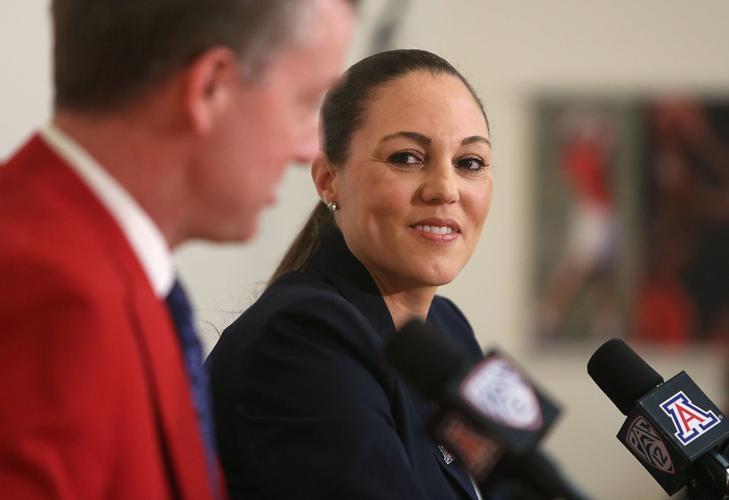
ITEM I: One of the welcome-to-the-world realities that must’ve shaken Arizona women’s basketball coach Adia Barnes during her first work days at McKale Center was that no one had recruited anyone.
The Class of 2016? Zip.
The Class of 2017? Bigger zip.
No wonder Arizona’s women’s basketball program had gone a morose 7-47 in Pac-12 games the last three seasons. No wonder coach Niya Butts was asked to leave.
The school’s recruiting database was that of a program that would go 7-47 for another three seasons unless someone got to work RIGHT NOW.
Today, five months after Barnes was hired from Washington’s Final Four staff, she has given Arizona a future. In short order, Barnes and her assistants have successfully recruited four players that the UA probably couldn’t have touched under Butts:
People are also reading…
- Kiana Chew, a 6-foot, 4-inch shot blocker from Palm Harbor, Florida.
- Marlee Kyles, a 5-7 point guard from Elgin, Illinois, who chose Arizona over, among others, Syracuse, Marquette and Ole Miss.
- Mallory Vaughn, a 6-4 center from Tulsa, Oklahoma, who had been recruited by TCU, Colorado and other D-1 schools.
- Samantha Fatkin, a 5-10 combo guard from the Seattle area, sought by Pac-12 and Mountain West schools.
Barnes earlier was successful in getting another Seattle-area guard, Bria Rice to withdraw from a commitment to Colorado and enroll at Arizona. In addition, Arizona is in the hunt with UCLA and Washington to get Australian power forward Chantel Horvat and Las Vegas forward Samantha Thomas, who has an offer from Michigan.
Barnes and her staff have been on the road so long, working from behind, that over the weekend she posted an Instagram photo showing two of her assistants sound asleep in a car to the airport.
ITEM II: One of Barnes’ leading transactions has been to hire former Tucson High standout Christine Clark to join the staff as a graduate assistant.
Clark, a three-time All-Ivy League guard at Harvard who spent the last two seasons playing professionally in Italy, has relocated to Tucson to assist in the reconstruction of a program that, during Barnes’ UA playing days, 1994-98, went to three NCAA tournaments.
Clark has been a winner every step of her career; she even won the state hurdles championship and set a THS record in the high jump.
Her presence should help change the losing culture in the school’s most unsuccessful athletic program of the last decade.
ITEM III: Four Pac-12 football games were in progress at 2 a.m. Eastern Time over the weekend, which is a TV ratings killer like none other.
Similarly, the backlash from fans is tangible. Of approximately 528,000 available seats at eight Pac-12 home games on Saturday, only one (BYU at Utah) was at capacity, at 46,915.
Total home attendance for the weekend was 420,868, or roughly 78 percent capacity.
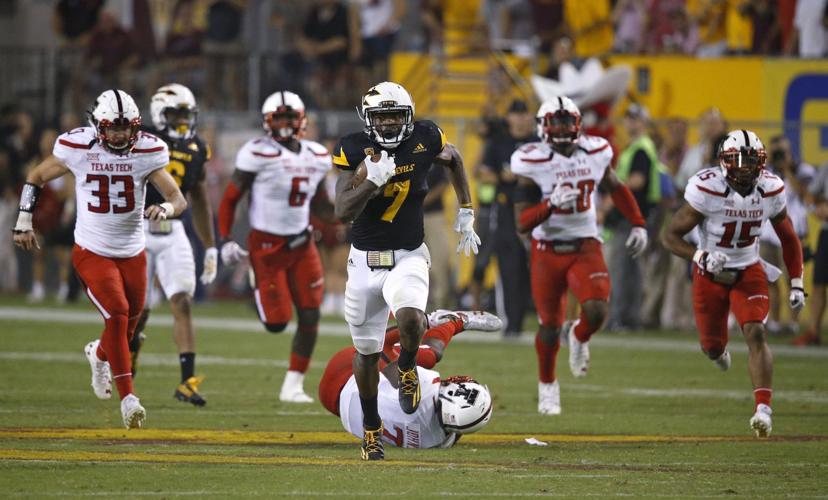
Arizona State reduced capacity by about 15,000 to 56,000 at Sun Devil Stadium, but in the first two weekends ASU drew just 44,511 against Texas Tech and 45,300 for NAU. ASU’s inability to create a steady fan base is probably a 50/50 split: It was 99 and 101 degrees, respectively, at kickoff for those night games. The Texas Tech game required 3 hours and 50 minutes.
That’s just too long.
Even the Oregon Ducks no longer automatically sell out Autzen Stadium. The Ducks have drawn about 58,500 at home for the last 15 seasons, but Saturday’s late game against Virginia drew just 53,774.
Arizona’s last four games at Eugene drew 59,990, 58,368, 58,334 and 56,032.
The league’s most trendy team, Washington, drew 60,678 for an early afternoon kickoff against Idaho. It was 71 degrees at kickoff. Perfect. But there were 9,983 empty seats.
It’s likely that Arizona will challenge its 25-year low of 38,819 (November 26, 2011 against Louisiana) for Saturday’s kickoff against Hawaii. Even though kickoff is scheduled at 7:45 p.m., last week’s game against Grambling State didn’t begin until 8:01 p.m., 16 minutes later than scheduled.
At 12:22 a.m., the Sixth Street Parking garage was in gridlock all the way to the fifth floor. No wonder college football attendance struggles in most places that aren’t in Alabama or Texas.
ITEM LAST: I watched highlights of ASU’s 68-55 victory over Texas Tech, which included an NCAA-record-tying eight touchdowns by junior running back Kalen Ballage.
Two impressions: One, Ballage is a game-changer. He mostly sat on the bench his first two ASU seasons and shares the job with Demario Richard. Both are terrific. The Sun Devils are going to be a tough out all season, able to score enough to beat almost anybody.
Two: modern statistics in the NCAA do not relate to the game from 1950-99.
Ballage carried just 13 times, gaining 137 yards, but will forever be remembered for scoring all of those touchdowns.
Six of those TDs were on short runs of 1, 1, 1, 2, 4 and 7 yards. That’s not immortal stuff. And it came against a historically poor Texas Tech defense that last year yielded 70 points to Oklahoma State, 63 to Baylor and Oklahoma, 56 to LSU and 55 to TCU (including 750 yards).
Not that I’m picking on a Sun Devil. When Ka’Deem Carey set the UA career record with 48 touchdowns, 34 of them were single-digit gains, including 18 of 1 or 2 yards.
If Ballage’s eight-touchdown night is historic, what do you call the November night in 1998 when Arizona’s Trung Canidate scored on touchdown runs of 80, 66 and 48 yards against ASU, gaining 288 total yards?



 Tucson's having a big fast-food reshuffle


