

The first time Sean Miller took the Arizona Wildcats to a game at Oregon State two seasons ago, their midweek journey took about 10 hours after delays, connecting flights and bus rides.
Not surprisingly, perhaps, the Wildcats lost 67-64 to the Beavers the next day.
But those times are over, thanks to the Pac-12's lucrative new media rights deal that begins next season. With about an extra $13 million on average coming in beginning next year, Arizona athletic director Greg Byrne agreed to give the Wildcats up to 12 one-way charter flights this season. The athletic department is mostly self-sustaining and does not draw from public funds.
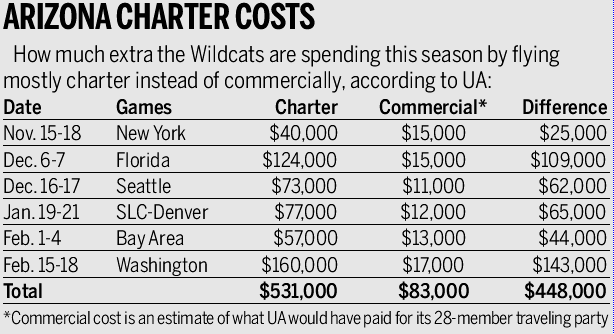
UA figures show the charters will cost Arizona $531,000, or $448,000 more than flying commercial. But the actual difference will exceed $300,000, associate AD John Perrin said, because the Wildcats normally chartered to at least one game along with top-level boosters each season. Despite the extra cost, the Wildcats cite plenty of time-saving and competitive benefits in taking them.
People are also reading…
"Charter flights are something that's awesome for our players," UA coach Sean Miller said.
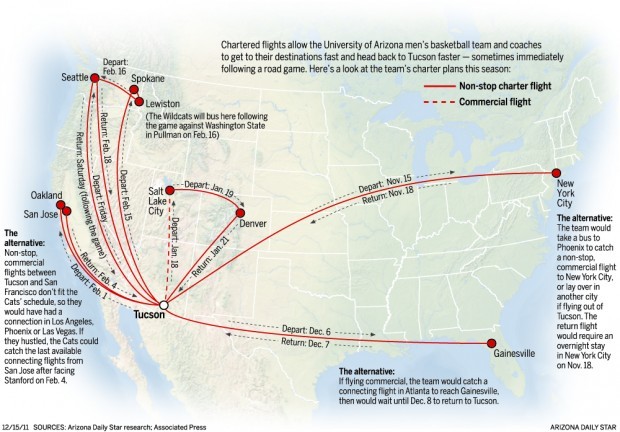
Already this season, the Wildcats enjoyed charters to New York for the 2K Sports Classic and to Florida for a game with the Gators. Arizona also will charter to Seattle this weekend for its game with Gonzaga.
"It makes a huge difference," senior guard Kyle Fogg said. "Just sitting in the airport, waiting forever, having to do connect flights to certain places. And just being able to fly back right after the game and getting a full day's rest as opposed to having to wake up at 4 a.m. to leave the next day."
In the past, the Wildcats chartered only during their booster trip or to the postseason, when the NCAA chips in for expenses.
Now, says Ryan Hansen, the former basketball operations chief under Lute Olson, it's a must for an elite-level team such as Arizona to charter to most games.
Here are five reasons, according to Hansen and UA officials:
1. Saving time
Flying commercial from Tucson often requires a connecting flight, adding time and the additional chance of delay.
During Olson's final years at Arizona, the Wildcats had so many problems catching their connecting flights in Phoenix that they stopped taking them - often riding a bus to Phoenix instead.
Now, the Wildcats won't have to connect in Phoenix or anywhere - and they often will have the extra advantage of using private charter terminals that are faster to get through or smaller airports that are closer to their game. This weekend, for example, the Wildcats will fly into Seattle's Boeing Field, just south of downtown, instead of Sea-Tac International Airport.
2. Quick returns
Thanks to airline cutbacks on late-evening flights in recent years, any tipoff time past 1 p.m. usually meant the Wildcats had to stay over in the city where they played their last game. In most cases, too, they would need to arise early the next morning just to get back by midday - typically on a Sunday that was meant to be their "off day."
Now Arizona will, in all cases, come back after their last game of a trip, arriving in the late evening or early morning hours but with their own beds awaiting them. If returning on a weeknight, the Wildcats can go to classes they would otherwise miss.
And, as a bonus, UA also saves money by avoiding the extra hotel night and meals - up to $3,000-$4,000 per night, according to UA basketball operations director Ryan Reynolds.
"It definitely helps them physically because they get back, and it's a lot easier on their bodies - and it's also a huge help academically," Reynolds said. Normally "on the return flight you would spend the night, wake up between 4 and 6 in the morning to take the earliest flight into Phoenix or Tucson," Reynolds said. "It just makes the day after the game a really long day."
3. The next game
One reason Arizona opted to charter to North Carolina State last season was that a commercial return flight would have left the Wildcats just one full day to prepare for Robert Morris.
The charter flight "has as much to do with these guys as it did North Carolina State," UA assistant coach James Whitford said before that game.
Then the Wildcats beat the Colonials 82-56.
This season, after UA flew home from an overtime game at Florida, the Wildcats hosted Clemson with two full days of practice. The Wildcats struggled briefly but were up by 14 points after 14 minutes and never trailed.
"I felt like had we not chartered, the first-four-minute problem would have been a problem for the first half" against Clemson, Hansen said. "It will also help coming back from Seattle" with a game against Oakland on Tuesday.
Another advantage will come in allowing the Wildcats to move on immediately after their Thursday game in a Pac-12 Thursday-Saturday combo, which they will do after games at Washington State and Utah.
That way, they arrive with a full day to rest and prepare for the next game.
"That day-in-between travel is tough on your body," Hansen says. And, on the WSU-Washington swing, "you get to Seattle, and it's 'Oh, by the way, you've gotta play the Huskies the next day - and in a lot of cases that game's at noon or 1 p.m."
4. Taking care of VIPs
Arizona already invites its top-level "Diamond Wildcats" along on one designated charter flight per season - this year's trip was to Florida - and the additional charters may have a few seats available that can be filled with other top donors or friends of the program.
Bon Voyage Travel, where Hansen now works as the operations director, also used the New York trip to sell packages or individual seats to UA fans.
5. Competition
At Miller's old place, Xavier, the Musketeers routinely took charter flights, as do an increasing number of college teams today.
Those who don't could face a competitive disadvantage in recruiting.
"You have to step up to the level you are competing against," Hansen said. "From a recruiting standpoint, it's showing the prospective student-athletes and their families that you are committed to giving them every possible resource to be successful on and off the court."
Up next
• Who: Arizona vs. Gonzaga at Seattle
• When: 2 p.m. Saturday
• TV; radio: Ch 13; 1290-AM, 107.5-FM


