

SANTA CLARA, Calif.
Words that begin with Z: zilch, zero, zapped, zippered, zyzzyva.
All of them apply to Arizona’s zestless debut in the Pac-12 championship game Friday night.
Zyzzyva? It’s the last word in some dictionaries, a tiny weevil sometimes mistaken for an ant.
On Friday night, No. 8 Arizona was a zyzzyva and No. 3 Oregon was an anteater.
At halftime, someone tried to organize a search party. Where had the Wildcats and their offense gone?
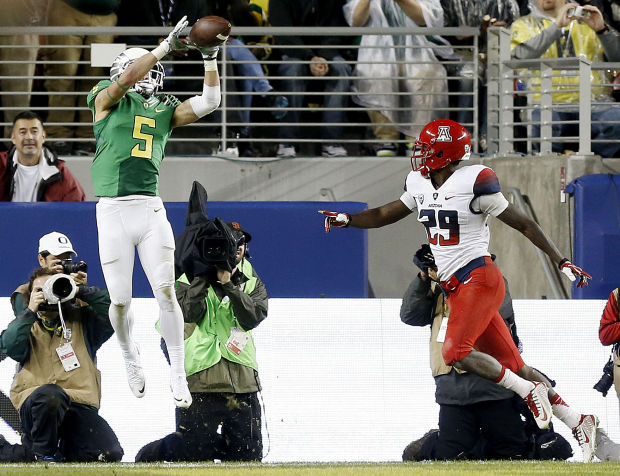
To the analysts who said Arizona had “Oregon’s number,” the number turned out to be 393. That’s the difference in yards between the Pac-12’s division winners. Oregon had 617, Arizona 224.
At one point it was 426 to 44, which seemed more like the final score than the actual 51-13.
People are also reading…
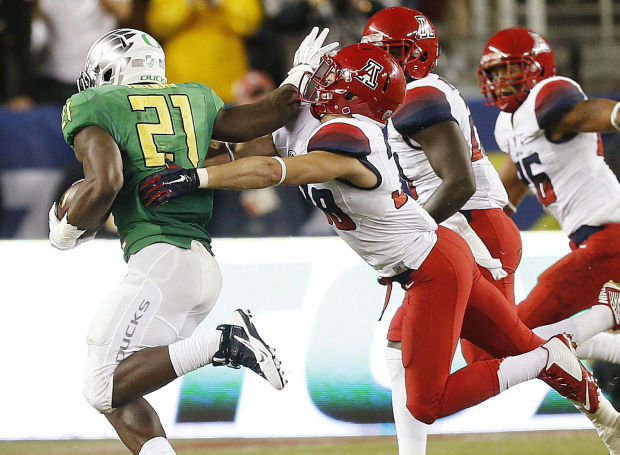
Arizona had so many missed tackles it was like chasing a fox.
UA coach Rich Rodriguez was so torqued that when he came to the formal interview session, he was asked a question and said, abruptly: “That wasn’t a good night. Next.”
At least it was over quickly, if not painlessly. Arizona succumbed to the biggest stage of its football history, fumbling its opening kickoff, and never getting much better.
If you’ve been around a bit, it was a familiar ending to a dare-to-dream-big football drama. In 1999, ranked No. 4 nationally, the Wildcats chose to open the season at Penn State. They lost 41-7. They weren’t ready for the Big Game then and they weren’t ready for the Big Game on Friday.
The difference in those 15 years is that this team, Rodriguez third-year program, should still be considered in Act I, the beginning of what could be an extended period in which college football’s selection committee knows the Wildcats exist and take football seriously.
It’s not like getting zombified by the Ducks means the Wildcats will be reclassified to the FCS, and sentenced to play against teams like Eastern Washington on a red turf in the middle of nowhere.
I mean, USC and UCLA didn’t even qualify for Friday’s game. The record still says 10-3.
The big surprise was that Oregon didn’t beat the Wildcats with its offense, but its defense. The Ducks completed the conference season ranked No. 8 in total defense and didn’t shut down anybody’s running game except Washington State’s.
But on Friday, Arizona’s offense was all but set in cement. The Ducks were everywhere, purposeful, limiting freshman tailback Nick Wilson to 14 yards in the first half, rendering quarterback Anu Solomon so ineffective that RichRod benched his hobbled freshman before he got a) impaired or b) a nervous disorder.
In their week of research and film study, Oregon’s coaches found the vulnerability in Arizona’s offense: In its two losses, to UCLA and USC, Arizona rushed for 80 yards or fewer.
The Ducks designed their strategy to eliminate Wilson and put the weight on Solomon. His battery wound down before halftime, and in fairness to him, his chronic right ankle injury didn’t give him much of a chance to elude onrushing Ducks.
In its seven Pac-10 victories, the UA always ran for more than 200 yards, and Wilson was a jackhammer, hitting ASU for 178 yards, Washington for 218 and Colorado for 153.
So the Ducks bunched six and seven tacklers near scrimmage and put so much pressure on Solomon, and gave so little space to Wilson, that there was nowhere to hide.
None of the UA receivers could get open because Solomon had no time to look for them.
Unlike the October game at Autzen Stadium, when the Wildcats ran for 208 yards and owned the lines of scrimmage, the Ducks this time were physically superior.
At one point late in the first half, Wilson had rushed for seven yards and punter Drew Riggleman had punted six times.
It’s ironic, but about the only time the UA showed any fight was when senior center Steven Gurrola was ejected for fighting in the third quarter. By then it was 37-7.
Ultimately, playing Oregon in a game of Friday’s magnitude was too much to ask for an Arizona team that survived by the seat of its pants week to week to week.
RichRod was a master at coaching the Wildcats to a division title, but you wonder: how much of a toll did it take? The UA had little fuel left for the year’s most difficult setting. By comparison, the Ducks spent the last few weeks steamrolling Colorado and Oregon State, building a reserve, taking aim at the Wildcats.
The Ducks hadn’t played a close game since it lost to Arizona three months ago, and this time they had retribution as motivation.
In time, Arizona and its fans will appreciate what it took to get to Levi’s Stadium in a championship game. With that, there should also come an appreciation of how much improvement is needed to win more than the Territorial Cup.
A year ago, ASU lost the title game 38-14 to Stanford, in Sun Devil Stadium, outgained 517-311. The lesson to be learned? ASU didn’t get its psyche in workable order again and was thumped 37-23 by an inferior Texas Tech team in the Holiday Bowl.
Whatever bowl game Arizona goes to — and my guess is that it might be the Sun Bowl, played in El Paso on Dec. 27 — it will take a week or three to get over the debacle against the Ducks.
On Friday, given an opportunity like no other in its football history, the Wildcats not just tripped up, but fell off a cliff.
It was like waking up on your wedding day with malaria.
Contact sports columnist Greg Hansen at 520-573-4145 or ghansen@tucson.com.
On Twitter @ghansen711

Greg Hansen
Columnist


