
KIRTLAND, Ohio — It may sound far-fetched to many, but northeast Ohio is home to a mountain, of sorts.
Little Mountain is actually an L-shaped ridge on the Lake-Geauga county line that rises 571 feet above Lake Erie. It was an imposing land form and created transportation problems for settlers.
Today, Holden Arboretum in Kirtland offers guided hikes to Little Mountain, a unique natural area and once a vacation center with five luxury hotels.
Wealthy Clevelanders, including the Rockefellers, the Hannas, the Wades and the Mathers, vacationed at Little Mountain from the 1830s into the early 1900s.
Little Mountain catches the winds and storms that sweep off the lake. It gets twice as much snowfall as the rest of northeast Ohio: typically more than 100 inches a year. It also gets more rain, creating its own wet, cool Canadian micro-climate.
People are also reading…
The 190-acre tract features dramatic rock outcroppings, ledges, sheer rock walls and unworldly crevices that suddenly open and stretch hundreds of feet. You can walk through some dark, cavelike crevices and look down more than 25 feet in others.
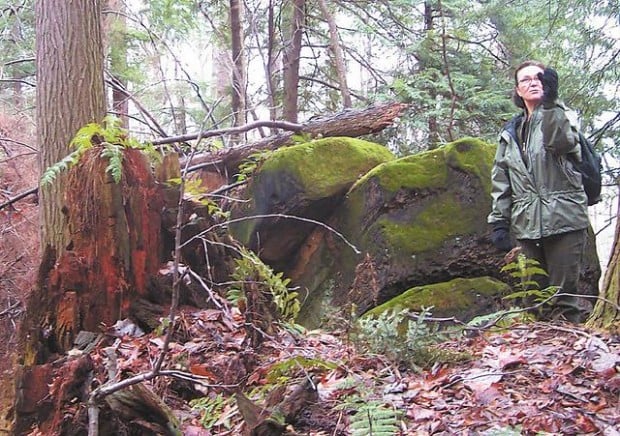
The sandstone rocks in many places are covered with thick blankets of eye-popping green moss and luxurious ferns.
Trees grow to the rocky edges with roots that seem to cling to bare rock.
The crevices are dangerous enough that you cannot explore Little Mountain on your own.
The area is a touch of Canada moved south to Ohio with trees, plants and birds more typically found farther north.
I got my first look at Little Mountain on a blustery Sunday afternoon with snow showers in November. I was among five people to sign up for a Little Mountain hike. The three-hour trip cost $10 and was guided by Holden Arboretum volunteers Eva Stephans and Bill Doolittle.
We met at the arboretum's Warren H. Corning Visitor Center in Kirtland and carpooled to nearby Little Mountain for the nonstrenuous 3-mile walk.
Little Mountain is surrounded by suburbia, yet it is still a wild spot.
The dominant rock on Little Mountain is sandstone, a Sharon Conglomerate that is 300 million years old. It is up to 100 feet thick atop Little Mountain.
The pebble-filled rock is hard enough to form cliffs and crevices, yet it is porous, acting like a sponge. It soaks up water that percolates through the rock until it hits the impermeable shale below. That results in numerous springs at the base of Little Mountain.
It was scoured by glaciers, and the glaciers helped widen many of the crevices on Little Mountain.
Devil's Kitchen is a narrow, rocky chamber that is dark and spooky. It is filled with names etched into the rock from when Little Mountain was a vacation spot for the well-to-do.
Names have also been found carved into the trunks in the upper reaches of some trees, Stephans told our group.
The mountain (it reaches an elevation of 1,266 feet) is covered at higher elevations with white pine, eastern hemlock, yellow birch and northern hardwoods.
The birds on Little Mountain "think they're in Canada," Stephans whispered, as if not to let the birds know they were really in Ohio.