

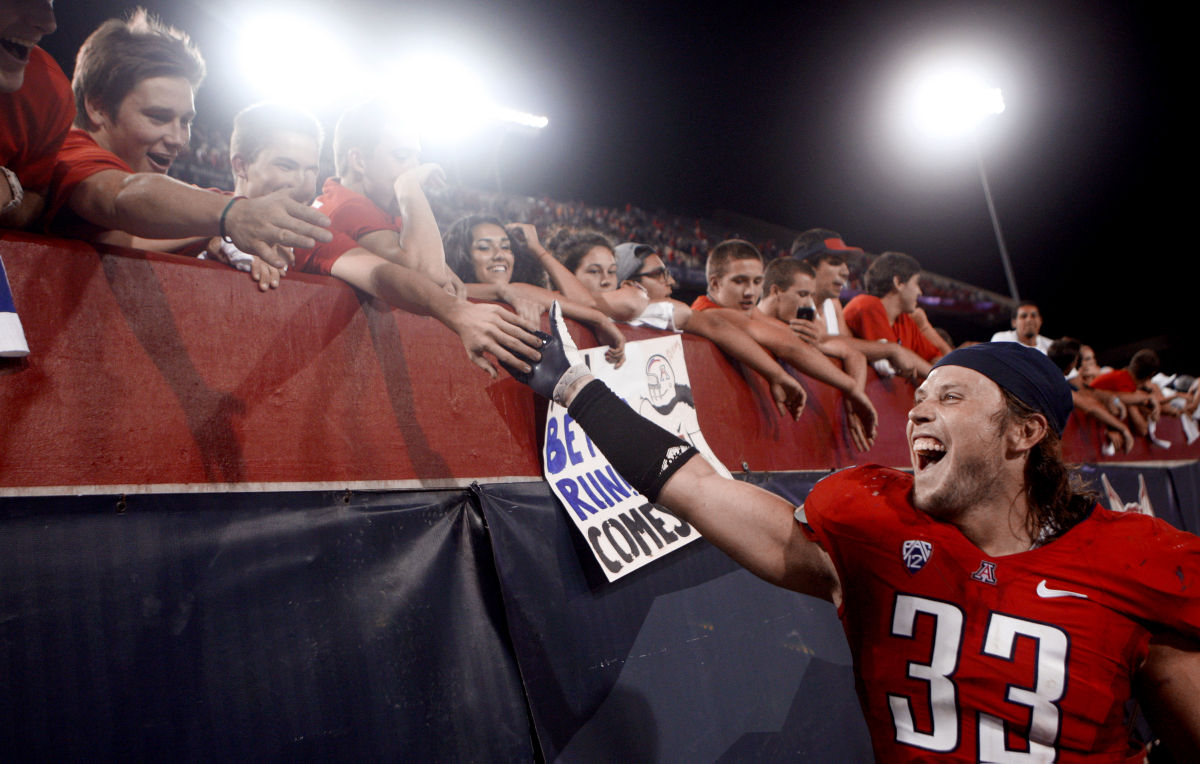
Stuck in the middle are the players most central to the fight.
“It’s hard to think logically,” says former wide receiver David Roberts, who played for the Wildcats from 2007 to 2011 while majoring in aerospace engineering. “Like, ‘Hey, I know I’m being screwed!’ If I say something that might mess it up. How many people know their bosses are doing something wrong but they won’t say anything?”
Roberts is one of the few players who has stepped forward to become public figures in the debate. In 2011, he helped spearhead an effort among his Wildcats teammates and members of the men’s basketball program to petition the NCAA for a bigger share of revenues. Sixty-five Wildcats signed the petition, along with more than 200 other college athletes from UCLA, Kentucky, Purdue and Georgia Tech.
People are also reading…
Two years later, two Wildcat senior football players – kicker Jake Smith and linebacker Jake Fischer – joined an antitrust lawsuit filed on behalf of Division 1 football and men’s basketball players against the NCAA. The suit, led by former UCLA basketball star Ed O’Bannon, argued that players should be entitled to a cut of the profits reaped from licensing their images.
Smith signed onto the suit because the inequities made him question the system.
“You create the brand for the school, but what does the school actually give you?” he asks. “They give you a piece of paper that might be a diploma but does that mean you have a career, that you’re set up for life?”
Also speaking out are former Northwestern quarterback Kain Colter, who led the fight to unionize, and former UCLA punter Jeff Locke, a player representative for the National College Players Association.
The athletes say they are not fighting just for a bigger paycheck, but for a seat at the table to answer the fundamental question: Is a scholarship enough?
“Nobody is saying the scholarship isn’t nice,” Bilas says. “It’s wonderful. But it’s nowhere near what they’re worth. The NCAA knows this or they wouldn’t be fighting so hard. It’s wrong to the point of being immoral. How can we, with a straight face, say it’s OK for a coach of a bunch of amateurs to make $9 million and if the amateur takes a sandwich somewhere, he’s a bad guy?”
Read the rest of the series.
Contact reporter Jon Gold at jgold@tucson.com or at (520) 573-8013. On Twitter: @TheCoolSub


Becky Pallack
Product manager
