

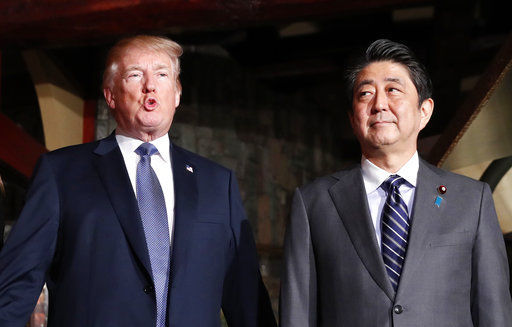
TOKYO — President Trump opened his second day in Japan by pushing for stronger, more equitable economic ties between the allies, yet his message in Asia threatened to be overshadowed by a tragic shooting back home.
Trump on Monday called the Texas church shooting that claimed at least 26 lives “an act of evil,” denounced the violence in “a place of sacred worship” and pledged the full support of the federal government.
He said that in a time of grief “Americans will do what we do best: we pull together and join hands and lock arms and through the tears and sadness we stand strong.”
He then shifted to his message to a group of American and Japanese business leaders: the United States was open for business, but he wanted to reshape the nations’ trade relationship.
“For the last many decades, Japan has been winning” the trade relationship, Trump said. “The U.S. has suffered massive trade deficits with Japan for many years.”
People are also reading…
He rebuked the current relationship, saying the trade deals were “not fair and not open.”
Trump downplayed the potentially contentious nature of the negotiations, though the Japanese government has not shown much appetite for striking a new bilateral trade agreement.
Tokyo had pushed to preserve the Trans- Pacific Partnership, which Trump has abandoned.
“We will have more trade than anybody ever thought under TPP. That I can tell you,” Trump said.
He said the multinational agreement was not the right deal for the United States and that while “probably some of you in this room disagree ... ultimately I’ll be proven to be right.”
The president seemed at ease in front of his CEO peers, calling out some by name, teasing that the first lady had to sell her Boeing stock once he took office and calling for Japanese automakers to make more of their cars in America.
He promised that profits would soon rise on both sides of the Pacific once new agreements were struck.
“We’ll have to negotiate that out and it’ll be a very friendly negotiation,” Trump said, suggesting it would be done “quickly” and “easily.”
Later Monday, Trump was scheduled to highlight the specter of North Korea and try to put a human face on its menace, hearing from anguished families of Japanese citizens snatched by Pyongyang’s agents.
The White House hopes the meeting will elevate these heart-wrenching tales of loss to the international stage to help pressure North Korea to end its provocative behavior toward American allies in the region.
North Korea has acknowledged apprehending 13 Japanese in the 1970s and 1980s, but claims they all died or have been released.
But in Japan, where grieving relatives of the abducted have become a symbol of heartbreak on the scale of American POW families, the government insists nearly 50 people were taken — and believes some may be alive.
Trump has delivered harsh denunciations of the renegade North Korean leader Kim Jong Un, belittling him as “Little Rocket Man” and threatening to rain “fire and fury” on his country if the belligerence continues.
But Trump also has begun highlighting the plight of ordinary North Koreans.
“I think they’re great people. They’re industrious. They’re warm, much warmer than the world really knows or understands,” Trump told reporters on Air Force One while flying to Japan on Sunday.
“And I hope it all works out for everybody.”
Also on the agenda during Trump’s second day in Asia: an audience with Emperor Akihito, more formal talks with Prime Minister Shinzo Abe and a state dinner.
North Korea is the critical issue looming over Trump’s 12-day, five-country trip that will include direct talks with Trump’s Chinese and Russian counterparts.