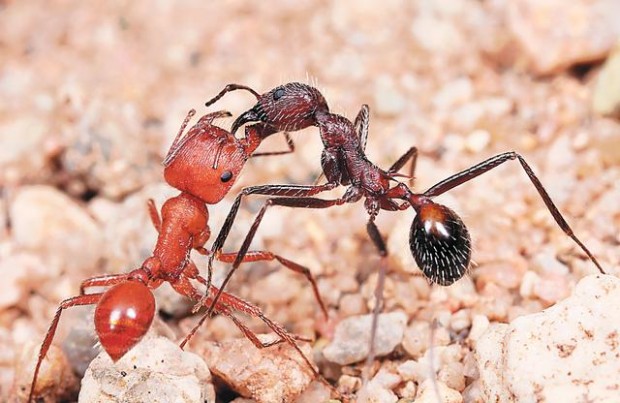

A British film crew is in Arizona to film "Planet of the Ants," a National Geographic Television documentary about the picnic-spoiling arthropods.
The filmmakers, who shot in Phoenix and Tucson over the past couple of weeks, are now in the town of Portal, near the New Mexico border, until Wednesday, when they'll head back to England.
They're on the hunt for red harvester ants and long-legged ants.
The leader of the crew, producer Martin Dohrn, director of the British production company Ammonite Ltd., said Arizona is a prime spot for ant filming.
"The ants are very easy to find here. They make it very obvious where their nests are. It's very easy to pick out," Dohrn said. "It's good from a photographic point of view. There is plenty of light and the sun is always out, making it easy to see social behavior that can be quite difficult to film."
People are also reading…
Dohrn added that Arizona also attracts top entomologists, including Alex Wild, a University of Illinois researcher whom the production flew in as a science consultant.
Wild called Tucson the ant capital of America and added that Arizona's 250 species of ants give the state the most diverse mix in the country.
He said Tucson is more accommodating to ants than Phoenix because Tucson gets more precipitation and has less intrusive construction, fewer lawns and more natural landscaping.
"Ants really are everywhere in Tucson," Wild said. "There are two or three harvester ant nests on every block."
While in Southern Arizona in late July, Ammonite filmed in Green Valley, Madera Canyon, Box Canyon, Saguaro National Park, Tucson Mountain Park and at an abandoned lot near North Fifth Avenue and East Speedway.
The crew would go out at 4 a.m. and Wild would lead them to ant nests. Once they found one, they'd stimulate activity by sprinkling water on and near the hole, simulating a monsoon.
The film should air in September 2010, Dohrn said. The crew will also shoot in Costa Rica in a few weeks.
"We've been filming like busy ants," he said.
The film has a budget of $250,000, which Dohrn called "more than your average reality show."
Armed with what Dohrn described as "20 cases of junk," the crew used cameras that peek inside holes and unobtrusively zoom in on ants doing their thing.
Not that the ants didn't notice their presence.
"We get stung all the time," Dohrn said. "In the end it's simpler just to kind of wade in there." He said there's no reason to be concerned that Tucson is infested with ants.
"The ants are harmless. There's no reason to bother them," he said. "They help turn the soil and are very beneficial. They do very well by the roadside. If there's a crack in the concrete that they can use to get down into the soil, that's all they need."
Wild said there are no deadly ants, although black and red harvester ants, which are common in Tucson, can cause trouble. They're the largest ants here, with bulbous heads that make them look as though they're going to tip over, Wild said. Harvesters' bites are harmless, but stings from their abdomens are filled with venom meant to subdue predators such as caterpillars and can be as painful as bee stings, even hospitalizing people who are allergic to the venom.
Dohrn said the Tucson Film Office was helpful, nailing down all the permits for the shoot on short notice.
Film office director Shelli Hall said Tucson is particularly attractive to foreign nature documentarians.
"What I think drives a lot of the Discovery Channel-type work here has to do with the unique aspects of Sonoran Desert, and we definitely portray ourselves as a place with well-known scientific types," said Hall, who estimated the economic impact of the Southern Arizona portion of the shoot to be between $30,000 and $50,000.
"We also get a slew every July — not so much this July — of documentaries on lightning and monsoons by filmmakers from Japan and the U.K.," Hall said. "They're fascinated by the lightning here."


 Second wall planned across Arizona as Trump administration doubles down on border