
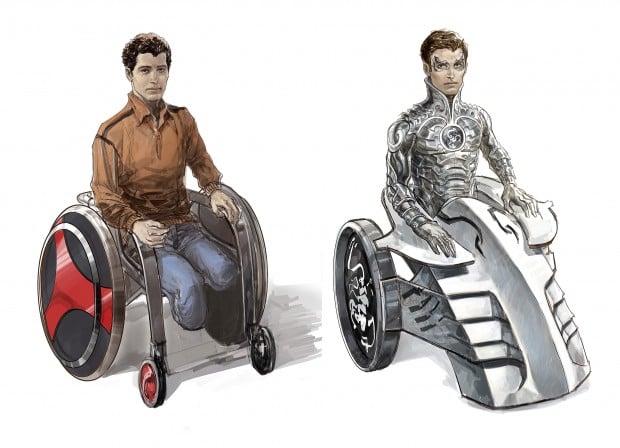
NEW YORK - Comic book fans will soon be getting their first glimpse at an unlikely new superhero - a Muslim boy in a wheelchair with superpowers.
The new superhero is the brainchild of a group of disabled young Americans and Syrians who were brought together last month in Damascus by the Open Hands Initiative, a nonprofit organization founded by U.S. philanthropist and businessman Jay T. Snyder.
The superhero's appearance hasn't been finalized, but an early sketch shows a Muslim boy who lost his legs in a land mine accident and later becomes the Silver Scorpion after discovering he has the power to control metal with his mind.
Sharad Devarajan, co-founder and CEO of Liquid Comics whose company is now turning the young people's ideas into pictures and a story line, said the goal is to release the first comic book - launching the disabled Muslim superhero - in early November in both Arabic and English.
People are also reading…
Snyder said he was inspired by President Obama's effort to reach out to the Muslim world in his January 2009 inaugural address. Last month, Snyder flew 12 disabled Americans to Damascus to meet their Syrian peers, and one of their main goals was to come up with ideas and story lines for the superhero.
"The only limit was the imagination these kids had - the opportunity for a great story," said Snyder, a comic book collector who heads HBJ Investments LLC. "They helped create something by their combined talents, and that becomes a gift to the world."
Devarajan found the young people's imaginations amazing.
"The opening question we asked the kids was, 'If you could have any superpower, what would it be?' I've asked that question in many different groups before, and the typical answers are always the ones you'd expect - flying, reading minds or being superstrong," he said.
"The fascinating thing about this group was that I don't think I heard any one of those three," he said.
Devarajan said it was noteworthy that none of the young people wanted the hero's power to be something that cured his disability.
"They were empowered by their own disabilities, and they should not be seen as a source of weakness," he said.
Initially, 50,000 Arabic-language comics will be distributed throughout Syria, and subsequent issues will be distributed elsewhere in the Middle East, Snyder said.


 Second wall planned across Arizona as Trump administration doubles down on border