

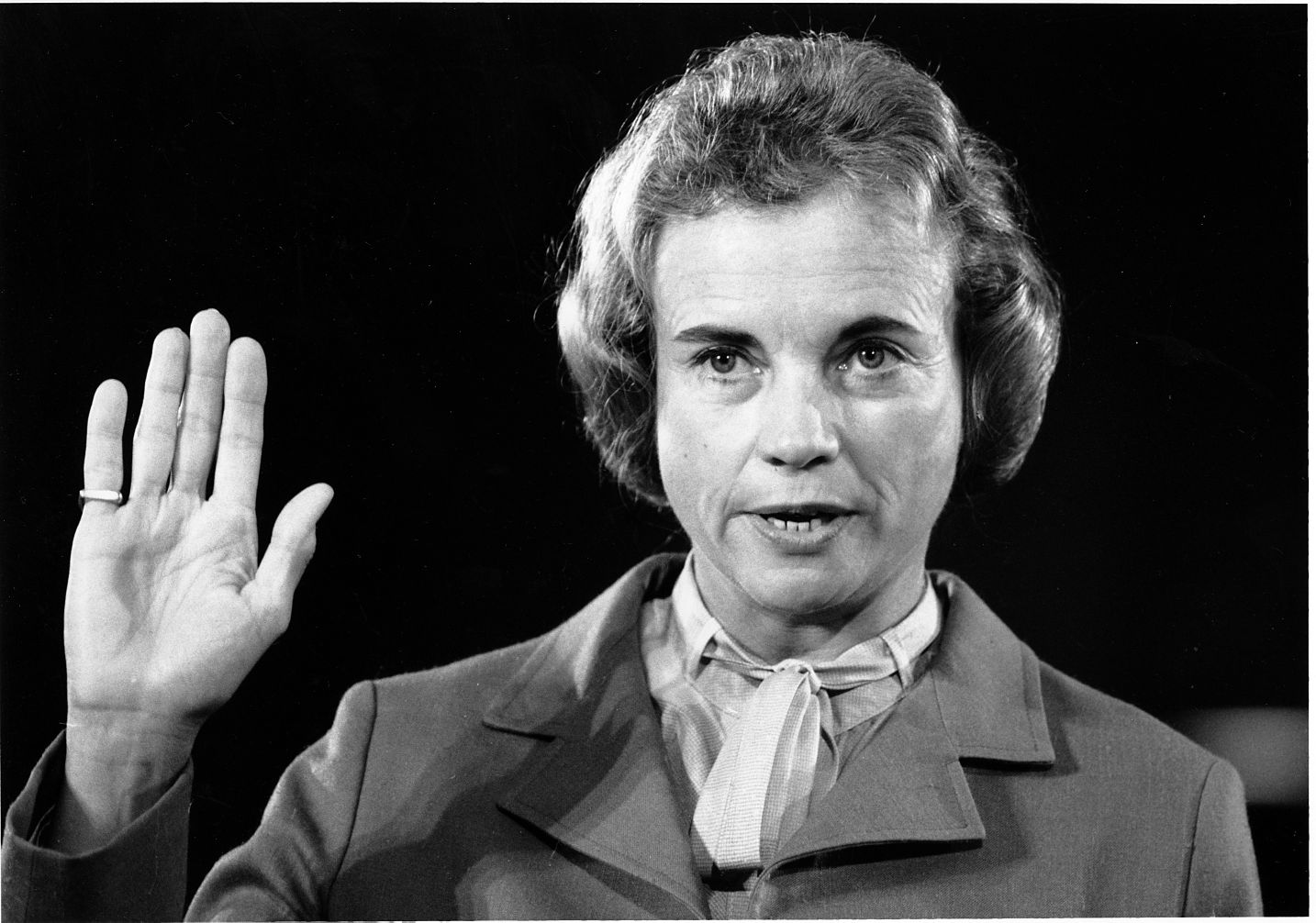
In 1981, Sandra Day O'Connor was sworn in as the first female justice on the Supreme Court.
President Ronald Reagan nominated Arizonan Sandra Day O'Connor for the U.S. Supreme Court. She was unanimously confirmed by the Senate September 21, 1981, and on September 25, 1981, became the first woman to serve as a Supreme Court justice.
The Arizona Daily Star carried an Associated Press article about her confirmation on September 22, 1981:
Arizona woman gains Supreme Court bench
WASHINGTON (AP) — The Senate, ending an all-male tradition nearly two centuries old, unanimously confirmed Sandra Day O'Connor as an associate justice of the Supreme Court yesterday.
O'Connor, a 51-year-old judge of the Arizona Court of Appeals, will be sworn in Friday in time to join the court for the opening of its 1981-82 term on Oct. 5.
The vote was 99-0, with only Sen. Max Baucus, D-Mont., who was attending an economic conference in his home state, missing from the tally. He had supported O'Connor in earlier committee action.
After the vote, O'Connor appeared on the steps of the Capitol with Senate leaders and Vice President George Bush.
Grinning jubilantly, she said she was overjoyed by the depth of Senate support for her nomination.
"My hope is that after I've been across the street and worked for a while that they'll all feel glad for the wonderful vote they gave me today," she said.
Once installed on the court, she said, "I'm going to get very busy, very fast."
"Today is truly a historic occasion," said Sen. Strom Thurmond, R-S.C., chairman of the Senate Judiciary Committee, leading off a series of 27 speeches in warm praise of President Reagan's first high-court nominee.
Hailing a "happy and historic day," Reagan said in a statement that the confirmation of his nominee "symbolizes the richness of opportunity that permits persons of any sex, age or race, from every section and walk of life, to aspire and achieve in a manner never before even dreamed about in human history."
As the vote neared, a small knot of conservatives who had questioned O'Connor's views on abortion fell into line behind her nomination.
Jesse Helms, R-N.C., leader of the most conservative bloc of Senate Republicans, voted for O'Connor, saying that although she wouldn't say so publicly, he believes she opposes the 1973 high-court decision legalizing most abortions.
Helms said that on the day Reagan announced that O'Connor would be his first Supreme Court nominee, he met privately in the White House with the president and was assured that O'Connor shares Reagan's opposition to a national policy of legalized abortions.
Sen. Joseph Biden of Delaware, the Senior Democrat on the judiciary panel, said however that it is fruitless and risky to predict how any Supreme Court nominee might vote once he or she is sworn in.
"Once a justice dons those robes, enters that inner sanctum across the road (in the Supreme Court building)," Biden said, "we have no control. All bets are off."
The late President Dwight Eisenhower nominated Earl Warren, believing he was a "mainstream Republican," and he turned out to be the most liberal Chief Justice in Supreme Court history, Biden recalled.
Biden said O'Connor won such broad support from conservatives and liberals from both parties because she has "superior intellect," strong moral character and the right temperament to be a judge.
"That's all I have a right to ask," said Biden, criticizing conservatives who attempted to make O'Connor's views on abortion the sole criterion on whether she should be confirmed.
O'Connor will become the 102nd person to don the black robes of a Supreme Court member since the court was created as one of three equal branches of the federal government 191 years ago.
A graduate of Stanford University Law School, she worked as as Arizona assistant attorney general before serving in the Arizona Senate, where she eventually became majority leader.
O'Connor served as a Maricopa County Superior Court judge, and was later named by Gov. Bruce Babbitt to the Arizona Court of Ap;peals.
Nothing Reagan has done in his eight months as president has won such broad support and acclaim from so many sides of the political spectrum on Capitol Hill.
O'Connor's confirmation represents a major political victory amid growing opposition to the president's economic, diplomatic and military programs.
In three days of testimony before the Senate Judiciary Committee, O'Connor said she finds abortion personally offensive, but declined to give her constitutional view of whether a woman has a legal right to end a pregnancy.
Reagan has said repeatedly that he disagrees with the Supreme Court decision to legalize abortions, and has supported legislative efforts to reverse it.
Because O'Connor's votes in the Arizona Legislature 10 years ago indicated some support for legalized abortion, Helms said in one Senate speech, "some uncertainty yet exists" about her position on abortion.
If O'Connor turns out to be a supporter of legalized abortions, she will have betrayed Reagan's long-stated views on the subject, Helms said.
Abortion was the only issue on which any opposition developed surrounding Reagan's choice to replace retiring Potter Stewart on the high court.
Only a few senators were on the floor yesterday during during four hours of debate set aside for the nomination, and there was effusive praise from liberals and conservatives of both parties.
Sen. Edward M. Kennedy, D-Mass., said the inability of groups like the Moral Majority and other anti-abortion groups to block the nomination demonstrated that single issue politics "has no place" in the confirmation process for a high-court justice.
He called O'Connor's confirmation "a significant victory for the cause of equal rights," in part because she is a woman.
Thurmond said that during her confirmation hearings, O'Connor demonstrated herself to be a "person who understands that federal law is changed by Congress, not by the court."
Several other senators said they believe O'Connor's history as a state legislator and state judge would make her more likely to play a restraining roll on the Supreme Court, which has been criticized by conservatives for tackling issues like abortion and busing for school desegregation.
People are also reading…
O'Connor retired from the Supreme Court in 2006.
