No. 9 seed Utah State (29-6) vs No. 1 seed Arizona (33-2) | NCAA Tournament second round | Viejas Arena, San Diego | 4:50 p.m. (approx.) | TruTV | 1290-AM, 107.5-FM
Probable starters
ARIZONA
0 G Jaden Bradley (6-3 senior)
5 G Brayden Burries (6-4 freshman)
18 F Ivan Kharchenkov (6-7 freshman)
10 F Koa Peat (6-8 freshman)
13 C Motiejus Krivas (7-2 junior)
Key reserves
30 F Tobe Awaka (6-8 senior)
3 F Anthony Dell’Orso (6-6 senior)
2 F Dwayne Aristode 96-8 freshman)
People are also reading…
UTAH STATE
8 G Drake Allen (6-5 senior)
2 G MJ Collins (6-4 senior)
12 F Mason Falslev (6-4 junior)
35 F Adlan Elamin (6-9 freshman)
32 C Zach Keller (6-10 senior)
Key reserves
22 C Karson Templin (6-9 senior)
11 F Garry Clark (6-9 senior)
7 G Kolby King (6-1 senior)
1 G Elijah Perryman (6-2 freshman)
How they match up
How they got here: Seeded No. 1 after winning the Big 12 regular-season and conference tournament titles, Arizona beat No. 16 LIU 92-58 on Friday in a first-round game.
Utah State went 15-5 to win the Mountain West by a game over San Diego State, then avenged losses to UNLV, Nevada and SDSU in the Mountain West Tournament to earn the conference’s automatic (and only) NCAA Tournament bid. Given a No. 9 seed, the Aggies beat No. 8 Villanova 86-76 on Friday.
Series history: Arizona is 1-4 against Utah State but has only played the Aggies once in the past 62 years, when the Wildcats beat them 66-53 in a first-round NCAA Tournament game in Boise, Idaho, in 2005.
Utah State overview: Different year, different Utah State coach, same results. The Aggies are playing in their fourth straight NCAA Tournament and have played in 14 since 2000 — despite constantly losing coaches Craig Smith (Utah), Ryan Odum (VCU, then Virginia) and Danny Sprinkle (Washington) all since 2021.
What’s more, the Aggies are reportedly a good bet to lose current coach Jerrod Calhoun to Cincinnati when this season ends. In just his second year at Utah State, Calhoun installed four new starters around local star Mason Falslev and wound up exceeding last season’s 26-8 record.
The Aggies rank 27th nationally in offense, looking to strike early in possessions whenever possible to get good looks at the basket. They set up 60.0% of their baskets with assists, the 30th highest percentage in Division I, and rank ninth in two-point shooting percentage (59.8). They don’t rely heavily on 3s but shoot them at a 34.6% rate, with Falslev shooting 39.8% from beyond the arc and reserve guard Kolby King shooting 38.0%.
Guard MJ Collins excels at getting to the basket, shooting 62.9% from two-point range, while he’s also an 80.8% shooter at the free-throw line.
Defensively, Utah State is aggressive, turning opponents over on 20.4% of their possessions. The Aggies steal the ball on 12.4% of opponents’ possessions. Falslev alone records a steal on 3.5% of opponent possessions when he’s on the floor. They are also tough in the paint, keeping teams to just 48.5% from inside.
He said it:
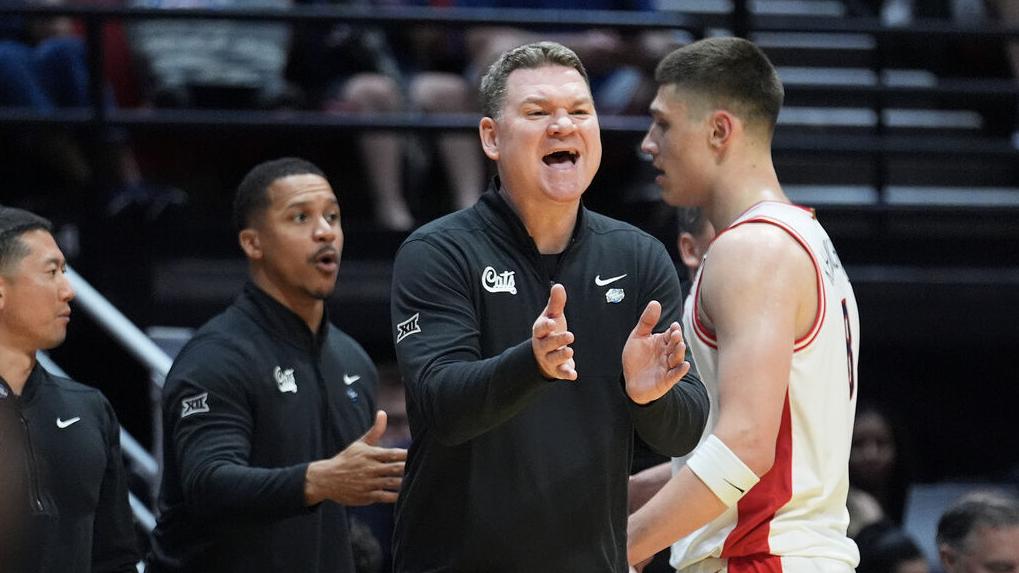
"I think what they've done a really good job of is being able to change defenses and being able to mix in some presses, and kind of like get you out of your rhythm a little bit.
"They do a great job at that. We're going to have to get out there and get a feel for it on the court tomorrow on how we can get comfortable moving the ball and moving our bodies and playing against it. Obviously it's got our full attention.
"Offensively, they've got a really creative system. It's based on a lot of player movement, and they have multiple options within it. There's a lot of people that are doing dribble-drive stuff or ball-screen-centric.
"They're a team that's kind of breaking the mold. They're doing a great job with their off-ball actions and in multiple screening actions. But they also have players that are good and then opportunistic in the ball-screen opportunities they have. Definitely a unique system, and it's going to present a lot of challenges."
-- UA coach Tommy Lloyd
Key players
UTAH STATE
Mason Falslev

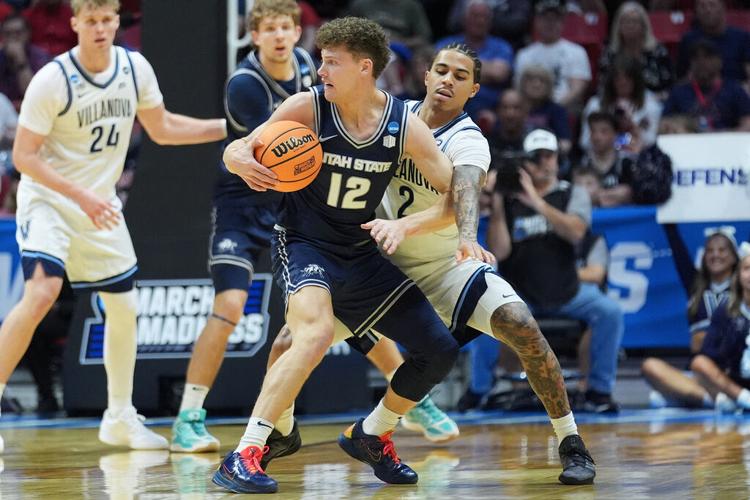
Utah State guard Mason Falslev (12) controls the ball while being defended by Villanova guard Bryce Lindsay (2) during the first half in the first round of the NCAA Tournament, Friday, March 20, 2026, in San Diego.
After returning to Utah State despite “astronomical numbers” that were thrown at him by other schools last spring, according to what Calhoun told Blue Ribbon Yearbook, Falslev made it worth his while. A product of nearby Sky View High School, Falslev picked up the Mountain West Player of the Year award with his versatile and clutch play.
ARIZONA
Brayden Burries

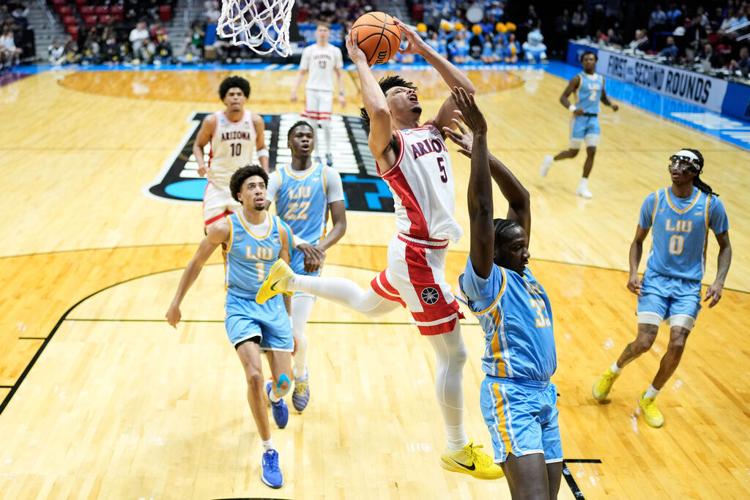
Arizona guard Brayden Burries (5) drives to the basket against LIU during the second half in the first round of the NCAA Tournament, Friday, March 20, 2026, in San Diego.
After a rough game against Iowa State in the Big 12 Tournament, the Wildcats’ leading scorer is back on a roll. The Southern California native, playing just two hours from his San Bernardino hometown, has averaged 19.5 points while hitting 7 of 10 3-pointers and all nine free throws he took over the Wildcats’ past two games.
Sidelines
McKale West?
While passionate Utah State fans might mitigate the effect Sunday, Viejas Arena turned nearly into something of a McKale West on Friday when UA faced LIU.
It was a payback of sorts from the "Hilton South" environment the Wildcats had to face when beating Iowa State 82-80 in the Big 12 Tournament semifinals on March 13, when rowdy Cyclones fans turned Kansas City’s T-Mobile Center into something comparable to Iowa State’s Hilton Coliseum.
But Friday morning at Viejas, UA fans appeared to fill up about two-thirds of the Viejas Arenas crowd and chanted "U of A" often throughout the game.
“I saw the majority of U of A fans,” freshman Dwayne Aristode said. “It did feel like a little bit of home game for sure.”
Later in the day, though, Utah State fans took over while their Aggies beat Villanova.
"It honestly feel like we won the conference championship again," guard MJ Collins said after that game. "We've got a great fan base. They travel for us. That's key part of why we win."
Bradley not concerned
UA point guard Jaden Bradley appeared compromised when he had to return to the Big 12 championship game against Houston with a protective wrap around his left index finger after jamming his finger earlier in the game.
But he had no such trouble Friday, having had six days to work with UA trainer Justin Kokoskie and get acclimated to the wrap in practice. Bradley had seven points, five rebounds, four assists and three steals.

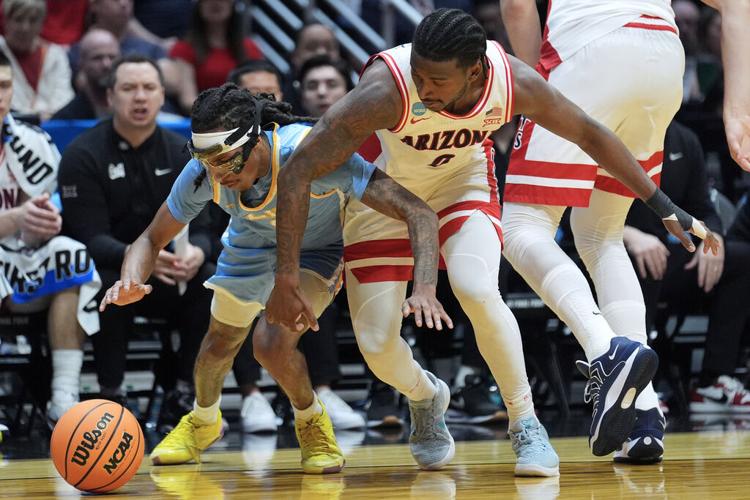
LIU guard Malachi Davis, left, looks for a loose ball next to Arizona guard Jaden Bradley during the first half in the first round of the NCAA Tournament, Friday, March 20, 2026, in San Diego.
“We did some treatment on it, taped it up to give it some support,” Bradley said. “It’s all good.”
Aggies at home (sort of)
Even if Utah State fans can't make the Aggies feel at home, the court might.
Utah State has played at Viejas Arena regularly as a member of the Mountain West, and even beat the Aztecs in the campus arena 67-66 last season (though SDSU won at home this season).
"San Diego State's fans aren't here, so they're not rooting against us," Collins said. "But it's just a great feeling to be back here, something we're familiar with."
No room for EMOY
Because the NCAA allows only 22 players and coaches to sit on the team bench, the Wildcats can't get the full earshot effect of ever-demonstrative equipment manager Brian Brigger.
Brigger and performance enhancement coach Chris Rounds were among the several UA staffers who operated behind a barrier between the bench area and public seating. But Brigger, commonly known as “EMOY” (Equipment Manager of the Year), wasn’t complaining.
“I got enough energy behind them,” Brigger said. “We’re good.”
Numbers game
3: Sweet 16 appearances for Arizona in four previous NCAA Tournaments under fifth-year coach Tommy Lloyd.
8: Utah State wins in 27 all-time NCAA Tournament games.
19: Utah State’s rank in Kenpom’s Division I experience calculation (2.44 years), a measure of the average number of full D-I seasons played by the current roster, as weighted by minutes played.
144: Arizona’s rank in Kenpom’s Division I experience calculation (1.58 years).
— Bruce Pascoe
Contact sports reporter Bruce Pascoe at bpascoe@tucson.com. On X(Twitter): @brucepascoe
Bruce Pascoe
Reporter


 5 takeaways from Arizona’s 92-58 victory over LIU in NCAA Tournament opener | Michael Lev