

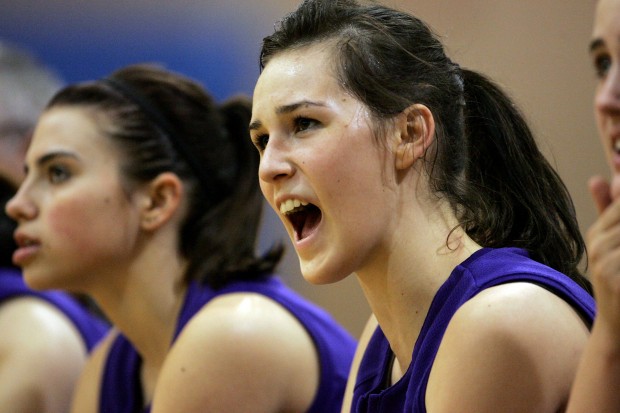
When center Anna Heaton feels the pain - which mimics someone shoving her in the back - she turns to a doctor who lives in her home.
David Heaton, a chiropractor, adjusts his 17-year-old daughter's spine, curved near the bottom by scoliosis, at least once a week. While she lies on her side on a table, he applies force to move her spine, alleviating pain.
The junior who plays basketball for Sabino High School is missing half of her L5 vertebra, so her spine has a 46-degree curvature. A normal spine curves zero degrees. Her spine curves upward to her left side before straightening again.
The treatments allow Anna to lead a regular life, which includes playing basketball for Sabino. A captain and 5-foot-9-inch starting center, Heaton is a defensive stopper, Sabercats coach Al Addleman said.
Anna said she doesn't feel pain during games or practice - as adrenaline kicks in - but afterward, she endures the pushing pain, which registers as a seven on a 1-to-10 scale. She applies ice, stretches or visits her dad, who practices at Tucson Chiropractic Center.
People are also reading…
"I get tons of great benefits from him working on me, and he X-rays me every year," Anna said.
David was studying to be a chiropractor when Anna was diagnosed with scoliosis at age 2.
He and Anna's mother, Dru, noticed Anna's body was crooked when she walked and crawled, and they remembered her legs tilted to the right when they changed her diapers. A doctor warned she could become paralyzed, but the more David learned about scoliosis, the more he learned she could avoid surgery, which would insert a rod to straighten her spine.
"I don't think she will (have surgery)," said David, who wanted to become a chiropractor after seeing one straighten the spine of his nephew, who had severe scoliosis.
"We'll do everything we can to avoid (surgery), especially on that, because you're talking about nerves that come out and go down your legs. If she had the surgery, there's a huge risk she can be paralyzed."
David said he worried about Anna's health when she began playing basketball three years ago, but he was comforted after talking to a friend who is a pediatric orthopedist. Plus, David knew the game. He played basketball at Weber State, Snow College and BYU-Hawaii.
"It's pretty stable, as far as it's not going to break or tear away," David said.
Defining the medical jargon explains how Anna has coped with scoliosis - and played basketball despite it:
Scoliosis: According to the Mayo Clinic, the cause of most scoliosis, a sideways curvature of the spine, is unknown. Anna was born with it. None of her four siblings have it.
Anna walks, runs and plays basketball. She said she has dimples on her back and someone might notice her spine "disappears" low in her back.
L5: The spine's lowest vertebra connects to the sacrum, a triangular bone between the hip bones. On Anna's left side, which is lacking half of the L5, the L4 is attached to the sacrum. When the joint gets fixated, she feels pain, and her dad adjusts her to move the joint again.
Hemivertebra: A half of the vertebra did not develop completely. "Every other vertebra in her whole spine is OK. Isn't that amazing?" David said. "Most of the time, there's three or four when one of them is like that."
The pain intensified as Anna grew about 3 inches last year. At worst, it forced her to stop running sprints during practice and walk and lie down.
"It was probably a 9 or 10 on the scale," she said. "Just my back crushing me down. I couldn't stand up straight."
To ease the pain, she underwent electric stimulation at her dad's office. The pain has subsided as Anna has likely finished growing.
She now plays 20 to 25 minutes a game, same as her teammates. She touches her toes or keeps moving on the bench to stay loose and rarely complains of pain.
"She's as determined of an individual as you can find," Addleman said. "She can put in the extra work."
BIO
• Who: Anna Heaton
• Age: 17
• School: Home-schooled
• Team: Sabino
• Sport: Basketball
• Statistics: 5.1 points per game; 4.2 rebounds per game