

How old is too old for an airplane?
Most travelers don't think twice about it - although there's something unsettling about easing into your seat and finding the armrest still has an ashtray built in.
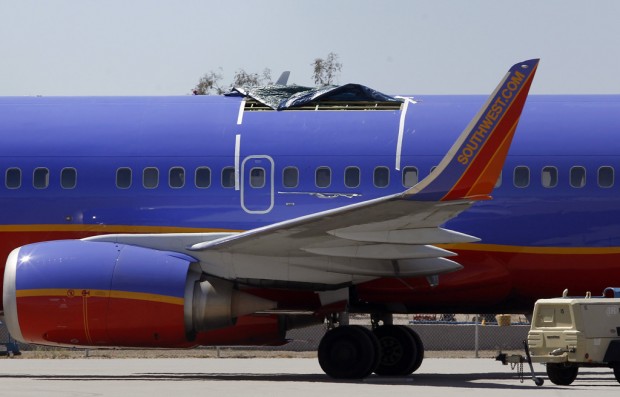
But passengers may be more worried than usual after a 5-foot hole opened in the roof of a 15-year-old Southwest Airlines jet earlier this month. Southwest quickly grounded 79 of its older Boeing 737s for inspections.
A well-maintained plane can fly for decades. Older planes do need more repairs, but experts say an aircraft's age has never been the cause of a passenger death. Pilot training and fatigue, as well as frequency of aircraft maintenance, are larger safety issues.
The average age of jets flown by U.S. airlines is 11 years, slightly above the world average of 10 but far shy of the 28 for Venezuela's fleet - the oldest of any country with more than a handful of jets.
People are also reading…
Theoretically, a jet could continue flying indefinitely as long as an airline maintained it, says Bill Voss, president and CEO of the Flight Safety Foundation. The costs would eventually be prohibitive, though. Deciding when to mothball an airplane is usually a matter of the economics of the individual airline.
More inspections
Older planes need more frequent inspections, and bigger and costlier repairs. That means less time in the sky carrying paying passengers. Besides being cheaper to maintain, newer planes offer substantial fuel savings, and passengers enjoy features like personal TVs.
"Aircraft become impractical a long time before they become unsafe," Voss said.
Nearly one out of every four planes flown today by U.S. airlines is more than 15 years old. That's about the same share as a decade ago, according to aviation consulting firm Ascend. The government requires more frequent inspections as an airplane or certain parts get older. The Federal Aviation Administration doesn't set a mandatory retirement age for planes.
Age isn't the only factor when it comes to safety. Each takeoff and landing cycle - and the pressurization and depressurization associated with it - adds stress to the skin of the plane. Aircraft that fly short, frequent routes go through more of these cycles than planes flying long distances. In 1988, a 19-year-old Aloha Airlines Boeing 737-200 that had made frequent, short hops among the Hawaiian islands lost a large part of its roof. Corrosion and metal fatigue were to blame.
On April 1, a Southwest Boeing 737-300 with 118 people on board lost cabin pressure just after takeoff from Phoenix when the plane's fuselage ruptured, causing a 5-foot tear. Passengers reached for oxygen masks as the pilots quickly brought the plane down to an altitude with more oxygen in the air before making an emergency landing at a military base.
No one was seriously injured. While the incident is still being investigated, the jet had been pressurized and depressurized 39,000 times in its 15 years, and metal fatigue is suspected. Cracks were subsequently found on five other Southwest jets with more than 30,000 cycles.
That came as a shock to the industry. Boeing engineers had forecast that the planes wouldn't need to be inspected for metal fatigue until at least 60,000 cycles.
"It reminds us that as much we know about metal structures, we haven't figured it all out yet," Voss said.
Safest way to go
Flying is the safest form of public transportation. John M. Cox, an aviation-safety consultant and former commercial pilot, says regulators do a good job of making sure airlines perform proper maintenance.
"A '55 Chevy in the right hands could go hundreds of thousands of miles," he said.
But that isn't much comfort to some passengers. After all, if the Chevy breaks down, you simply pull off to the side of the road.
Emily Kahn of Portland, Ore., says she now does more research before booking a flight and is willing to pay more for a newer plane.
"When the magazine rack in front of me is falling apart, it's not the best feeling in the world," Kahn said. "It makes me think they aren't spending enough time inspecting this plane."
Of the 5,363 jets used by U.S. airlines today, almost 1,300 are more than 15 years old and 235 were built before 1988, the year the government banned smoking on most domestic flights.
At least one site, Airfarewatchdog.com, provided travelers last week with instructions on how to find the type of plane assigned to a route. "If you have a choice, why not go with a newer model?" founder George Hobica said.
Passengers can check the make and model of a plane by entering the flight number on sites such as Flightaware.com and Flightstats.com. The airlines also usually provide that information on their websites. However, aircraft can be changed at the last minute.
Some airlines have much newer fleets than others. Virgin America, which started service in August 2007, is flying planes that average just 3.4 years. Allegiant Air, which bought MD-80s once flown by Aeromexico and SAS Scandinavian Airlines, has an average fleet age of 21.5 years.
Not even new planes have spotless safety records, of course. The last two U.S. fatal airline crashes - a Continental Express flight to Buffalo, N.Y., and a Delta Connection flight out of Kentucky - were both on relatively new planes.
The average age of U.S. airlines' fleets:
Allegiant Air: 21.5 years
Delta Air Lines: 16 years
American Airlines: 15.1 years
United Airlines: 15 years
US Airways: 12.8 years
Hawaiian Airlines: 12.1 years
Southwest Airlines: 11.7 years
Continental Airlines: 10 years
Alaska Airlines: 7.7 years
Frontier Airlines: 6.3 years
JetBlue Airways: 5.8 years
Spirit Airlines: 4.2 years
Virgin America: 3.4 years
Source: Ascend Worldwide Ltd.
Ages of US airline fleets