WASHINGTON — The Supreme Court unanimously upheld access to a drug used in the majority of U.S. abortions on Thursday, though abortion opponents say the ruling won't be the last word in the fight over mifepristone.

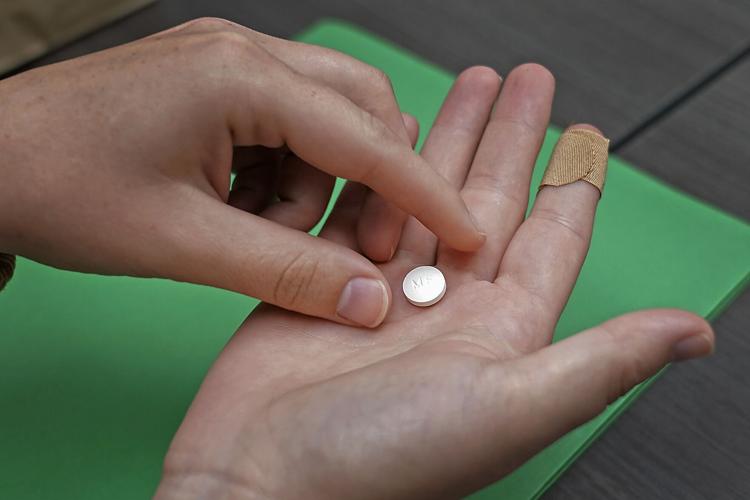
A patient prepares to take the first of two combination pills, mifepristone, for a medication abortion during an Oct. 12, 2022, visit to a clinic in Kansas City, Kan. Mifepristone was approved for use by the Food and Drug Administration more than two decades ago, and today more than half of women who end a pregnancy rely on the drug, the Justice Department said.
The narrow decision came two years after the high court overturned the nationwide right to abortion. Rather than fully dive into the issue, the high court found that anti-abortion doctors lacked the legal right to sue.
That could leave an opening for anti-abortion states or other opponents to keep up the fight.
Some takeaways from the decision:
People are also reading…
What does this say about the Supreme Court and abortion?
Not necessarily very much. Justice Brett Kavanaugh, who was part of the court majority two years ago to overturn Roe, employed a minimalist approach in the opinion that seemed designed to sidestep disagreements and arrive at a unanimous outcome.
The court found that the abortion opponents couldn't sue because they weren't actually injured by the medication, in part because federal laws protect doctors from performing abortions if they object.
The court did not address whether the FDA ultimately adhered to the law when it made changes to relax access to mifepristone, including allowing telehealth prescribing and mail delivery to patients. It said opponents could go elsewhere with their arguments, like to the president or the FDA.

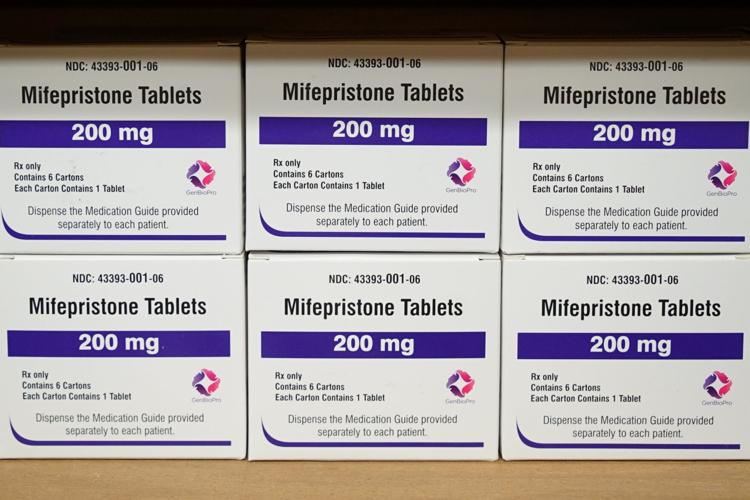
Boxes of the drug mifepristone sit on a shelf March 16, 2022, at the West Alabama Women's Center in Tuscaloosa, Ala. Mifepristone is one of two pills used in medication abortions, along with misoprostol.
Not a word was written about the Comstock Act, a 19th-century law that some abortion opponents think can be used to prevent mifepristone from being sent in the mail and was mentioned by two conservative justices during oral arguments.
The court’s ability to reach a unanimous decision was also surely made easier by the aggressive lower-court rulings that embraced much of the abortion opponents’ lawsuits and strayed from how courts typically decide whether someone can sue.
This term, the Supreme Court is weighing several appeals of novel rulings by the New Orleans-based 5th U.S. Circuit Court of Appeals.
Kavanaugh delivered a rebuke in the form of a brief but pointed civics lesson, saying a federal court is “not a legislative assembly, a town square, or a faculty lounge.”
What happens next?
The legal fight over mifepristone doesn't seem to be over.
Erin Hawley, the lead attorney for the abortion opponents, said she expects states who previously joined the lawsuit to continue the case.
They could argue that while doctors may not have legal standing to challenge the drug, states do.
The attorney general in one of those states, Kris Kobach of Kansas, sounded a similar note, saying it is “essential” the case continues.
One potential problem for the states is that the justices refused to let them intervene in the Supreme Court case.
Abortion rights advocates have also said they expect the push to restrict mifepristone to continue.
What does this mean politically?
Thursday's ruling sidesteps immediate seismic political effects, but the issue will still be center stage this election year.
Democrats said the Supreme Court made the right call on abortion medication, but warned that the ruling wouldn't end GOP threats to abortion rights. Vice President Kamala Harris said former President Donald Trump’s allies would still try to halt access to medication abortion and enact further restrictions, including a nationwide ban.

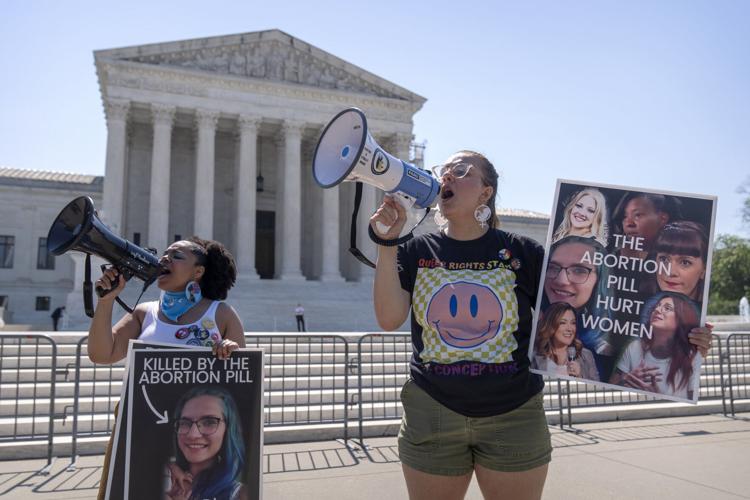
Anti-abortion protesters demonstrate outside the Supreme Court on Thursday in Washington after justices unanimously preserved access to a medication that was used in nearly two-thirds of all abortions in the U.S. last year. It was the court's first abortion decision since conservative justices overturned Roe v. Wade two years ago.
Patient Kaniya Harris, 21, said she was deeply relieved the medication allowed her to self-manage her abortion in Bethesda, Maryland, during her junior year in college in March 2023. She later demonstrated in front of the court to support access to the drug.
“We still have a ways to go,” she said. “We’re still pushing for abortion access ... . But at least this is a step in the right direction.”
Currently, only about half of states allow full access to the drug under the FDA’s framework, though statistics show people in restricted states have continued to receive the drug by mail.
Most Republican officials and candidates weren't as vocal. Trump, the presumed Republican nominee, has previously said he’d announce a position on medication abortion but hasn’t done so. He said in April that abortion should be left up to states, though this week he also urged an anti-abortion Christian group to stand up for “innocent life.”
Abortion will also be directly on the ballot in at least four states where voters are being asked to approve constitutional amendments that would assure abortion access. Similar measures could be before voters in several other states, too.
Is the Supreme Court done with abortion?
No. It's not even the last abortion case this term. The Supreme Court is also expected to hand down a decision in the next few weeks on whether federal law protects emergency abortions in states with strict bans.
The Biden administration argues that abortion care must be allowed in cases where a woman's health is at serious risk. It sued the state of Idaho, which maintains that its exception for life-saving care is enough.
Kavanaugh mentioned the high court's other abortion case in Thursday's ruling, as he pointed out that the Justice Department has acknowledged that doctors who are opposed to abortion don't have to take part under federal conscience laws.
The reference doesn't hint at how the court might rule in the case, said Sara Rosenbaum, a health policy professor at George Washington University. The fact that the court didn't release a decision in that case along with the mifepristone case could signal that the emergency abortion ruling “is going to be a much more difficult decision.”
Notable Supreme Court cases of 2024
Review key cases decided by the United States Supreme Court in 2024.


Both laws aimed to address conservative complaints that the social media companies were liberal-leaning and censored users based on their viewpoints, especially on the political right.

Supreme Court makes it harder to charge Capitol riot defendants with obstruction, charge Trump faces
Roughly 170 Capitol insurrection defendants have been convicted of obstructing or conspiring to obstruct the Jan. 6 joint session of Congress, including the leaders of two far-right extremist groups.

The current high court, with a 6-3 conservative majority, has been increasingly skeptical of the powers of federal agencies.

The case is the most significant to come before the high court in decades on the issue and comes as a rising number of people in the U.S. are without a permanent place to live.

The high court had put the settlement on hold last summer, in response to objections from the Biden administration.

The ruling came after a day an opinion was briefly posted on the court's website accidently and quickly taken down, but not before it was obtained by Bloomberg News.

The justices ruled that people accused of fraud by the SEC, which regulates securities markets, have the right to a jury trial in federal court.

The Supreme Court is putting the Environmental Protection Agency’s air pollution-fighting “good neighbor” plan on hold while legal challenges continue, the conservative-led court’s latest blow to federal regulations.

The justices ruled in favor of a 1994 ban on firearms for people under restraining orders to stay away from their spouses or partners.

The high court found 6-3 that the Trump administration did not follow federal law when it reversed course and banned bump stocks.

The Supreme Court has preserved access to a medication that was used in nearly two-thirds of all abortions in the U.S. last year.

The unanimous opinion reverses a lower court decision tossing out the gun rights group’s lawsuit against ex-New York State Department of Financial Services Ssuperintendent Maria Vullo.

The Supreme Court has preserved a Republican-held South Carolina congressional district, rejecting a lower-court ruling the district discriminated against Black voters.

The Supreme Court has rejected a conservative-led attack that could've undermined the Consumer Financial Protection Bureau.

The Supreme Court on Monday restored Donald Trump to 2024 presidential primary ballots, rejecting state attempts to hold the Republican former president accountable for the Capitol riot.