

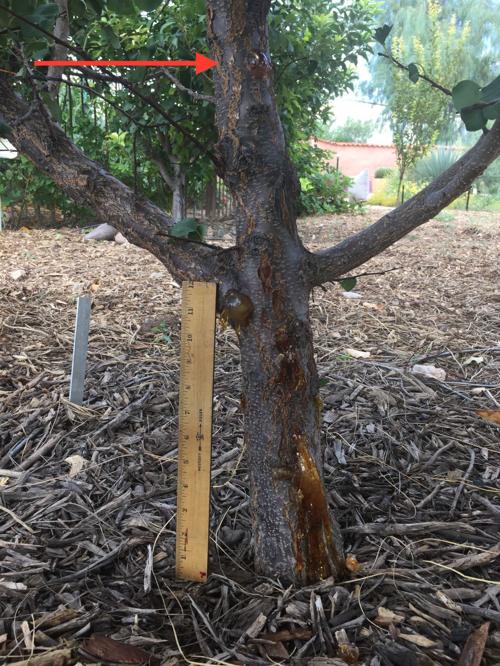
Q: Our apricot tree has yellow ooze on the trunk, which we think could be a fruit tree borer. Do you have any words of wisdom about how to control this insect on this tree and others, as well as how we might treat this particular infection?
We’d like to use the IPM approach that you instilled in us. We’ve heard about covering damaged areas of bark, insect traps and other products, poking wires into larvae holes, etc.
A: After looking at the tree, I think it might be gummosis rather than a peach tree borer. The main reason is the location of the gum. The borer you mentioned typically attacks less than one foot from the soil line. I see gum higher on the trunk and also some near a pruning cut on the north side of the tree.
The gummosis pathogen is known as Cytospora canker and is caused by a fungus, Leucostoma cincta. It invades and kills bark and cambial tissue through wounds such as pruning cuts, sunscald, hail, etc. Gumming from cytospora is dark amber in color, and if you scrape the outer bark, the dead phloem will appear cinnamon brown in color.
People are also reading…
Cytospora canker is an opportunistic pathogen, meaning that it invades trees through wounds. It can be found almost everywhere, so prevention is the key to management. Management for cytospora includes making proper pruning cuts (i.e., do not leave stubs or do not make “flat cuts” that remove the branch collar where healing would normally occur) and do not prune in wet weather.
Affected limbs should be pruned back to healthy wood and make sure you sterilize pruning tools with 10 percent bleach between cuts. If a tree is severely affected, it’s best to remove it and start over. Prevention also includes keeping trees healthy with optimal watering, mulching, nutrition, etc.
Peter L. Warren is the urban horticulture agent for the Pima County Cooperative Extension and the University of Arizona. Questions may be emailed to

