

WASHINGTON — How bad is the current recession?
Here's one measure: The United States now has fewer jobs than it did nine years ago, even though the work force — the number of people either working or looking for work — has grown by 12.5 million people since then.
It's the first time since the Great Depression that a recession has wiped out all the jobs created during the previous business cycle, said Heidi Shierholz, an economist at the Economic Policy Institute, a think tank.
That's a "testament to both the enormity of the current crisis and to the extreme weakness of jobs growth from 2000 to 2007," Shierholz said.
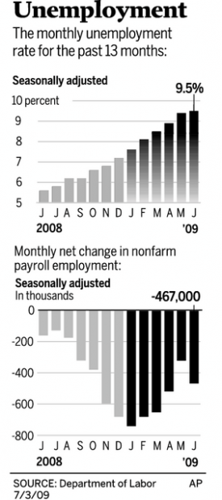
The Labor Department said Thursday that U.S. payrolls shrank by 467,000 in June, more than analysts expected. That pushed the unemployment rate up to 9.5 percent, a 26-year high.
People are also reading…
There are now 131.7 million jobs in the United States, the department said. That's fewer than in May 2000, when companies reported 131.9 million jobs.
In the most recent business cycle — from the beginning of the last recession in March 2001 until the beginning of the current recession in December 2007 — the economy created about 5.7 million jobs.
But so far, more than 6.5 million jobs have been lost in the current recession. Meanwhile, the total work force grew from 142.4 million in May 2000 to 154.9 people in June 2009, according to Labor Department data.
Bury your nose in these gloomy numbers
They say that recessions always come to an end, but no one needs to point out that this one is especially long and deep. The stock market's dive has been painful, but the persistent joblessness is even worse.
MISERY LOVES COMPANY
14.7 million
People unemployed in June 2009, the most ever in records dating to 1948.
12.1 million
People unemployed in December 1982, the record before the current downturn.
9.5 %
Unemployment rate in June 2009.
August 1983
Last time the unemployment rate was this high.
10.8%
Unemployment rate in December 1982, the highest since World War II.
JOBLESS FOR MONTHS
29%
The proportion of the unemployed who've been out of work six months or longer, a record.
24.5 weeks
The average length of unemployment in June, also a record.
4.38 million
The number of people unemployed for 27 weeks or longer.
1.32 million
The number unemployed for that long in December 2007, when the recession began.
GOVERNMENT JOBS AREN'T SO SAFE
49,000
Jobs cut by federal government, partly due to layoff of temporary census workers.
4,000
Jobs cut by state governments.
1,000
Jobs added by local governments.
WHERE THE JOBS ARE
34,000
Jobs added in the education and health services industries, the only one of seven broad categories to add jobs.
UNDEREMPLOYED
8.9 million
Number of part-time workers who would have preferred full-time work last month.
2.17 million
People without jobs who wanted to work, were available and had looked in the last 12 months, but had not looked in the last month.
16.5%
Unemployment rate if you include involuntary part-time workers and those without jobs who hadn't looked for work in 12 months — the highest in records dating to 1994.