Sex trafficking is a growing problem locally and globally and often involves young children, representatives at a forum said Thursday.
Health and law enforcement professionals gathered for the third Sex Trafficking Response Forum, presented by CODAC Behavioral Health Services.
Participants heard from government agencies, including local and U.S. prosecutors, and Tucson Police Department, which provided information and statistics about the growing international problem.
Sex trafficking and prostitution are the same thing in the eyes of law enforcement and prosecutors, said Pima County Attorney Barbara LaWall.
“The average age of girls and boys sold is 13 years old,” she said. “Most are runaways, and children are often lured into the trade from public venues.”
People are also reading…
Tucson Police Assistant Chief John Leavitt addressed law enforcement’s side of the struggle.
“We’ve had 15 cases in the past couple of years that were juvenile cases in our sex trafficking department,” he said.
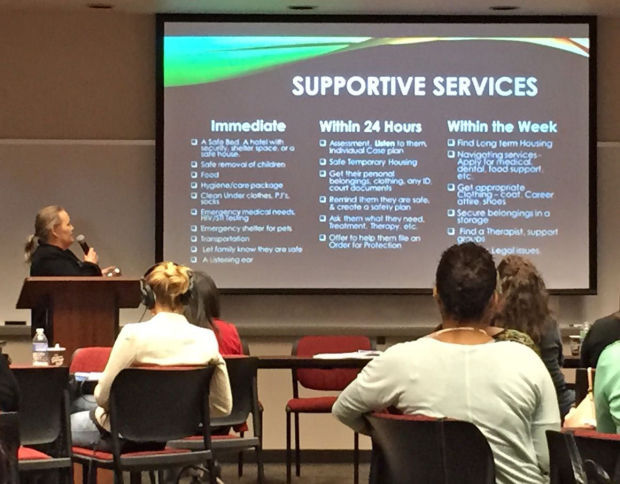
One of the focuses of this year’s forum was what issues arise and how to assist victims when they are identified.
Something as simple as providing a phone can be an important step to helping a victim, Leavitt said.
That’s because a victim’s phone is considered evidence and usually taken from them by authorities.
“Victims have no phone as soon as they get involved with law enforcement,” Leavitt said. “It’s important to provide them with a phone, because it’s absolutely necessary for them to keep in contact with the people in their lives who they want to.”
A representative from the U.S. Attorney’s Office, Karen Rolley, talked about the Southern Arizona Human Trafficking Working Group, which was established three years ago.
Made up of 10 local and national agencies, employees of the Department of Public Safety, Department of Children’s Services, FBI, Tucson police and more all work together to fight the problem by sharing information across the different sectors.
In addition to an increased effort to respond to the problem, authorities have also seen an increased ability to prosecute offenders.
“We’ve got a lot more to do here,” Rolley said. “It’s three years in and we’re just beginning.”
In Pima County, sex trafficking is one of the fastest growing problems and globally, it’s just as grim, according to Deborah Lee, a deputy Pima County attorney.
“Human trafficking is the second largest and fastest growing criminal enterprise in the world, depending on which research you’re looking at,” she said. “It’s our duty to take the load off victim’s shoulders as best we can.”
Survivors and advocates were also present, telling the human side of the story.
Liz Kimbel became a victim of sex trafficking in Washington, D.C., when she was 11. When law enforcement intervened when she was 15, there were no services available to victims, she said.
“There were no nonprofits, volunteer groups or therapists at the time,” Kimbel said. “The best they could offer was to help me move. That’s why I do what I do.”
Kimbel is a survivor advocate and mentor with the Tucson nonprofit Sold No More, which works to combat juvenile sex trafficking in Tucson. Resources are limited in Tucson, and it’s difficult to find victims a safe place to stay, she said.
“If we could just dedicate one bed in the youth, domestic violence and other shelters to trafficking victims, it could change the first 24 hours or week for him or her.”
A representative and survivor herself, Beth Jacobs used her experience and founded Willow Way, a social services group in Tucson that aims to support and empower victims escaping prostitution and sex trafficking.
One approach being used by groups, including Willow Way, is a treatment framework that involves understanding, recognizing and responding to the effects of all types of trauma.
“It’s so important to understand and support the victims and where they are emotionally,” Jacobs said. “We must provide services using this trauma informed care.”


 Faculty concerned about changes to U of A admissions policy