

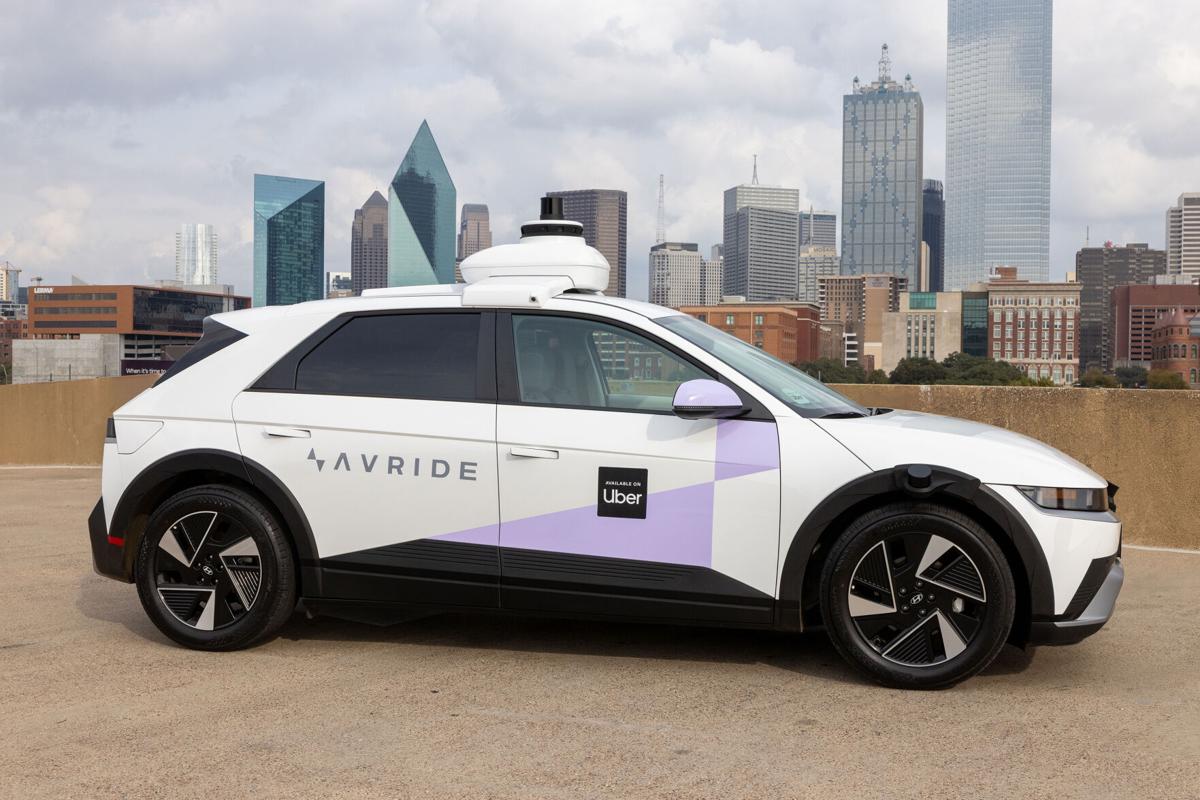
Autobots, roll out.
Beginning Wednesday, when Dallas residents call an Uber, they may be matched with an autonomous robotaxi, thanks to the rideshare platform’s partnership with Avride.
To get a ride from the robots, you just call an Uber as normal. The fleet of autonomous Hyundai Ioniq 5s are integrated into the service’s person-driven fleet, and you will be notified if one is assigned to your ride.
In the Uber app, riders have the ability to decline an autonomous ride when offered or, for the adventurous, increase their odds of getting one in settings. You also use the app to open the door of the vehicle and start the ride.
“We’re excited to launch autonomous rides in Dallas with Avride, as we continue to build towards an increasingly electric and autonomous future,” said Sarfraz Maredia, global head of autonomous at Uber, in a statement. “With the world’s largest hybrid network, we’re proving how AVs and drivers can work side by side to make transportation more convenient, sustainable, and affordable for people everywhere.”
People are also reading…
Autonomous service is currently available in a nine-square-mile region of Dallas encompassing Downtown, Uptown, Turtle Creek and Deep Ellum. Uber plans to expand that area eventually, along with the fleet size of the robotaxis.
For now, the robotaxis have a human safety monitor in the driver’s seat as part of a phased introduction of the service. They will be removed down the line, though not on a clear timeline.
The Dallas Morning News participated in a short demo ride Tuesday with representatives from Uber. During a left turn at a tricky intersection, the safety monitor took control of the wheel when an oncoming car, appearing to turn left, went straight instead, though it seemed the autonomous system also detected the unexpected movement. Other than that, the two-mile round-trip ride was satisfactorily uneventful.
“One of the things that’s always amazing to me is how it feels so magical the first or second time or so, and then all of a sudden it just feels very normal,” said Annie Duvnjak, global head of autonomous mobility operations, during the drive.
Avride’s robotaxis have 13 cameras, 5 lidars, and 4 radars, and like Uber’s other autonomous partners, are subject to the rideshare company’s extensive safety guidelines.
Inside the Avride vehicles is a large screen where riders can view a real-time map of the roads with animations of obstacles and control the ride, including pulling over or contacting support if necessary.
Autonomous taxis generally have a strong safety track record. A study conducted by Waymo and published in the independent, peer-reviewed journal Traffic Injury Prevention found its robotaxis caused significantly fewer accidents compared with human benchmarks.
The study found statistically significant reductions in the number of most crash types studied, with no disbenefits in any, across 56.7 million miles of driverless Waymo rides.
Avride also claims its cars are designed to be safer than human drivers, with experience that “spans more miles and data than any human could achieve, making roads safer for everyone,” according to its website.
In 2025, Avride only reported involvement in two crashes: one in which a human-operated Avride vehicle was rear-ended, and one Avride describes as a hit-and-run where its car was “suddenly reversed” into, according to Austin’s KXAN.
An autonomous Uber with a safety monitor, though not powered by Avride, was involved in a fatal crash with a pedestrian in 2018, and Uber sold its self-driving unit two years later.
Uber announced its Dallas partnership with Avride in October 2024, and it already yielded the little four-wheeled food delivery robots seen scurrying around Downtown and Deep Ellum.
“Building on the success of our autonomous delivery partnership, we’re now expanding our collaboration with Uber and bringing our core technology to passenger mobility, laying the groundwork for scalable autonomous transportation,” said Avride CEO Dmitry Polishchuk.
“Robotaxis are what we’ve been building from day one, and we’re excited to begin introducing them in Dallas, with our partners at Uber.”
Currently, Avride manages its own fleet — which includes cleaning, maintenance, inspections, charging, and depot management — but Uber plans to take over down the line.
In May, Uber announced a partnership offering autonomous rides in Arlington through May Mobility, and Lyft announced plans to bring robotaxis to Dallas in February.
Local Waymos, meanwhile, will part with their safety monitors any day now. Last month the company announced the final phase of testing — driverless rides for employees — would begin in “the coming weeks,” and rides would be public early next year.
Uber currently offers autonomous vehicles in Abu Dhabi, Atlanta, Austin, Phoenix, and Riyadh. In addition to Dallas and Arlington, the rideshare company is working on robotaxis in Dubai, London, Los Angeles, Munich, and the San Francisco Bay Area.


 Faculty concerned about changes to U of A admissions policy

