

An unprecedented amount of state spending planned for Buffalo's East Side was in the pipeline before last month's racially motivated mass shooting that killed 10 people at Tops Friendly Market and traumatized a community.
But the gunman's grim toll on May 14 and the reason why he picked the East Side – where 78% of residents are people of color – cast a greater light on inequity and disinvestment on the East Side.
"Hopefully, this will open the entire region's eyes to the urgency of redeveloping and revitalizing the East Side for the very residents who live there," said Paul Tronolone, vice president of policy and planning for Empire State Development, the state's development arm.
New York officials say the $225 million – $185 million from the state, with $41 million from philanthropies and $9 million from the City of Buffalo – will follow a planned, step-by-step approach that began several years ago. Those on the giving and receiving ends point to signs the public funds will be well spent.
People are also reading…
"I'm 39, and this is the first time I've seen an intentional, large-scale investment for the East Side," said Brandi Barrett, a lifelong Fruit Belt resident who is operations director of the Fruit Belt Community Land Trust. "They want to do the right thing, and they want to do it from a community level. That's unheard of."
The spending stands out for its size and scope:
- $76 million for expansion of Northland Avenue Belt Line Corridor and Northland Workforce Training Center.
- $61 million for Central Terminal improvements.
- $37 million for the Broadway Market.
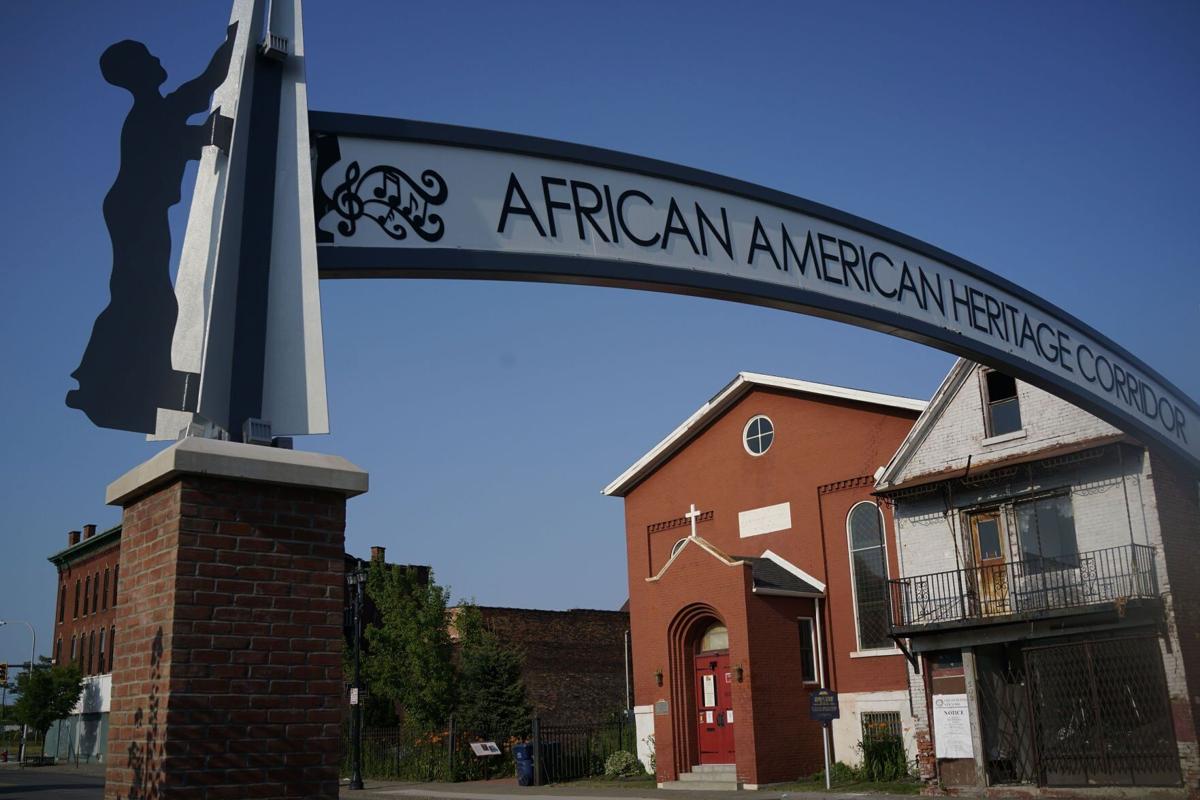
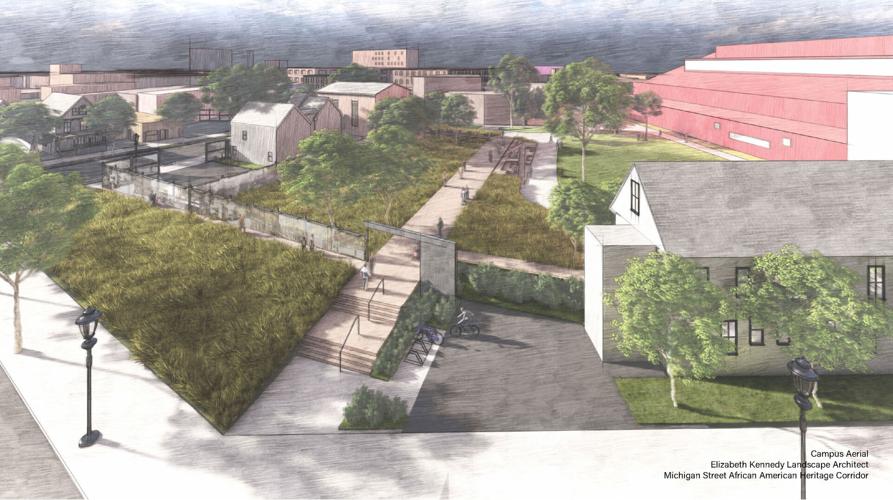
- $30 million for the Michigan Street African American Heritage Corridor.
- $15 million to bolster commercial corridors.
- $6 million to restore greenhouses at Martin Luther King Jr. Park.
"I know this community's needs better than most people would, and therefore I thought this was a once-in-a-generation opportunity to just give that community hope and a far better future than they would experience otherwise," Gov. Kathy Hochul said.
The projects on the East Side are being led by Empire State Development.
"Back in the day, the government would build something for you and toss you the keys and say, 'OK, here you go – take care of it,' " Tronolone said. "Now, it's 'Let us help you do it.' "
That's an approach appreciated by Terry Alford, executive director of the Michigan Street African American Heritage Corridor Commission.
"The smart thing they did was instead of just showering these organizations, including ours, with money, they first decided to provide all the mechanisms to make us successful," he said.
The state's approach on the East Side is prudent, said Patrick Orecki, director of state studies for the nonpartisan Citizens Budget Commission in New York City.
"We have seen plenty of state economic development spending that hasn't worked, so there are certainly models for that," Orecki said. "Obviously, trying to be more integrated and concentrated and also localized is a more likely scenario for positive results."
Forging a framework
The state's focus on the East Side began with former Gov. Andrew Cuomo and the Buffalo Billion program, which in 2012 committed to what would become $60 million to create workforce training and a light industrial hub in the Northland Avenue Belt Line Corridor.
Advice from East Side leaders proved invaluable, Tronolone said, as Empire State Development crafted the plan with Buffalo Urban Development Corp.
"They included the neighbors, the community, at every level of their decision-making," said Beverly Crowley, past president of the Northland Beltline Taxpayers Association. "We were on an advisory committee, and they made sure we had a seat at the table."
Hochul was at Northland for ribbon cuttings for years as lieutenant governor.
"She's a greater champion and cheerleader for Northland than anyone," Tronolone said.
The vision for the East Side broadened with Buffalo Billion II, also launched by the Cuomo administration. A $65 million, five-year fund announced in March 2019 was created for the same East Side projects the state is now building on.
"That started from a blank sheet of paper," Tronolone said. "We were very intentional that we couldn't drop this from the sky on the East Side. It had to grow up from the community."
Key was the formation of East Side Avenues, a group of philanthropies and banks. Working with University at Buffalo Regional Institute, they created an $8.3 million fund to help with organizational development and operational costs.
"The participants in East Side Avenues first wanted to be reassured that the state was going to really do this, and that it wasn't just another announcement," Tronolone said.
To avoid pouring money into projects without results, Empire State Development and its partners created a framework around the resuscitation of four north-south commercial corridors – Bailey, Fillmore, Jefferson and Michigan avenues.
The goals included strengthening small businesses, promoting community-based real estate development, repairing infrastructure and, through a partnership with Preservation Buffalo Niagara, reviving historic assets and stabilizing at-risk buildings.
Consultants were brought in to help not-for-profit organizations with staff and board development, day-to-day expenses, deferred maintenance and master plans.
City officials also played a role.
"The mayor was integral in identifying the policy directive for the East Side starting with Northland, and then going to the commercial corridors," Tronolone said.
Forty meetings with community groups and other stakeholders contributed to the plan's focus on the commercial corridors. Their input also helped steer the focus to training for advanced manufacturing and other jobs in demand, providing job placement and offering day care and bus passes to remove attendance barriers.
Small grants for businesses became a priority.
Ahmed Saleh, owner of Mandella Market at Jefferson Avenue and East Ferry Street, used a grant for a new storeroom and kitchen to provide fresh produce and prepared foods.
But over time, it became clear efforts to help small business owners were being hampered by the state's inability to pay contractors directly or allow nonprofits more autonomy, Tronolone said. Small business owners didn't necessarily have the out-of-pocket money for repairs, couldn't get financing on their own or maybe didn't know how to.
"Our rules don't work for a lot of small businesses and property owners," Tronolone said.
Empire State Development is trying to do things differently, but it's going to take more time, he said.
The projects didn't fit the agency's mold, said Johanna Walczyk, a senior project manager at Empire State Development. "Everything I've heard is that what we are doing on the East Side isn't ESD's normal wheelhouse."
Walcyzk said she's been struck by the community's appreciation for the work they are doing.
"When we talked to our commercial district nonprofits, all Black women, they said we are so moved and touched that you would make these changes for our community because these are neighborhoods that are forgotten in Buffalo," Walcyzk said.
"If we can give them state resources to make changes where it's deserved the most, I believe that will really be something," she said.
Tronolone said the goal is to help the neighborhoods and allow people to stay where they want to live.
"We don't have all the answers, but we're being intentional in trying to do reinvestment without gentrification," he said. "It's literally a work in progress."
Building off of the public-private model with East Side Avenues, four foundations, including the Ralph C. Wilson Jr. Foundation, have followed suit. They have committed $81 million to support the East Side projects, as well as projects to address economic disparity in Niagara Falls and Rochester.
The collaboration will provide a major impact in these communities and represents "a huge culture shift moment in the Buffalo community," said Jim Boyle, the Wilson foundation's vice president of programs and communications.
Banding together
The African American Heritage Corridor Commission had been ineffective for years in turning the corridor into a destination where people could learn about the Niagara Movement or Buffalo's role in the Underground Railroad.
"When they came in to talk to us during a listening session, the commission came in, and then each of the individual entities came in separately," Tronolone said, referring to the Michigan Street Baptist Church, the Colored Musicians Club, the Nash House and WUFO radio.
"It was a perfect example of how there was an opportunity for them if they all worked together," he said.
East Side Avenues is covering operational expenses for five years at a cost of $850,000. That includes two staff members for what had been an all-volunteer commission, and a consultant experienced in organization building to work with the commission and each of the anchor organizations.
"If it wasn't for East Side Avenues, we wouldn't have an endowment with the Ralph Wilson Foundation right now," Alford said, referring to the $100,000 a year that the organization and the four anchors will evenly split for operational expenses.
"We couldn't have done that on our own," Alford said. "We didn't have that cachet."
Empire State Development also gave the anchor organizations $3 million for deferred building repairs from Buffalo Billion II, with $4 million more to follow.
Hochul's announcement included millions to implement key provisions of the master plan, which cost $250,000 to develop.
"This corridor has had master plans in the past but they didn't go anywhere," Alford said. "We have all the necessary tools to make us successful, but without Empire State Development and East Side Avenues, we'd just be spinning our wheels."
Central Terminal
The nonprofit Central Terminal Restoration Corp. has spent 25 years caring for the 1929 art deco building, until the past several years as an all-volunteer endeavor.
Empire State Development provided $5 million from Buffalo Billion II to make upgrades to the main terminal building and $400,000 to develop a community-driven master plan.
East Side Avenues committed $1 million over five years to support daily operating costs, including the salaries of two employees and a consultant.
Last week's announcement that the state will be providing $61 million to make improvements to the Central Terminal is something supporters of the iconic space had long dreamed of.
The public-private partnership has brought a needed "systematic approach" to the Central Terminal and the East Side, said Monica Pellegrino Faix, executive director of the Central Terminal Restoration Corp.
"It's a solid, supportive belief that the city's future is tied to the East Side's future," Faix said.
Broadway Market
Empire State Development gave $4 million to the Broadway Market during Buffalo Billion II to implement improvements, help with strategic planning and develop a master plan, completed in 2021.
The plan, which cost $350,000, recommended a not-for-profit operate the market. That process is now underway and should be completed this summer, said Lisa Hicks, director of development in the city's Office of Strategic Planning.
Empire State Development is paying consultant Aaron Zaretsky, who developed the plan, to help shape board composition, fundraising and tenant outreach.
"One thing that's wonderful about Empire State Development is that they raised the money to do the initial planning work that was needed to be done," Hicks said. "It was critical to establish the needs of the market and the cost, but they didn't just leave it at that. They doubled down on the investment and the planning and the strategy, and raised additional funds to get this going."
'You can't understand'
Barrett, the Fruit Belt resident, was among those who took the real estate training program.
She wanted to understand the forces at play around development and find her niche as a community developer.
"I thought this would be the perfect opportunity to rub elbows with professionals and teachers that you wouldn't necessarily have access to otherwise," Barrett said.
She plans to open an ecofriendly laundromat in the Fruit Belt, and she has applied for a grant from a fund Empire State Development set up for people who complete the course.
"It's been years of disinvestment and to have something that literally says 'East Side initiative,' you can't understand what that feels like," she said.
Mark Sommer covers preservation, development, the waterfront, culture and more. He's also a former arts editor at The News.
In this Series
Complete coverage: 10 killed, 3 wounded in mass shooting at Buffalo supermarket
-
Updated
Hochul pledges pursuit of justice after shooting, calls on sites to crack down on white supremacist content
-
Updated
Sean Kirst: In Buffalo, hearing the song of a grieving child who 'could not weep anymore'
-
Updated
Recently retired police officer, mother of former fire commissioner both killed in Tops shooting
- 307 updates


