

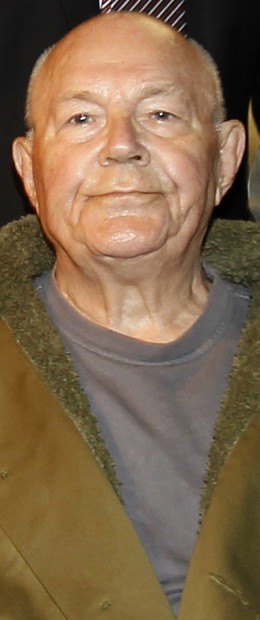
BERLIN - John Demjanjuk was convicted of being a low-ranking guard at the Sobibor death camp, but his 35-year fight on three continents to clear his name - a legal battle that had not yet ended when he died Saturday at age 91 - made him one of the best-known faces of Nazi prosecutions.
The conviction of the retired Ohio autoworker in a Munich court in May on 28,060 counts of being an accessory to murder was still being appealed. The case broke new legal ground in Germany as the first time someone was convicted solely on the basis of serving as a camp guard, with no evidence of involvement in a specific killing.
It has opened the floodgates to hundreds of new investigations in Germany, though his death serves as a reminder that time is running out for prosecutors.
The Ukrainian-born Demjanjuk steadfastly maintained he had been mistaken for someone else, and he is probably best known as someone he was not: the notoriously brutal guard "Ivan the Terrible" at the Treblinka extermination camp. That was the first accusation against him, which led to his being extradited from the U.S. to Israel in the 1980s.
People are also reading…
He was tried, convicted and sentenced to death - only to have the Israeli Supreme Court unanimously overturn the verdict and return him to the U.S. after it received evidence that another Ukrainian, not Demjanjuk, was that guard.
"He has become at least one of the faces" of the Holocaust, Israeli historian Yehuda Bauer said by telephone from Jerusalem.
"His case illustrates the principle that whenever even a very low-ranking Nazi criminal can be found and convicted, the importance is not in the sentence, not in the amount of time such a person may have to sit in jail ... the important thing is to bring the crime to the attention of the general public."
But attorney Yoram Sheftel, who defended Demjanjuk in the Israel trial, criticized the German conviction of Demjanjuk as a Sobibor Wachmann - the lowest rank of the prisoners who agreed to serve the Nazis and were subordinate to German SS men - while higher-ranking Germans were acquitted in years past.
"I can only call it a prostitution of the Holocaust," he said.
After his conviction in May, Demjanjuk was sentenced to five years in prison but was appealing to Germany's high court. He was released pending the appeal, and died a free man in his own room in a nursing home in the southern Bavarian town of Bad Feilnbach.
His son, John Demjanjuk Jr., said in a telephone interview from Ohio that his father apparently died of natural causes. Demjanjuk had terminal bone-marrow disease, chronic kidney disease and other ailments, and local authorities said the exact cause of death was still being determined.
"My father fell asleep with the Lord as a victim and survivor of Soviet and German brutality since childhood," Demjanjuk said. "He loved life, family and humanity. History will show Germany used him as a scapegoat to blame helpless Ukrainian POWs for the deeds of Nazi Germans."
Demjanjuk spent most of his 18-month trial in Munich lying in a special bed in the courtroom, and listened to the proceedings through a Ukrainian interpreter.
Though he made no lengthy statements to the court on his own, in one read aloud by his attorney he told the panel of judges he had been a victim of the Nazis himself - first wounded as a Soviet soldier fighting German forces, then captured and held as a prisoner of war under brutal conditions.
"I am again and again an innocent victim of the Germans," he said in the statement.
He said that after the war he was unable to return to his homeland, and that taking him away from his family in the U.S. to stand trial in Germany was a "continuation of the injustice."
"Germany is responsible for the fact that I have lost for good my whole reason to live, my family, my happiness, any future and hope," he said.
His family never gave up its battle to have his U.S. citizenship reinstated so he could live out his final days near them in the Cleveland area. One of their main arguments was that the defense had never seen a 1985 FBI document, uncovered in early 2011 by the AP, calling into question the authenticity of a Nazi ID card used against him.