The federal officer steps in front of the Honda SUV, parked nearly perpendicular across a one-way residential street in Minneapolis, with snow piled up on the curb.
Within seconds, he shot and killed the driver, Renee Good, a 37-year-old mother of three.
Federal officials claimed the officer acted in self-defense, that the driver of the Honda engaged in "an act of domestic terrorism" when she pulled forward toward him and that he was lucky to escape alive.
Policing experts say some of the choices the officer made in that moment defy practices almost every law enforcement agency followed for decades.

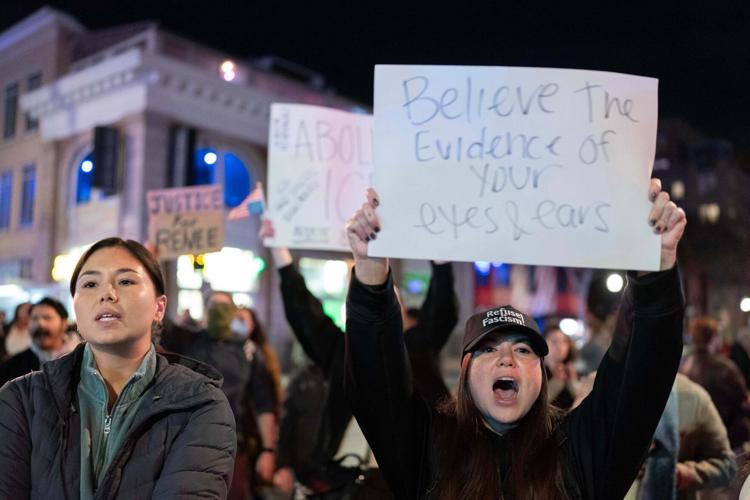
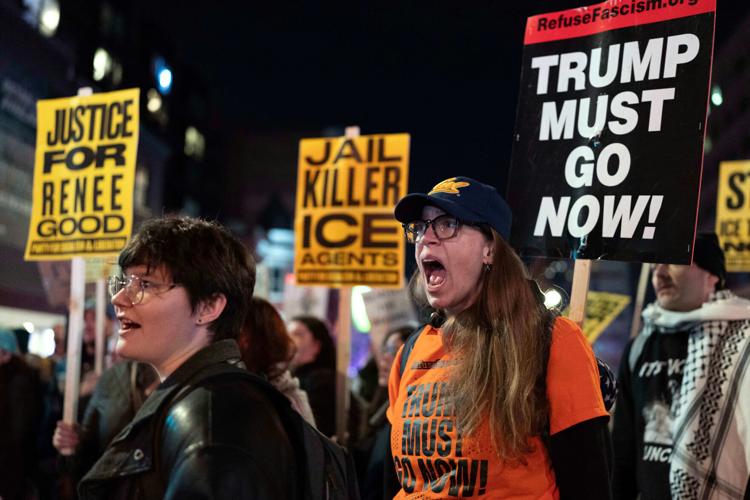
Demonstrators march to the White House on Thursday in Washington as they protest against the Immigration and Customs Enforcement agent who shot and killed Renee Nicole Good in Minneapolis.
'Dangerous decision'
Videos filmed by bystanders from several angles show the Honda stopped on Portland Avenue just before the shooting. It straddles multiple lanes but doesn't entirely block traffic: the driver-side window is open, the driver waving their left arm as if to signal cars to go around. One large SUV drives around the front of the Honda and down the street. Multiple unmarked federal vehicles idle on the road nearby.
People are also reading…
Some bystanders heckle officers: "Go home to Texas," one woman shouts from the sidewalk. "Why won't you let your faces be seen?" shouts another. Some blow whistles to alert neighbors immigration agents are in the area, others honk.
A gray four-door Titan truck comes to a stop facing the driver's side of the Honda. Two officers climb out and approach the Honda. Both officers wear what appear to be wool hats and black masks covering their noses and mouths.
A woman can be heard saying "go around."
One officer says, "Get out of the car. Out of the car. Get out of the f---ing car."

Demonstrators rally Thursday before marching to the White House in Washington as they protest the Immigration and Customs Enforcement agent who shot and killed Renee Nicole Good in Minneapolis.
The Honda's reverse lights come on, and it begins to roll slowly backward as one of the officers grabs the driver-side door handle and tries to pull it twice, then puts his arm into the open driver's window.
A third officer, who was out of the way on the passenger side of the car then walks around the Honda's hood, stands just in front of the driver and appears to be holding his phone up like he's filming.
"Why would he do that? Why would he put himself in a more dangerous position than he was already in?" asked Geoffrey P. Alpert, an expert on policing at the University of South Carolina, who called it "absurd" for an officer to use his body to try to block a 4,000-pound SUV.
Darrel W. Stephens, former chief of the Charlotte-Mecklenburg Police Department, also pointed to this moment as the baffling first step in a series of questionable actions that most police departments discouraged for years. As a police chief, he prohibited officers from standing in front of cars in the early 1990s.
"I can't explain why he would stand there and place himself in front of the car," Stephens said. "That's a dangerous decision to make."
Official accounts
Homeland Security Secretary Kristi Noem described the incident as an "act of domestic terrorism" carried out against ICE officers by a woman who "attempted to run them over and rammed them with her vehicle. An officer of ours acted quickly and defensively, shot, to protect himself and the people around him."
President Donald Trump said in a post on Truth Social that the ICE officer shot the driver in self-defense. Trump said based on that video "it is hard to believe he is alive." He said the driver "viciously ran over the ICE officer."
But it's unclear in the videos whether the car even makes contact with the officer.
The Honda starts to drive forward, its tires turning to the right as the officer stands in front.
"Why doesn't he step out of the way? Why doesn't he move?" asked Alpert.

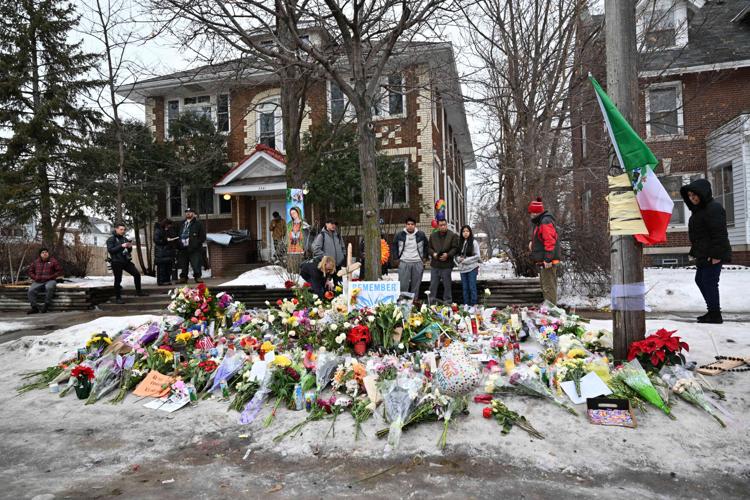
People gather Thursday around a makeshift memorial honoring Renee Good, who was shot and killed by a federal law enforcement agent, near the site of the shooting in Minneapolis.
The officer unholsters his gun. Within a second he shoots into the windshield and then lurches backward away from the car as it turns away from him.
Noem didn't publicly identify the officer who shot Good, but she spoke of an incident last June in which the same officer was dragged by a fleeing vehicle. Court records from that case identify the officer as Jonathan Ross.
Most police departments long ago prohibited officers from shooting at moving vehicles except for very limited circumstances where there's no other option to save lives, experts say.
"And the reason is a good one," said Sharon Fairley, a law professor and criminal justice expert at the University of Chicago. "If the officer is successful at shooting the driver, then you have a motor vehicle, a two-ton vehicle that's not being directed, and it creates a huge public safety risk."
The officer shoots a second time. By then, he's at the side of the car, an arm's length from the driver-side window. A third shot immediately follows.
The officer who fired the shots watches the car careen down the road and re-holsters his gun.
Three seconds later, the Honda crashes into a parked car with such force its tires leave the street, the pile of cars lurches forward several feet and snow billows.
"Thank goodness no one was in the car she hit on the side of the road," Alpert said, "and fortunately there were no kids playing out there and no one else got hurt."

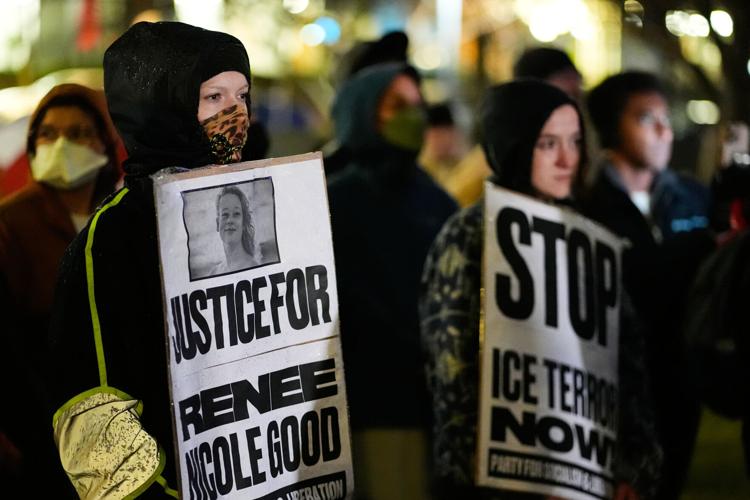
Anna Donigan, left, stands with other protesters Thursday during a rally in Kansas City, Mo., for Renee Good, who was shot and killed by an ICE agent in Minneapolis.
Investigation
Fairley, the University of Chicago professor, said the investigation into what happened here will have to examine whether the officer acted reasonably, both in firing his gun and in the moments leading up to it.
It can weigh questions like whether the agent put himself in danger by stepping in front of the car, and if along the way there were other choices the officers might have made to avoid a death.
"The question is going to come down to is was the officer reasonable in their belief that the driver presented an imminent threat of death or bodily harm to himself or to someone else," she said. "That's really the legal question that has to be answered."
The car's license plate, for example, was visible throughout the ordeal. One alternative, Fairley said, was to have just let her leave, and go arrest her later.


 Faculty concerned about changes to U of A admissions policy