

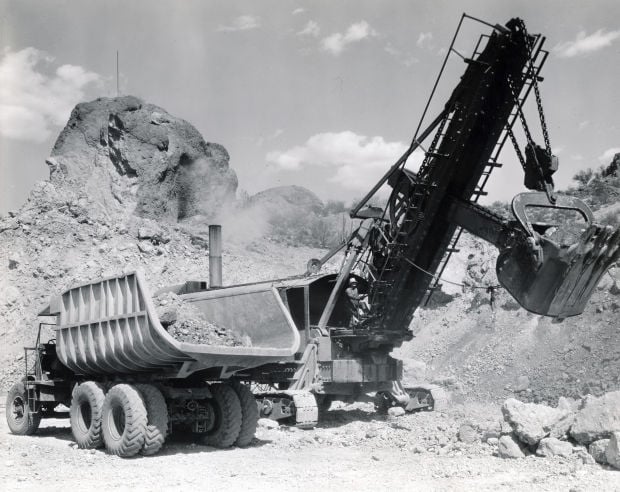
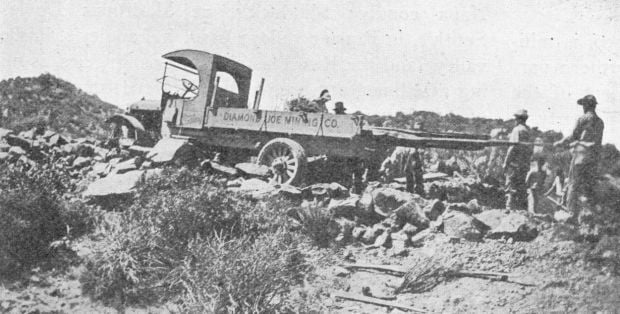
The importance of haul trucks in the history of surface mining in Arizona cannot be overstated.
Hand labor, wheelbarrows, horse-drawn vehicles and ore cars were the principal means of earth-moving equipment until the early 20th century. The advent of the internal combustion engine led to the development of the haul truck in the mining industry.
Early motor trucks were manufactured by companies including Mack, Moreland, Sterling and White. Classified as heavy-duty off-road trucks during the 1920s, the trucks were built with capacities ranging from 1.5 to 7 tons using engines powered by kerosene, ethanol and gasoline.
A decade later, companies such as Caterpillar and Dart Truck Co., increased the size of their haul trucks.
Work began on stripping the clay ore body at Morenci in 1938 using a fleet of 18 30-ton, end-dump, six-wheeled, gasoline trucks that cost $16,000 apiece.
People are also reading…
The Dart 75-TA, which at 75-ton capacity set a 1951 world record for haul-truck size, was unveiled at the Bagdad Mine.
Open-pit mining required a shift in mining technique from the vertical to the horizontal and a greater demand for truck transport of ore and waste rock. The efficiency and greater load capacity of electrical and diesel-powered haul trucks became the preferred method for hauling in surface mining, gradually replacing rail haulage by the 1960s.
Phelps Dodge superseded train haulage at Morenci in May 1986 with a fleet of 29 170-ton haul trucks at a cost of over $750,000.
Today, the average cost of a new haul truck is $3.5 million. Common sizes include trucks with 240-, 320- and 400-ton capacities capable of speeds in excess of 28 miles per hour.
The average haul truck is 24 feet tall, 29 feet wide and 51 feet long. Tire diameter ranges from 10 to 15 feet while tires last about nine months. The loaders for these trucks are large electric shovels, some of which have a 56-cubic-yard dipper capable of excavating 98 tons of material in a scoop. The size of the excavator is proportionate to the size of the haul truck, which can be loaded in three to five passes of the shovel.
To best accommodate haul trucks, the average gradient of haul roads is between 8 and 15 percent. While motor graders build, maintain and repair haul roads, water trucks reduce dust by applying water from 9,500- to 90,000-gallon tanks.
Service and maintenance trucks must always yield the right-of-way to haul trucks at the mine site. They fly 12-foot buggy whips with orange mesh flags signaling their presence to oncoming haul trucks.
A high-speed computer dispatch system monitors both trucks and shovels, keeping their performance in sync so little time is lost in between loads. The system also prevents equipment failures by measuring oil pressure and temperature. Each haul truck includes a GPS unit so its whereabouts can be tracked at the mine site.
When not in use, the trucks are shut down to reduce emissions and fuel consumption. Newer haul trucks feature systems that reduce an engine’s RPMs on an incline, for more fuel conservation.
The Ray Mine employs a fleet of 39 haul trucks, over half of which are 400-ton ultra-class trucks with 3,600-horsepower engines. These workhorses operate 22 hours a day, seven days a week.
Currently, the largest haul truck ever built in the world is the BelAZ 500-ton truck, affirming that haul trucks will continue to increase in size.
William Ascarza is an archivist, historian and author. His latest book, “The Chiricahua Mountains: History and Nature,” is available at Barnes and Noble online. Email him at mining@azstarnet.com
Sources: “Cutting cost in mining by motor truck transportation” (Sept. 1, 1921), Arizona Mining Journal; Mining & Engineering World (Dec. 30, 1916); Robert Peele, Mining Engineers’ Handbook, Vol. I (1948); John Wiley & Sons Inc., New York; D.J. Peterson, Tom LaTourrette, James T. Bartis (2001), “New Forces at Work in Mining: Industry Views of Critical Technologies,” RAND Corp.,; Carlos A. Schwantes (2000), “Vision & Enterprise: Exploring the History of the Phelps Dodge Corporation.”

 Faculty concerned about changes to U of A admissions policy


