


Here’s another reason why you should social distance, wear a mask in public, and wash your hands often.
If you contract the novel coronavirus and pass it on to someone who works or lives in a long-term care facility, you will cut off residents from loved ones they’ve only recently been able to visit with in person.
Visitation resumed last week at nursing homes and assisted living centers across New York State, although the mingling comes with tight requirements.
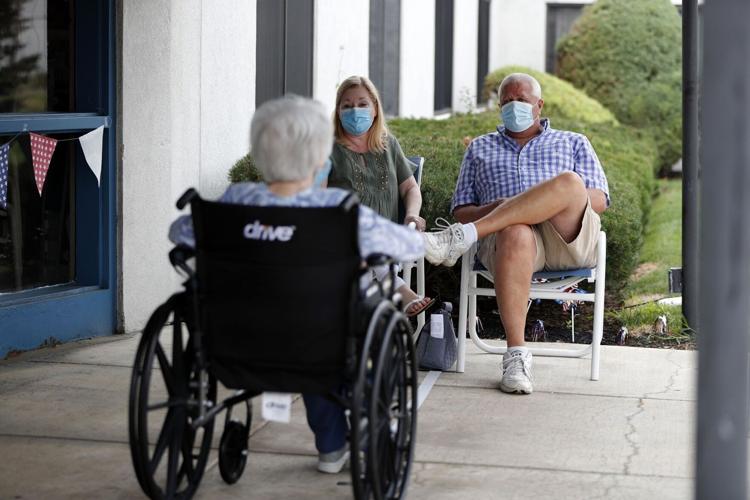
Visits must be scheduled and short, with a firm physical distance of at least 6 feet.
That means no passing gifts and treats – or sharing hugs and kisses.
“We've gotten a lot of questions on that,” said Christopher E. Koenig, president of the Niagara Lutheran Health System, which owns the GreenField Senior Living Community in Lancaster. “Covid is still here. It hasn't gone away, so we have to maintain the social distance to keep everybody safe.”
People are also reading…
During the pandemic, there also are no guarantees that most of those with loved ones in long-term care will be able to pay a visit at all. Facilities must be free of the novel coronavirus for at least four weeks before they can welcome guests – and a single positive virus test result for a staff member or resident can close them to visitors for 28 days.
The safety precautions explain why less than one-quarter of the 613 nursing homes and 544 assisted living facilities statewide opened to visitors in recent days, why visitors allowed to see family members and friends need to be patient and understanding, and just how disruptive the pandemic has been for those with ties to long-term care.
Elderwood Village at Bassett Park is a case in point. Visitation resumed June 15 at the Amherst assisted living community and stopped a few days later, after a staff member tested positive for the new coronavirus.
“In senior living facilities, obviously this population is so susceptible to the Covid-19 virus that it is just critical that we do everything we can to mitigate the spread of infection,” said Charles Hayes, vice president for marketing and communications with Elderwood, which has 17 long-term care facilities in Erie and Niagara counties.
Major transitions
Change hit hard for those who live and work in long-term care residences.
At the start of the year, these living quarters teemed daily with dozens of visitors, including volunteers, who could come and go with few restrictions. Some stayed for hours, several days a week.
The same was true on elder care campuses, including GreenField. Residents and guests who were able to do so could mix almost freely in independent living, memory care, assisted living and skilled nursing communities. They walked the grounds, dined, socialized and attended birthday celebrations and church services together.
Gov. Andrew M. Cuomo banned visits at long-term care facilities March 13 as the new coronavirus pandemic began to rage in parts of the state. Dining halls, auditoriums and other gathering spaces went dark. Barbers and hairstylists were among those told to stay away. Residents began to spend more time in their rooms.
Despite the precautions, more than 6,300 people have died in New York nursing homes and assisted living facilities in a little over four months.
Resumption of visitation signals some semblance to yesteryear.
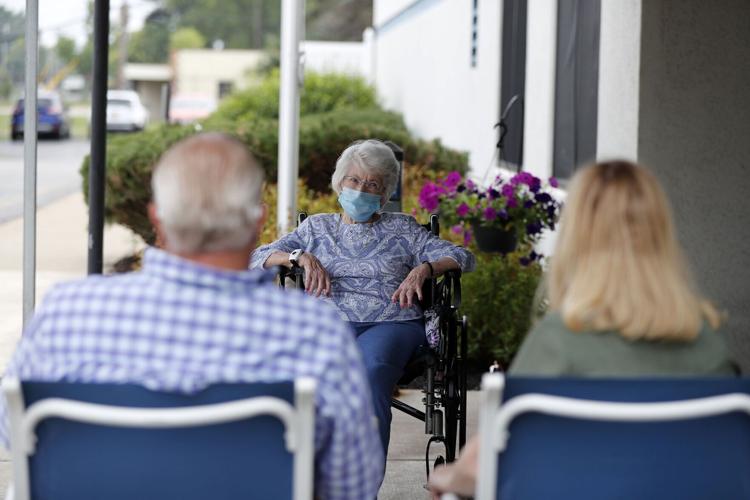
Janet Hoadley is among those who welcomes it. She and her husband, Glenn, sat down with her aunt, Ann Zuege, Thursday morning on the grounds of Elderwood Assisted Living at Tonawanda for the first time in more than four months. She and her sister, who lives in Philadelphia, have called almost daily during that time and Hoadley arranged a couple of window-side greetings outside her aunt’s apartment.
“Sometimes she seems a little lonely and bored,” Hoadley said, but the staff does its best to help. “Her biggest complaint is not being able to get her hair done – her one vanity – but she, thank goodness, gets (the restrictions).”
Prevention guides visits
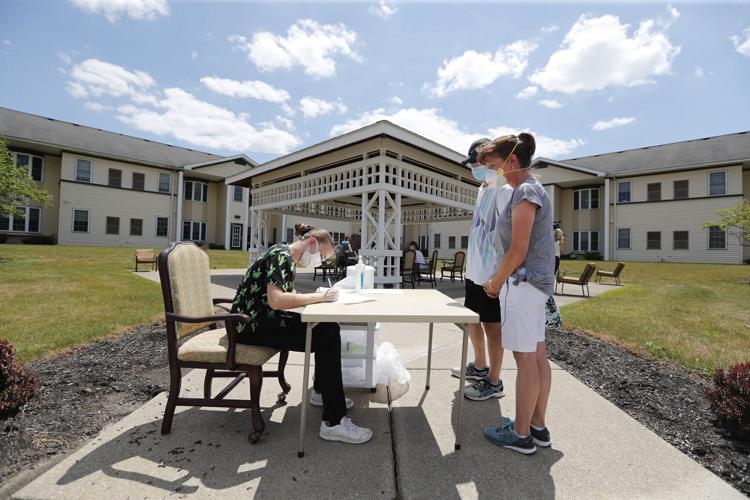
Visitors now undergo a health screening when they arrive at a long-term facility and will be asked if they’ve been in a state during the last two weeks where coronavirus cases are high. Visits, at least at first, mostly will take place outdoors over a half-hour or less.
“We've had some facilities go slightly shorter based on the volume of residents and some which are able to offer a slightly longer visit,” Hayes said. “This allows us sufficient time between visitations to thoroughly clean the designated area.
“One of the driving forces for the limited duration visitation right now so that we can accommodate as many appointments as possible in a given day,” he added. “We are counseling our families that we need to try and get through at least one visit with all of our residents before we reschedule multiple visits.”
Hayes knows that can be hard. He’s the youngest of nine siblings whose late father once needed assisted living and skilled nursing care.
At GreenField Manor – a 92-unit independent living center on the Lancaster campus – church services and the hairdresser are back, though capacity for religious gatherings is limited and masks are mandatory for those who get into the stylist’s chair.
Rules at GreenField are similar to those that govern most people who live off-campus, though one reality strikes harder for some residents, who have a spouse or partner in a higher level of care on the same grounds.
“They’ve found some solace in that they knew we didn't have any community spread of Covid here, and that we’re following the same protocols and procedures at each building,” Koenig said.
Rolling with change
Other familiar dynamics have slowly resumed at GreenField, as well as most of Elderwood’s seven assisted living facilities, eight skilled nursing homes and two independent living centers in Erie and Niagara counties.
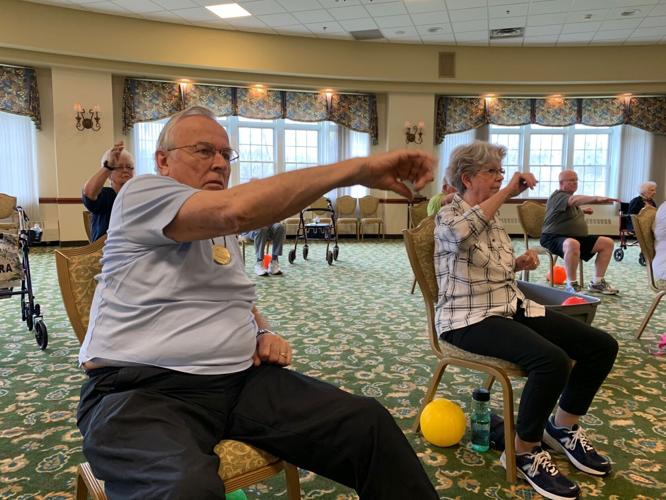
Small groups of residents can once again gather indoors to eat or chat, as long as they distance themselves appropriately – although that can pose its own challenges. Koenig said one resident told him he was glad to be around his three closest friends, but they found it harder to communicate because of hearing losses.
Still, there is gratitude for more togetherness, even if visits might be postponed because of downpours like the ones at midweek.
“Families have been really understanding,” Koenig said. “They're just happy to have the opportunity. If today gets postponed, they know that they can come another day. It's not like they're waiting another four months, like they were before.”
One of the things that troubles administrators, however, is the length of the pause after a positive test result. Those who learn they have the virus must quarantine for only half as many days.
Lisa Newcomb, executive director of the Empire State Association of Assisted Living, said the nonprofit appreciates the cautious approach to resuming visitation but remains puzzled by the 28-day shutdown rule.
“We are enforcing safety protocols with our members ... ” Newcomb said in a statement. “It is painful for all of us when a resident believes that they are going to see their daughter tomorrow, only to have their hopes dashed at the last moment. The rule causes more harm than good.”
Jeffrey Hammond, a state Health Department spokesman, said science and safety guided decisions on visits.
“The number of facilities that are eligible to reopen to visitors, and the number that have taken the next step, shows they are appropriately adhering to (federal) guidelines with smart and cautious plans for visitation,” Hammond said. “Given the increase in cases nationally, we commend them for all they – and all New Yorkers – have done to flatten the curve and to stay safe.”
Hammond said 71 nursing homes were in full compliance to start visitation plans this week and another 190 were eligible but had yet to submit those plans to the state. He said 62 assisted living and other adult care facilities are in full compliance and 352 others are eligible but have not yet submitted visitation plans.
Changes that will stick
Koenig and Hayes expect further restrictions to be lifted more gradually.
“We've not received any timetables for relaxing any of these measures,” Hayes said, “and it's far too early to speculate on when that may happen. But if we continue to follow the guidelines, we expect that we'll get there sooner than if we don't.”
He and Koenig also stressed that visitation will end if a percentage of positive coronavirus test results climbs within a community or region to a rate that raises alarm with state officials who have the final authority to make that decision.
Meanwhile, those who operate long-term care settings have been encouraged to better communicate with families of their residents, as well as help fill the void of companionship the virus has wrought on those in their care.
“The staffs have been really good throughout the pandemic in terms of stepping up that role,” Hayes said. “They are dealing with family issues of their own, be it child care or be it elderly parents, yet they come in day in and day out and they are extended family to our residents.”
Emotions sometimes run high as residents and staff adjust to new restrictions, Koenig said, “but one of the things that's come out of this is our staff and our residents have become very close, which is a good thing.”
The pandemic also changed important approaches to connectivity, particularly when it comes to technology that leaders predict will become part of the long-term care culture.
Nursing home and assisted living workers have connected residents and loved ones through FaceTime, Skype, Zoom and other interactive platforms. Doctors have been able to assess many resident ailments using telehealth.
“We’ve had dozens and dozens of virtual visits where the staff helps the residents,” Hayes said, “and surprisingly enough, this allows the residents to become pretty tech savvy throughout the process, too.”
Those with loved ones at Elderwood also can send e-greetings through the company’s website that can include art, images and words of encouragement that may be printed and displayed in-house.
Most residents have loved ones who live outside the region, so the changes provided opportunities for many to expand their circle of communication, Hayes and Koenig said.
Nearby loved ones – particularly those at or approaching retirement – also took comfort in the technology during such troubling times.
“Some families,” said Koenig, “don't want to leave the house either.”
Visiting senior living facilities
Here’s what you need to know if you plan to visit a loved one in Western New York who lives in an assisted living or skilled nursing residence.
Covid-19 defeat remains paramount: Facilities must close, or stay closed, to visitors for 28 days if a staff member or resident has tested positive with the novel coronavirus. Visitation also will end in a community where a climbing percentage of positive test results portends greater risk to the elderly.
Scheduling is required: Any adult can schedule a visit by phone or on a facility website. No more than two people can visit at once. If you plan to bring someone under age 18, check to see if the facility will allow that.
Patience is a virtue: Expect visits to be sporadic and short as staff tries to accommodate all who are anxious to see residents. Those who have yet to see a resident likely will be given preferential treatment over those looking to visit more often. If you feel sick, cancel your appointment and stay home.
Expect to get screened: Your temperature will be taken when you arrive. You will be asked several questions about your health. You’ll also be asked if you’ve been out of New York during the last two weeks. More than half of U.S. states are on a list that now require those who’ve been in them recently to quarantine for 14 days after they arrive in the Empire State.
Pandemic prevention rules apply: Most meetings will be held outdoors, though common, well-ventilated areas may be used during inclement weather. Visitors and residents will need to don protective masks, although there may be exceptions for residents who struggle to wear them. All will need to maintain a distance of at least 6 feet – so hugs and kisses will need to wait for now.
Gifts are welcome: But baked goods and other treats cannot be shared during visits.
Resiliency counts: Rules can change from facility to facility based on weather conditions, building layout and availability of indoor open space.
Follow directions: Expect a greater staff presence to help residents stay hydrated and comfortable while loved ones abide by physical distancing requirements. Remember that you’re not being singled out but helping to improve the odds that facilities will stay Covid-free and continue to welcome visitors.


